 Thu, 06 Aug 2026
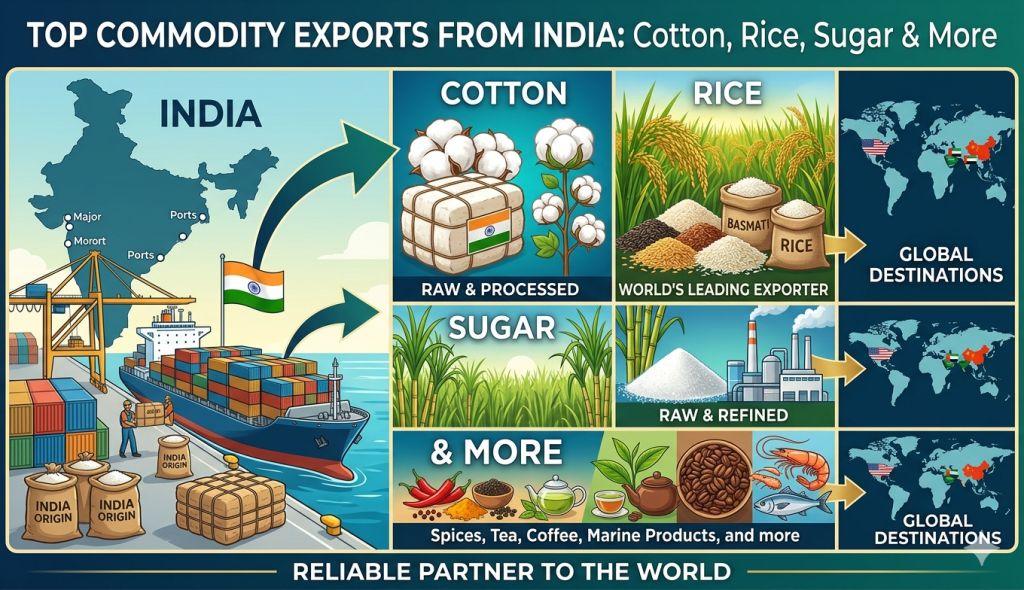
Top Commodity Exports from India: Cotton, Rice, Sugar & More


India's agricultural exports hit $51.9 billion in FY2024-25 - a 6.47% jump from the year before, at a time when overall merchandise exports grew by just 0.1%.
That gap is worth noting. When the rest of India's export basket was barely moving, agriculture pulled ahead. Rice, spices, coffee, marine products, cotton - these are not slow-growth categories. They are, increasingly, where global buyers come when they want reliable volume, competitive pricing, and product diversity.
India is the world's largest exporter of rice. The largest exporter of spices. One of the biggest players in cotton, sugar, and marine products. The government's target is $100 billion in agri exports by 2030, and the FY25 number - despite export restrictions on wheat and limited sugar quotas - shows the trajectory is real.
This guide covers the main commodity export categories: what India ships, who buys it, what the current policy situation looks like for each, and what you need to know if you are buying or selling.
India's Commodity Export Snapshot - FY2024-25
Before going commodity-by-commodity, the big picture:
| Commodity | FY25 Export Value | Global Rank |
| Rice (basmati + non-basmati) | $12.95 billion | #1 globally |
| Marine Products | $7.41 billion | Top 5 globally |
| Spices | $4.72 billion (record) | #1 globally |
| Cotton (yarn, fabric, raw) | ~$11.49 billion | Top 5 globally |
| Coffee | $1.81 billion (record +40%) | 7th producer |
| Sugar | ~$1B (restricted quota) | #2 producer |
| Tea | $0.92 billion | #2 producer |
| Buffalo Meat | $3B+ | #1 exporter |
Sources: IBEF, APEDA, Ministry of Commerce & Industry, PIB India
Total agricultural and allied exports: $51.9 billion in FY25. The target is $100 billion by 2030. That is ambitious - but given that the sector grew 6.47% in a year when overall merchandise exports grew 0.1%, not unreasonable.
1. Rice - India's Largest and Most Dominant Export
India exported 20.1 million tonnes of rice worth $12.95 billion in FY25, reaching over 172 countries. It is the world's largest rice exporter not by a small margin. Thailand and Vietnam, the second and third largest, export roughly 7-8 million metric tons combined.
But the number that actually tells the story is the policy history. In July 2023, India banned non-basmati white rice exports to protect domestic supply. Prices in Asia surged. Countries that depended on Indian rice had to scramble - some paying significantly more from Thailand and Pakistan. That single policy decision showed the rest of the world how much it depends on Indian rice.
By late 2024, the bans lifted. In September 2024, the government removed the floor price on non-basmati white rice exports and lifted all major restrictions. In March 2025, the ban on broken rice - imposed since September 2022 - was removed. India's government was confident enough in domestic stocks (reserves far above buffer norms) to let the market run.
The result: India is expected to export a record 22–22.5 million metric tonnes in 2025, potentially pushing global market share back toward 40%.
Two segments to understand:
Basmati rice - premium aromatic variety, priced at a significant premium over non-basmati. FY25 basmati exports were around $5.8 billion. Saudi Arabia, Iran, Iraq, UAE, and the US are the top buyers. The floor price restriction on basmati was removed in September 2024.
Non-basmati rice - bulk volume, competitive pricing, feeds Africa, Southeast Asia, and parts of the Middle East. Africa (Kenya, Mozambique, Cameroon, Guinea) is the dominant destination for non-basmati. This is where most of India's 20+ million tonne export volume lives.
Who buys Indian rice: Saudi Arabia, Iran, Iraq, UAE, USA (basmati); Kenya, Mozambique, Cameroon, Malaysia, Guinea (non-basmati); Bangladesh and Nepal (both varieties, driven by proximity).
Key HS codes: 1006.20 (husked rice), 1006.30 (semi-milled or wholly milled), 1006.40 (broken rice)
Related Navi Exports: Agriculture & Food Exporters | Commodity Exporters
2. Cotton - India's Textile Backbone
India is the world's second-largest cotton producer and among its largest cotton exporters. The cotton export number is somewhat complex because it covers three distinct product types: raw cotton (fiber), cotton yarn, and cotton fabrics/made-ups. Combined, cotton and cotton textile exports from India reached around $11.49 billion in FY25.
India holds a 31.2% global market share in cotton yarn - the world's fourth-largest exporter of the processed product. For raw cotton, India ranks third globally.
The main buyers by category:
Raw cotton: Bangladesh takes the largest share - over 90% of raw cotton exports in the most recent marketing year per USDA data. This reflects Bangladesh's massive garment industry, which produces mostly knit fabric domestically but imports yarn-stage inputs from India. Vietnam, Indonesia, and China are secondary buyers.
Cotton yarn: Bangladesh and China are the biggest markets. During FY26 (April-July 2025), Bangladesh imported cotton yarn from India worth $535 million, Egypt $86 million, China $55 million. India's cotton yarn exports grew approximately 16% in early 2025.
Cotton fabrics and made-ups: The US is the largest buyer of Indian cotton fabrics, accounting for 29% of India's total textile and apparel exports in FY26 so far. Bangladesh ($160M), Sri Lanka ($107M), and Germany/UK also import significant volumes.
One honest note on the raw cotton side: Indian cotton has faced pricing challenges. In recent marketing years, Indian raw cotton was priced 7% above the Cotlook A-Index, making it one of the more expensive cottons in the global market. This has pushed some mills to import rather than buy domestic. The raw cotton export volume dropped ~40% year-on-year in MY 2024/25 (Aug–Feb). Yarn and fabric exports - the value-added end - held up better.
The takeaway for buyers: India is a reliable source for cotton yarn and processed cotton products. Raw cotton sourcing depends heavily on the price cycle.
Key production states: Gujarat, Maharashtra, Karnataka (cotton); Tamil Nadu/Tirupur (knitwear/yarn); Gujarat/UP (cotton fabrics)
Related Navi Exports: Textile Products & Fabric | Yarn, Threads & Fiber | Apparel & Accessories
3. Spices - India Is the World's Supplier
India produces around 75 of the 109 spice varieties listed by the International Organization for Standardization. It is the world's largest spice producer, largest consumer, and largest exporter - all three at once, which is an unusual position for any commodity.
Spice exports hit a record $4.72 billion in FY25, up 6% from the year before. The government's target for the sector: $10 billion by 2030.
What moved in FY25:
- Chilli: Still the highest-volume export by value, though value dropped 11% to $1.34 billion due to price corrections. Volume jumped 19% to 7.15 lakh tonnes - buyers were buying more but paying less per kilo
- Cumin: $732 million, up 5%; India dominates global cumin supply
- Turmeric: Surged 51% in value to $341 million - the wellness and nutraceutical market driving demand globally for curcumin
- Pepper: Up 40% to $124 million; small cardamom up 53% to $184 million
- Spice oils and oleoresins: $535 million, up 8%; used heavily in food processing, pharma, and cosmetics globally
India exports spices to 200 countries. The top destinations are China, USA, UAE, Bangladesh, Thailand, Malaysia, UK, Saudi Arabia, Indonesia, and Germany.
The US market for Indian spices is significant - turmeric supplements, cumin in Tex-Mex blends, chilli in sauces, cardamom in specialty coffee. These are not niche uses. They are mainstream food manufacturing ingredient sourcing.
Who regulates it: The Spices Board of India under the Ministry of Commerce. Export requires Spices Board registration for exporters. FSSAI compliance is mandatory for food-grade shipments.
Related Navi Exports: Agriculture & Food Exporters | Spice Exports | Dehydrated Vegetables
4. Sugar - High Production, Managed Exports
India is the world's second-largest sugar producer after Brazil, and the world's largest consumer. Production in 2024-25 was estimated at 26.1 million tonnes. For 2025-26, ISMA projects 34.9 million tonnes - an 18% jump, driven by better rainfall in Maharashtra, expanded acreage, and higher yields.
But production and exports are not the same thing in India's sugar sector.
Since 2022, the government has kept sugar exports under a restricted/quota system to protect domestic prices and food security. In 2024–25, the government allowed 1 million tonnes of exports. In early 2025, an additional 500,000 MT quota was approved, taking the total to 1.5 million tonnes. For 2025-26, ISMA is lobbying for a 2 million tonne quota, given the production jump.
The international market watches India's sugar policy closely- Indian sugar quotas have a direct impact on global white sugar prices. When India announced it would not ban exports in April 2026, global sugar prices dropped.
India's sugar goes primarily to Indonesia, Bangladesh, the UAE, Somalia, and Sudan. The US and EU have separate TRQ arrangements under which Indian sugar gets duty-free or reduced-duty access.
The ethanol angle matters here: India's sugar mills divert a substantial portion of sugar production to ethanol under the government's Ethanol Blending Programme. In 2024–25, 3.4 million tonnes went to ethanol. As ethanol targets rise, the balance between domestic consumption, ethanol diversion, and exports shifts each season.
For international buyers: Sugar exports from India are commercially available but quota-constrained. Buy through registered sugar mills and confirm export quota availability before placing large orders.
Key HS code: 1701 (cane or beet sugar)
5. Marine Products - India's Largest Agri Export by Value
Marine products were India's single largest agricultural export category in FY25 at $7.41 billion, shipped to 130+ countries.
Frozen shrimp is the dominant product - and India is one of the world's top shrimp exporters. The coastal states of Andhra Pradesh, Gujarat, West Bengal, Tamil Nadu, Kerala, Maharashtra, and Odisha are the main production hubs.
Top destinations: USA (the largest importer by value - $966 million in April–July FY26 alone), China, Japan, Vietnam, Thailand, and Belgium.
A significant development: India and the UK signed a free trade agreement granting India 100% duty-free access for seafood products, removing tariffs of up to 21.5% on shrimp, lobster, squid, and value-added marine goods. This is expected to boost India's seafood exports to the UK by around 70%.
Frozen shrimp leads, but India also exports cuttlefish, squid, fish meal, and various processed seafood products. The EU (which imported $1.125 billion of Indian marine products in FY25) and the US together account for the largest share.
Compliance note: Marine product exports require MPEDA (Marine Products Export Development Authority) registration. The US requires FDA registration. The EU has its own HACCP and equivalency requirements. These are well-established pathways — most serious Indian marine exporters are already compliant.
→ MPEDA
6. Coffee - A Surprising Record
India is not the first country that comes to mind when you think of global coffee supply. Brazil, Vietnam, Colombia - those are the names. But India's coffee export number in FY25 was worth paying attention to: $1.81 billion, up 40% year-on-year. That is an all-time high.
Karnataka produces roughly 70% of India's coffee. Kerala and Tamil Nadu contribute most of the rest. India grows both Arabica and Robusta, with Robusta being the dominant export variety. India's Robusta goes heavily into European blends - Italian espresso in particular has relied on Indian Robusta for decades.
Top buyers: Italy, Belgium, Germany, Russia, USA, UAE.
The 40% jump in FY25 reflects both price increases in global coffee markets (robusta prices hit multi-year highs in 2024 due to supply tightness in Vietnam) and volume growth. India benefited from being a consistent, quality-controlled supplier when Vietnam's crop underperformed.
FY26 looks good too: April–October FY26 coffee exports reached $1.176 billion, up 12% year-on-year.
For buyers: Indian coffee is commercially available through coffee exporters registered with the Coffee Board of India. No export restrictions currently.
Related Products : Cold Brew | Espresso Roast | Flavored Coffee Blend | Roasted Coffee Powder | Green Coffee Beans | Arabica Coffee
7. Tea - Steady, Premium, and Undervalued by the Market
India's tea exports earned $0.92 billion in FY25. That number looks small relative to production, and it is - India consumes the vast majority of what it grows. It is the world's second-largest tea producer after China, and the second-largest consumer.
But the tea India exports commands a premium. Assam is the most recognized origin globally - used in English Breakfast blends worldwide. Darjeeling has geographic indication (GI) status and trades at some of the highest per-kilo prices of any tea globally. Nilgiri tea from Tamil Nadu supplies European blends and private-label markets.
Top buyers: UAE, Germany, Russia, USA, UK, Iran, Netherlands.
One challenge: India's tea exports face competition from Kenya, Sri Lanka, and Vietnam on commodity-grade product. The growth opportunity for Indian tea exporters is in origin branding and premium positioning - not in competing on commodity price with East African producers.
India's tea production in FY25 (April-December) reached 1,284.7 million kilograms.
8. Buffalo Meat - India's Quietly Dominant Export
This category surprises people. India is the world's largest exporter of buffalo meat (carabeef) - exporting over $3 billion worth annually.
This is not beef in the conventional sense (India bans cow slaughter in most states), but buffalo is commercially slaughtered and exported at significant scale. Uttar Pradesh is the largest producing state, with major processing facilities in and around Aligarh.
Top destinations: Vietnam, Malaysia, Iraq, Egypt, Hong Kong, Indonesia, Saudi Arabia. Most goes to Southeast Asia and the Middle East.
The product is predominantly frozen boneless buffalo meat, and Indian processors have achieved significant scale and FSSAI/APEDA certification for export.
9. Wheat - Returning After a 4-Year Hiatus
Wheat gets its own section because of what is happening right now.
India banned wheat exports in May 2022 as domestic prices surged in the wake of Russia's Ukraine invasion. The ban has been in place for nearly four years. As of early 2026, the government is actively considering lifting it - India's Food Ministry proposed permitting an initial export of 2.5 million metric tonnes, with wheat stocks at 30.46 million tonnes against a buffer norm of 20.52 million tonnes.
India is the world's second-largest wheat producer. If exports resume at meaningful scale, it will add a major new commodity flow to the global market. Pre-ban (FY22), India exported $2.05 billion of wheat to Bangladesh, Indonesia, UAE, Yemen, and others.
The timing matters for buyers: if you source wheat and have not historically looked at India, that is worth revisiting in the next 6-12 months.
10. Pulses, Oilseeds, and Fruits & Vegetables
Pulses: India exported approximately $454 million in pulses in FY24, led by chickpeas, lentils, and black gram. The Middle East and Southeast Asia are the main buyers. India both exports pulses (mostly lentils, chickpeas) and imports them (Canada and Australia supply much of India's domestic lentil demand). The export side is smaller but growing.
Oilseeds: Castor oil is a standout - India dominates global castor production (90%+ of world supply) and exports mainly to the US, EU, China, and Japan. India also exports groundnuts, sesame, and de-oiled rice bran.
Fruits and vegetables: Exports grew rapidly in FY25. Onions, grapes, mangoes, bananas, and pomegranates are the main fruit/vegetable exports. Maharashtra dominates. The Middle East and Southeast Asia are top buyers. Fresh fruit exports grew nearly 25% in FY25.
Export Policy Situations to Know
This is where most commodity export guides fall short — they list products but skip the regulatory picture. Here is the current status for key commodities as of 2025:
| Commodity | Current Export Status |
|---|---|
| Basmati rice | Free - floor price removed September 2024 |
| Non-basmati white rice | Free - ban lifted September 2024, MEP removed October 2024 |
| Broken rice | Free - ban lifted March 2025 |
| Wheat | Banned since May 2022; limited exports to Nepal/Bhutan permitted; government proposing partial lift |
| Sugar | Restricted; 1-2 MT quota per season; 500K MT additional approved early 2025 |
| Onions | Periodically restricted; check DGFT current policy before contracting |
| Cotton (raw) | Generally free; price competitiveness is the main constraint |
| Spices | Free - Spices Board registration required |
| Marine products | Free - MPEDA registration required |
| Coffee | Free - Coffee Board registration required |
| Tea | Free - Tea Board registration required |
The DGFT (Directorate General of Foreign Trade) is the primary authority for export policy changes. For live policy status before signing contracts: DGFT official site.
Government Support for Agricultural Commodity Exporters
Several schemes directly support Indian agri commodity exporters:
APEDA (Agricultural and Processed Food Products Export Development Authority) The primary government body for agricultural export promotion. APEDA manages quality standards, market development funds, and country-specific market access for key commodities. Exporters of fresh fruits, vegetables, processed food, basmati rice, and several other categories must register with APEDA. → APEDA Registration
MPEDA (Marine Products Export Development Authority) Handles certification, quality control, and promotion for seafood exports. Required registration for all marine product exporters. → MPEDA
Spices Board of India Certifies Indian spice exporters, manages the Spices Mark certification, and runs global promotion programs. Exporter registration with the Spices Board is mandatory. → Spices Board
Coffee Board and Tea Board Similar roles for their respective sectors - certification, export promotion, quality standards.
Agricultural and Processed Food Products Export Zones (APEZ) Designated zones with streamlined infrastructure for food exports.
RoSCTL and Duty Drawback Schemes Apply primarily to cotton textiles but reduce effective export costs significantly for yarn and fabric exporters.
APEDA's $100B Target by 2030 APEDA's stated goal is $100 billion in agricultural and processed food exports by 2030. From $51.9B today, that requires roughly 10-12% annual growth. Achievable if export restrictions ease and infrastructure continues to develop.
Who Buys India's Commodities - Top Destination Countries
USA - Largest market for basmati rice (premium segment), cotton fabrics, spices (turmeric, cumin, pepper in bulk for food processing), marine products (shrimp is the primary US import from India), coffee. India's largest overall export destination.
UAE - Major hub for re-export. Buys rice, spices, dates and dry fruits, marine products, cotton goods. The UAE's role as a Gulf logistics center amplifies its actual consumption.
China - Buys cotton yarn, marine products (crabs, fish), castor oil, organic chemicals, and some agricultural inputs. The China-India commodity trade relationship is larger than most people realize.
Bangladesh - Depends heavily on India for raw cotton, cotton yarn, rice (proximity-driven), sugar, onions. One of India's most important commodity trade partners by volume.
Saudi Arabia, Iran, Iraq - Major buyers of basmati rice and sugar. The Middle East's rice consumption is heavily influenced by Indian supply.
EU (Germany, Belgium, Italy, Netherlands) - Coffee, marine products (Belgium and the Netherlands as processing hubs), spices, cotton fabrics, castor oil. Germany is a top buyer of Indian coffee.
Southeast Asia (Vietnam, Indonesia, Malaysia) - Cotton yarn, buffalo meat, marine products, broken rice for industrial use.
Africa (Kenya, Mozambique, Cameroon, Ghana, Guinea) - Non-basmati rice, sugar, pulses. India is the dominant food supplier to large parts of East and West Africa.
How to Source or Export India's Commodities
For international buyers:
- Identify the commodity and grade - Rice has Basmati/non-basmati and dozens of varieties within each. Spices have different quality grades (ASTA standards for chilli, for example). Know your spec before approaching suppliers.
- Check current export policy - Sugar and wheat in particular have quota restrictions. Onion exports get periodically restricted. Confirm the policy status via DGFT before committing to supply.
- Use verified platforms - Navi Exports lists verified Indian commodity exporters across agriculture and food. Browse the Agriculture & Food category or Commodity section to find active, credentialed exporters.
- Request certifications - APEDA certificate for grains/processed food, MPEDA for seafood, Spices Board registration for spices. These are standard for serious exporters.
- Understand the HS code - Critical for customs. Wrong HS code = delays, overpayment, rejection. Key codes: rice (1006), cotton (5201–5212 range), spices (0902–0910), sugar (1701), coffee (0901), tea (0902).
For Indian exporters:
- Register with APEDA, MPEDA, or the relevant commodity board for your product
- Obtain IEC from DGFT
- Ensure your product meets importing country standards (FDA for US, EC regulations for EU)
- List on verified B2B platforms to reach international buyers directly
- Check DGFT for current export policy — it changes more frequently than most exporters track
Related Categories on Navi Exports
- Agriculture & Food Exporters
- Commodity Exporters
- Textile Products & Fabric
- Yarn, Threads & Fiber
- Confectionary & Beverages
- Animal Products
The Bottom Line
India's commodity export story in FY25 was essentially this: the products that were allowed to flow freely - spices, coffee, marine products, cotton yarn - hit records or near-records. The products that were under restriction - wheat (still banned), sugar (quota-limited), rice (partially restricted until late 2024) - still did well once restrictions eased.
The signal for FY26 and beyond: wheat export restrictions are likely to ease, sugar production is surging, and rice is fully open again. If all three move in tandem, India's agricultural export number could push toward $60 billion in FY26.
For international buyers, India's commodity export mix is unusually broad. Rice, spices, cotton, seafood, coffee, tea, buffalo meat - few countries can offer this range at this scale. The constraint is not supply. It is navigating the policy environment, finding reliable verified exporters, and understanding what grade and certification your market actually needs.
→ Browse verified Indian commodity and agricultural exporters on Navi Exports
→ Curious which countries are buying the most right now? full data here
Frequently Asked Questions
In FY2024–25, India's top agricultural commodity exports by value were: rice ($12.95B), marine products ($7.41B), cotton and cotton textiles (~$11.49B combined), spices ($4.72B), buffalo meat (~$3B), coffee ($1.81B), sugar (~$1B under restricted quota), tea ($0.92B), and tobacco ($1.98B). Total agricultural exports reached $51.9 billion.
Yes. India exported 20.1 million tonnes of rice worth $12.95 billion in FY25 - far more than any other country. Thailand is second at around 7.5 million metric tonnes. The government lifted all major non-basmati export restrictions by October-November 2024, and India is expected to export 22-22.5 million tonnes in 2025.
Sugar exports are permitted but quota-constrained. For the 2024-25 season, the government allowed 1.5 million tonnes of exports (including an additional 500,000 MT approved in early 2025). For 2025-26, ISMA has requested a 2 million tonne quota. Buyers should confirm available quota and find a registered mill before contracting. Raw, white, refined, and organic sugar all fall under the restricted category.
Wheat exports remain banned for commercial purposes since May 2022, with limited exceptions for Nepal and Bhutan. However, with India's wheat stocks at 30.46 million tonnes (well above the 20.52 million tonne buffer norm), the government proposed in early 2026 allowing an initial export of 2.5 million tonnes. The situation may change - check the DGFT website for current policy.
It depends on the product: APEDA registration for fruits, vegetables, processed food, rice, and meat; MPEDA for marine products; Spices Board registration for spices; Coffee Board for coffee. All exporters need an IEC (Import Export Code) from DGFT. Products going to the US need FDA registration. Products going to the EU need appropriate food safety documentation and EU importer compliance.
Navi Exports connects international buyers with verified Indian exporters across all commodity categories. The Agriculture & Food and Commodity sections list exporters with credentials you can compare directly.
APEDA and the Ministry of Commerce have set a target of $100 billion in agricultural and processed food exports by 2030. India exported $51.9 billion in FY25. Reaching $100 billion requires roughly 10-12% annual growth, which is achievable if export restrictions continue easing and logistics infrastructure keeps developing.