-
-
-
Electrical Equipment Exports from India: Wires, Cables & Switchgear
 Thu, 06 Aug 2026
Electrical Equipment Exports from India: Wires, Cables & Switchgear


Between FY17 and FY24, Indian cable exports to the United States grew at a 44% CAGR. Not 44% total over seven years. 44% compounded annually for seven years.
That trajectory needs a moment's attention. It means India went from a relatively minor supplier of cables to the US market to a genuinely significant one, outpacing pretty much every other country except China - and increasingly, it is outpacing China because of China. The China+1 sourcing diversification that Western buyers accelerated after COVID-era supply chain disruptions has directly benefited Indian cable and electrical equipment manufacturers.
India is now a net exporter of cables and wires. That designation flipped relatively recently and reflects years of deliberate capacity investment by companies like Polycab, KEI Industries, RR Kabel, Apar Industries, and Finolex - all of which have been building export infrastructure alongside their dominant domestic positions.
The broader picture: India's electrical and allied electronics industry is worth 7.2% of India's total manufacturing GDP, employing over 2.2 million people. Engineering exports (which include electrical equipment) hit a record $116.67 billion in FY25 - up 6.74% year-on-year. The electrical equipment sub-sector within this is growing faster than the overall engineering basket.
For new exporters and international buyers, this guide covers the product categories in detail, the manufacturers and clusters, which markets are buying and why, and what the compliance requirements actually look like.
The Sector at a Glance
| Segment | Share of Electrical Industry | Key Export Products |
|---|---|---|
| Cables & Wires | ~35.8% of electrical industry revenue | Power cables, housing wires, EHV cables, fiber optic |
| Switchgear | ~15.9% | LV switchgear, MV panels, GIS |
| Transformers | ~11.3% | Distribution transformers, power transformers |
| Transmission Line Towers & Conductors | Significant segment | Steel towers, ACSR/HTLS conductors |
| Power Electronics | Growing segment | Inverters, drives, converters |
Looking for verified electrical equipment exporters from India?
Browse verified Indian suppliers of wires, cables, switchgear, and industrial electrical components on Navi Exports. Free to contact. No middlemen.
Browse Electrical Equipment SuppliersKey export destination countries (IEEMA/EEPC data): USA, UAE, Germany, UK, Australia, France, Saudi Arabia, Nigeria, Kenya, Brazil
India's engineering exports FY25 (total including electrical): $116.67 billion - record high
India cables and wires market size: $9.32 billion in 2024, projected $17.08 billion by 2032 at 7.94% CAGR
Export growth forecast FY26: 20-22% year-on-year for organized cable and wire manufacturers
Sources: IBEF Engineering Goods Export Report, IEEMA Industry Update, Motilal Oswal Cables & Wires Thematic Report, Energetica India, EEPC India
1. Cables and Wires - India's Export Standout
This is the category that has moved fastest and where the export growth story is most concrete.
The India cables and wires market will cross $23 billion by 2026 according to Mordor Intelligence, growing at a 9% CAGR toward $35.58 billion by 2031. Export revenue has been growing at 16% CAGR since FY17, with a particularly aggressive 36% CAGR during FY21-23 as global demand surged post-COVID.
India is now a net exporter. That reversal happened over the past five to seven years as major Indian manufacturers simultaneously scaled capacity and qualified for international certifications required by US, EU, and Australian buyers.
What Gets Exported
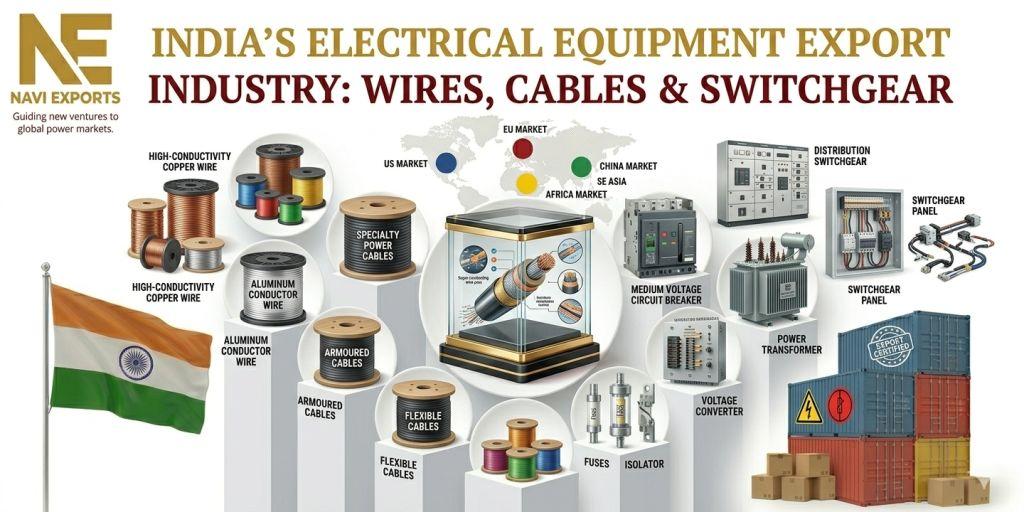
Power cables (HV, MV, EHV) - High-voltage and extra-high-voltage cables for transmission infrastructure. LV and MV Power Cables grew approximately 23% in FY25 per IEEMA data. EHV cables are in particular demand as India's domestic renewable energy infrastructure expands - and the same manufacturers serving domestic grid projects are now qualifying for export orders.
Housing and building wires - Lower margin but high volume. Polycab, Havells, and Finolex dominate this segment domestically and are extending into export markets through distributors in the Middle East, Africa, and Southeast Asia.
Specialty cables - Solar cables (UV-resistant DC strings for rooftop and utility-scale solar), EV charging cables, instrumentation cables, fire-resistant cables. These are the fastest-growing export segments by value. Finolex noted that global demand from North America and Europe "surged," with prices rising from $2.5 to $3.5 per unit in recent periods.
Fiber optic cables - Domestic fiber production crossed 100 million fiber-km in FY24. India is a net exporter of fiber optic cable, with significant demand from Africa, South Asia, and Southeast Asia. Finolex Cables committed INR 500 crore to double fiber drawing capacity to 8 million FKM per year as of February 2024.
ACSR conductors and specialty conductors - Aluminium Conductor Steel Reinforced (ACSR) and High Temperature Low Sag (HTLS) conductors for transmission lines. Apar Industries tripled planned CTC (Compact Twisted Conductor) capacity to 20,490 MT by Q3 FY26. Apar's management positioned itself explicitly as "the most export-ready cable maker in India, with global compliance and scale driving future growth."
The Companies and Their Export Strategies
Understanding who the major players are matters for international buyers doing supplier qualification:
Polycab - India's largest cable manufacturer by market share (20-22%). FY26 management guidance: "We are building a global C&W powerhouse. FY26 will see exports rebound and solar demand accelerate." Polycab is adding capacity at its Halol, Gujarat plant specifically for export-oriented cable production.
KEI Industries - Q4 FY25 profits up 34% year-on-year, driven by export momentum to Africa and Southeast Asia. KEI is spending INR 13 billion in capex over 3-4 years for capacity expansion. Management targets 15-17% revenue CAGR.
RR Kabel - Derives approximately 25% of revenue from exports. "Project Rise" is specifically focused on shifting from wire-dominant to cable-dominant product mix to improve margins and scale export capabilities in EV and telecom segments.
Apar Industries - The most globally-oriented Indian cable manufacturer. Strong in specialty conductors for export, with capacity expansion announcements through FY26. Multiple international certifications.
Havells India - Completed the Tumkur, Karnataka manufacturing facility specifically to meet premium cable demand. Positioned for formalization-driven domestic growth and selected export markets.
Finolex Cables - Specific callout from management: "Global demand, especially from North America and Europe, has surged, pushing prices up." Fiber optic capacity investment signals long-term export commitment.
Why International Buyers Are Choosing India
Three real reasons, not marketing-speak:
China+1 and supply chain risk. Western utilities, contractors, and distributors are actively qualifying alternative suppliers. Indian cable manufacturers that already hold international certifications (UL, CPR, AS/NZS) are capturing this diversification demand.
Quality at competitive price. Indian power cables, particularly in the mid-to-premium segment, offer quality comparable to European manufacturers at significantly lower cost. The price-per-quality-unit calculation works in India's favor for buyers who have historically sourced from European or Japanese manufacturers.
Renewable energy alignment. India's own massive solar and wind buildout is pushing Indian cable manufacturers to continuously develop and improve solar DC cables, wind farm power cables, and grid interconnection cables. Buyers sourcing for their own renewable projects are getting battle-tested product.
2. Switchgear - Strong Domestic Base, Growing Export
India's switchgear industry was valued at $10.7 billion in 2024 and is projected to reach $18.9 billion by 2033 at a 5.9% CAGR. LV switchgear accounts for roughly 70% of the total market.
Switchgear export from India is real and growing, but with a different profile than cables. It is less driven by commodity volume and more by project-based orders - a utility in Nigeria buying distribution switchgear panels, a data center developer in the UAE specifying LV switchboards, a manufacturing plant in Southeast Asia ordering motor control centers.
Major products exported:
- LV (low voltage) switchgear and panels
- MV (medium voltage) switchgear
- Motor control centers (MCCs)
- Power distribution boards and busbar systems
- Industrial control panels
Key manufacturers: ABB India, Siemens India, Schneider Electric India, Havells, L&T Electrical & Automation, Salzer Electronics. The multinational entities (ABB, Siemens, Schneider) manufacture in India for both domestic and export markets - their Indian plants produce to global standards and supply international project orders through parent company networks.
The pure Indian companies in this space (Havells, L&T, Salzer) are increasingly qualified for international markets. Salzer's Q1 FY26 results showed 24.57% revenue growth, driven specifically by Industrial Switchgear division growth "mainly due to high demand products like three-phase transformers, wire harness" and international certifications covering approximately 15 product lines.
High Voltage Switchgear - The IEEMA data highlights growth in HV & EHV GIS (Gas-Insulated Switchgear) and MV AIS (Air-Insulated Switchgear) segments. GIS is a premium product competing directly with European and Japanese manufacturers. Indian GIS installations are primarily for domestic utilities, but export orders are building. ABB in India (Goa GIS factory) produces for both domestic and global markets.
Export destinations: USA, Germany, UAE, UK, France, Australia, Nigeria, Saudi Arabia. The African market (Nigeria, Kenya, South Africa) is significant for distribution-level switchgear - where pricing is competitive and product standards, while demanding, are achievable for well-certified Indian manufacturers.
3. Transformers - Scale Meets Compliance
Power and distribution transformers are India's third major electrical export category. IEEMA data shows approximately 10% growth in power transformers in FY25, with good growth for distribution transformers driven by the RDSS (Revamped Distribution Sector Scheme) program domestically and increasing export orders internationally.
India manufactures transformers across the full voltage range — distribution transformers from 11 kV to 33 kV, power transformers up to 1200 kV, and high-end gas-insulated transformers for dense urban applications.
Major manufacturers:
- BHEL (Bhopal, Haridwar, Trichy) - state-owned; manufactures up to 1200 kV
- Transformers and Rectifiers India (TRIL) - Odhav, Ahmedabad; significant exporter
- Voltamp Transformers - Vadodara, Gujarat
- Electrotherm India
- ABB India, Siemens India (GIS and power transformers)
Transformer export markets are typically project-based - a power utility in Kenya ordering distribution transformers for rural electrification, or a utility in Australia ordering power transformers for substation upgrade. The project sales cycle is longer than cable or switchgear distribution sales.
Key fact: India's transformer export capacity has been growing alongside domestic demand. The RDSS scheme's INR 3 lakh crore allocation to distribution infrastructure is keeping domestic factories running at high utilization, which is paradoxically creating pressure on export delivery timelines. Buyers planning large transformer orders should factor in lead time carefully.
4. Transmission Line Towers and Conductors
Transmission Line Towers (TLT) and conductors are an underappreciated Indian export strength. IEEMA consistently lists TLT alongside cables as major export products.
India has world-class steel tower manufacturers - Kalpataru Power Transmission, KEC International, Skipper Limited - who build transmission infrastructure for utilities in Africa, Southeast Asia, and the Middle East. These are not components; these are entire turnkey project supply chains.
What gets exported:
- Galvanized steel lattice towers (angle iron, tubular)
- ACSR, AAAC, HTLS conductors
- Insulator strings and hardware
Export markets: Africa (sub-Saharan utilities building out grid infrastructure), Bangladesh, Nepal, Southeast Asia, Middle East. KEC International and Kalpataru in particular have significant international project portfolios.
This segment intersects with India's government infrastructure push - the same companies building domestic grid expansion have excess capacity and international project management capability that they apply to export orders.
5. Smart Meters and Power Electronics - The Emerging Export Categories
Two categories worth flagging for new exporters because they represent where export momentum is building:
Smart and Prepaid Meters - IEEMA data explicitly notes that Energy Meters, especially Smart and prepaid meters, are in demand for domestic consumption "as well as Exports." India's domestic smart meter rollout (the Advanced Metering Infrastructure program under RDSS targets 250 million smart meters) is building manufacturing capacity that will eventually support export. Salzer's INR 50 crore smart meter order in Q1 FY26 is an early signal.
Power Electronics (Inverters, Drives, Converters) - IEEMA lists Power Electronics among major exported products. India's solar inverter manufacturing is growing - primarily domestic-focused now, but as quality and scale improve, export opportunity builds. The residential EV charging infrastructure is another emerging segment: Salzer sold 40 DC fast chargers in Q1 FY26 and management flagged accelerating demand.
Manufacturing Clusters: Where the Industry Lives
Gujarat - Vadodara is India's transformer manufacturing capital. Major transformer companies (Voltamp, TRIL, others) cluster here. The Halol area has significant cable manufacturing (Polycab). Hazira has industrial cable manufacturing. Anand has wire harness operations.
Maharashtra - Mumbai and Pune area hosts ABB India, Siemens India, and Schneider Electric's Indian operations. Aurangabad hosts Siemens' transformer factory and multiple electrical equipment manufacturers. Nashik area has cable manufacturing.
Tamil Nadu - Coimbatore has a concentration of electrical motor, transformer, and switchgear manufacturers. Chennai area for cable manufacturing. Coimbatore is sometimes called "the Manchester of South India" for its industrial machinery concentration, but it is equally important for electrical equipment.
Uttar Pradesh, Haridwar and Noida - BHEL's major transformer plant in Haridwar. Noida has power electronics and control equipment manufacturers.
Rajasthan - Growing electrical equipment manufacturing hub with lower land and labor costs relative to Gujarat and Maharashtra.
Himachal Pradesh - Some switchgear and transformer manufacturing attracted by the previous tax incentive regime (though those incentives have largely normalized now).
Top Destination Markets
United States - The largest and fastest-growing export destination for Indian cables. The 44% CAGR from FY17-FY24 is exceptional. US buyers want UL certification (Underwriters Laboratories) for wires and cables used in construction, NEC compliance for electrical installations, and consistent quality documentation. The China+1 sourcing shift has significantly opened US distributor and contractor channels for Indian cable manufacturers. Europe and North America together account for 45-55% of Indian cable exports.
UAE and Gulf - Significant market for both cables and switchgear. Dubai's construction sector drives continuous demand for building wires and LV switchgear. The UAE's role as a regional distribution hub extends Indian electrical product reach into Saudi Arabia, Qatar, Oman, Kuwait. India-UAE CEPA is providing preferential access - relevant for electrical equipment export pricing competitiveness.
Germany - A demanding but valuable market. German buyers for electrical equipment require CE marking, conformance with IEC standards (which Indian manufacturers increasingly hold), and consistent documentation. German buyers have historically preferred European suppliers but are actively qualifying Indian manufacturers as supply chain resilience becomes a priority.
UK - Post-Brexit, the UK has its own import regulations but broadly recognizes IEC standards and CE marking transitionally. The 32.9% growth in UK exports of Indian engineering goods in FY25 reflects the broad attractiveness of Indian engineering product in this market.
Africa (Nigeria, Kenya, South Africa, Ethiopia) - A genuinely significant and often underestimated market for Indian electrical equipment. Nigerian grid expansion, Kenya's ongoing rural electrification, South Africa's aging infrastructure maintenance - all create demand for transformers, switchgear, and cables at the distribution level. Indian manufacturers compete favorably on price against European alternatives and on quality against Chinese alternatives. Nigeria and Kenya are explicitly listed by IEEMA and EEPC as major export destinations.
Australia - Australian standards (AS/NZS) are the main compliance hurdle. Indian manufacturers who have qualified to AS/NZS standards are finding a receptive market. Australia is listed as a top exporting country by IEEMA.
Southeast Asia - Vietnam, Indonesia, Philippines, Malaysia. Growing industrial base, significant infrastructure investment, and openness to Indian suppliers. KEI specifically called out export momentum to Africa and Southeast Asia in its Q4 FY25 results.
Compliance: What Buyers in Each Market Actually Require
This is where most competitor guides fail exporters. Generic advice about "getting certifications" is not helpful when the specific requirements differ materially by product and market.
BIS Certification (India Mandatory)
Bureau of Indian Standards certification is mandatory for many electrical products sold in India under the ISI mark scheme. For export-oriented production, BIS certification to Indian Standards (IS codes) is the baseline quality credential, but it is not what most international buyers ask for - they ask for international marks.
However: BIS IS standards are broadly aligned with IEC (International Electrotechnical Commission) standards, which helps Indian manufacturers qualify for international marks without starting from zero.
IEC Standards - The International Baseline
The International Electrotechnical Commission sets the base standards for electrical equipment globally. Most major markets - EU, Australia, Gulf, much of Asia and Africa - either adopt IEC standards directly or base their national standards on IEC. An Indian manufacturer with IEC-compliant product is 80% of the way to most international markets.
Key IEC standards for cables: IEC 60228 (conductor requirements), IEC 60502 (power cables), IEC 60332 (fire resistance). For switchgear: IEC 60947 (LV switchgear), IEC 62271 (HV switchgear). For transformers: IEC 60076 series.
CE Marking (EU Market)
For electrical equipment sold in the European Union, CE marking is mandatory. Low Voltage Directive (LVD 2014/35/EU) covers most electrical equipment operating between 50V and 1000V AC. Electromagnetic Compatibility Directive (EMC 2014/30/EU) applies to electrical equipment that generates or is susceptible to electromagnetic interference.
For cables in the EU specifically: Construction Products Regulation (CPR) applies to cables installed in buildings. CPR requires cables to be classified by their reaction-to-fire performance (Euroclass B, C, D, E) and marked accordingly. This is a specific requirement that trips up many non-European cable exporters targeting EU building sector buyers. Post-CPR, exporting standard cable to the EU for construction applications requires fire-class testing and certification.
UL Certification (US Market)
Underwriters Laboratories certification is the dominant safety standard for electrical products in the US. UL 44 (for rubber-insulated cables), UL 83 (thermoplastic-insulated wires), UL 508A (industrial control panels), UL 1066 (circuit breakers) - these are the standards that US distributors, electrical contractors, and utilities require.
Getting UL certification involves product testing by UL's laboratories, factory inspection, and ongoing compliance monitoring. It is not a one-time event. For Indian cable manufacturers targeting the US market seriously, UL certification is a multi-year investment with real cost - but it is also the single most effective market access credential for the US channel.
AS/NZS Standards (Australia/New Zealand)
Australian and New Zealand markets use AS/NZS standards administered by Standards Australia. For cables: AS/NZS 5000 series. For switchgear: aligned with IEC standards but with Australian-specific modifications. Products must be tested and certified to AS/NZS before importation. The Australian ERAC (Electrical Regulatory Authorities Council) oversees compliance.
Gulf Standardization Organization (GCC)
GCC countries (Saudi Arabia, UAE, Kuwait, Bahrain, Qatar, Oman) use Gulf Standards (GSO) for electrical equipment. Many GSO standards are based on IEC. For products with GSO mandatory standards, conformity assessment and registration is required before export to the GCC market. The SASO (Saudi Standards, Metrology and Quality Organization) manages Saudi Arabia's requirements.
IEC vs UL: The Practical Implication
One thing worth flagging that most guides skip: UL and IEC are different systems, and product certified to IEC standards is not automatically acceptable in the US, and vice versa. A cable manufacturer that has IEC-certified product for the EU cannot automatically export the same product to the US with UL certification - the specifications, testing methods, and marking requirements are different. Major Indian exporters like Polycab and Apar maintain dual certification specifically because US and EU are separate certification regimes.
What Competitor Guides Miss
Three consistent gaps:
They quote the cable and wire market size but not the export-specific trajectory. The 44% CAGR to the US, the 20-22% export growth forecast for FY26, the specific management guidance from Polycab, KEI, and Apar - this is what actually tells you whether the export opportunity is real and growing. Market size alone does not answer that question.
They ignore the certification distinction between UL and IEC. Almost every competitor article says "get international certifications" without explaining that UL (for US) and CE/IEC (for EU) are separate pathways with different testing, different marking, different costs. An Indian manufacturer investing in CE marking is not automatically US-qualified. This gap catches new exporters.
They skip Africa entirely. Nigeria and Kenya are explicitly named by IEEMA and EEPC as major electrical equipment export destinations. The African market for distribution transformers, LV switchgear, and cables is substantial and growing - and India has both the price competitiveness and the product range to serve it. Leaving it out of any guide on Indian electrical equipment exports is simply wrong.
Government Support for Electrical Equipment Exporters
EEPC India (Engineering Export Promotion Council) EEPC has a dedicated Electrical Machinery and Equipment panel. It provides Market Development Assistance (MDA) and Market Access Initiative (MAI) grants for trade fair participation and export market development. EEPC specifically identifies electrical machinery as one of four focus sectors under "Brand India Engineering."
IEEMA (Indian Electrical and Allied Manufacturers Association) The primary industry body for the electrical equipment sector. Provides industry data, policy advocacy, standards liaison, and export promotion support. Active at international trade shows (Hannover Messe, Middle East Electricity, etc.)
PLI Scheme for White Goods and Capital Goods While the primary PLI schemes for electrical equipment cover consumer durables (AC, LED lights), the Capital Goods PLI scheme supports investment in manufacturing equipment relevant to electrical sector production. The de-licensing of the sector and 100% FDI under automatic route removes regulatory friction for new investment.
RDSS (Revamped Distribution Sector Scheme) - Indirect Support The INR 3 lakh crore RDSS scheme for power distribution infrastructure is driving massive domestic demand for cables, transformers, and switchgear. This domestic demand is simultaneously filling capacity, generating quality certifications through rigorous utility procurement processes, and building manufacturing capability that makes export more viable.
Union Budget FY26 Infrastructure Capex The government's INR 11.21 lakh crore ($128.42 billion) capital expenditure for FY26, combined with INR 9 lakh crore in infrastructure investment from public and private sources, is directly creating demand for electrical equipment. Companies running at 80-85% domestic capacity utilization are upgrading facilities and certifications — which benefits export readiness.
How to Start Exporting Electrical Equipment from India
Step 1: IEC from DGFT - Mandatory starting point for all exports.
Step 2: EEPC RCMC - Registration with Engineering Export Promotion Council. Required for accessing MDA/MAI grants and EEPC trade fair participation.
Step 3: Identify your product's HS code - Electrical equipment spans multiple HS chapters: 8504 (transformers, inductors), 8537 (switchgear panels), 8544 (insulated wire and cable). Getting this right determines import duty at destination and FTA tariff benefit eligibility.
Step 4: BIS certification for Indian standards - For products also sold domestically, BIS IS certification is the baseline.
Step 5: Map your target market's certification requirement - CE + CPR for EU, UL for US, AS/NZS for Australia, GSO for GCC, IEC-based standards for most other markets. Choose your first export market based on your ability to achieve certification cost-effectively.
Step 6: Engage a testing lab - National labs like ERDA (Electrical Research and Development Association, Vadodara) or private NABL-accredited labs for IEC testing. For UL certification: engage directly with UL's India office. For CE: engage a Notified Body.
Step 7: EEPC trade fair participation - Middle East Electricity (Dubai, March annually) is the primary show for Middle East market entry. Hannover Messe for Europe. Cabling events in North America for the cable segment.
Pre-Export Checklist
Before your first international electrical equipment shipment:
- IEC from DGFT - active
- EEPC RCMC - issued
- HS code confirmed for your specific product (8-digit precision)
- BIS certification current for any products with mandatory BIS coverage
- Target market certification confirmed - UL / CE+CPR / IEC / AS/NZS / GSO
- Test reports from accredited lab in the format required by the destination market
- Installation and wiring diagram documentation in destination market's language (required by most B2B electrical buyers)
- Safety Data Sheet for any hazardous material in product (insulation compounds, flux materials)
- Country of origin documentation confirmed - relevant for FTA tariff benefits
- Freight forwarder briefed on product category - electrical equipment may have weight and dimensional restrictions for air freight; large transformers require specialized heavy-lift logistics.
Related Navi Exports Categories
- Electrical Equipment & Accessories Exporters
- Industrial Equipments & Tools
- Solar & Environmental Systems
- Electronic Products & Components
- Machinery & Parts
- Measure Meter & Analytic Products
The Bottom Line
India's electrical equipment export story has two timelines. There is the cable and wire story - fast, concrete, measurable, with public company management guidance confirming 20-22% export growth in FY26, a 44% CAGR to the US over seven years, and major capacity investments at Polycab, KEI, Apar, and Finolex specifically targeting export markets. This part of the story is already playing out.
Then there is the switchgear, transformer, and power electronics story - real and growing, but more project-based, more relationship-dependent, and more compliance-intensive. This part is building toward what cables accomplished, but it is earlier in that journey.
The common thread is the China+1 dynamic. Western utilities, contractors, and distributors are actively qualifying Indian suppliers as a deliberate supply chain risk reduction. Indian manufacturers that have invested in international certifications (UL, CE, AS/NZS) are capturing this diversification demand. Those that have not are watching it happen to their competitors.
For new exporters entering this space, the certification investment is the primary barrier. It is not quick, it is not cheap, and the requirements differ meaningfully by market. But it is a one-time investment - once a product line is UL-certified or CE-marked, the certification is maintained through periodic audits rather than re-done from scratch. The first year is the expensive one.
For international buyers, India's cable and wire manufacturers are among the most qualified B2B partners in emerging-market manufacturing - publicly listed, professionally managed, internationally certified, and actively competing for global business.
→ Browse verified Indian electrical equipment exporters on Navi Exports
→ LED lighting is one of the fastest-growing segments here, browse suppliers
Data sources: IBEF Engineering Goods Export Report FY25 (record $116.67B), IEEMA Industry Update (electrical equipment export categories and country data), Motilal Oswal Cables & Wires Thematic Report April 2024 (16% export CAGR, India net exporter status), Energetica India (44% CAGR cable exports to US, FY26 outlook), Mordor Intelligence India Wire and Cable Market Report January 2026 ($23B by 2026), Salzer Electronics Q1 FY26 results (switchgear export data), EEPC India Engineering Exports FY25 report, IBEF Capital Goods and Engineering Sector Report, IEC Standards (IEC 60228, 60502, 60947, 62271, 60076), CE CPR Directive 305/2011/EU.
Frequently Asked Questions
India's engineering exports (which include electrical and electronic equipment) reached a record $116.67 billion in FY25. Electrical machinery and electronic equipment exports were $32.32 billion in 2023 per UN COMTRADE. The cables and wires segment specifically is growing at 20-22% year-on-year in FY26, with the market projected to reach $23 billion by 2026 and $35 billion by 2031.
Cables and wires are the dominant export category (approximately 35.8% of the electrical industry by revenue). Switchgear and panels (15.9%), transformers (11.3%), and transmission line towers and conductors make up the remainder of major export categories. Power electronics, smart meters, and specialty cables (solar, EV, fiber optic) are the fastest-growing emerging segments.
Per IEEMA and EEPC data: USA, UAE, Germany, UK, Australia, France, Saudi Arabia, Nigeria, Kenya, and Brazil are the primary destination markets. North America accounts for approximately 20.5% of engineering export share. The USA is the largest single market for Indian cables, where exports grew at 44% CAGR between FY17 and FY24.
The requirements differ by destination: US market requires UL certification (Underwriters Laboratories). EU market requires CE marking under the Low Voltage Directive and, for cables in buildings, CPR classification. Australia and New Zealand require AS/NZS certification. GCC countries require GSO conformity. Most markets except the US accept IEC-based standards as the foundation. BIS IS certification is required for Indian market products and serves as a baseline, but is not a substitute for international certification marks.
No. UL is a US-specific certification system. CE is the EU conformity marking. The testing methods, product specifications, and marking requirements are different between the two systems. A cable certified to IEC standards for CE marking is not automatically UL-listed for the US market. Major Indian exporters like Polycab and Apar maintain both because the US and EU are separate markets with separate requirements.
The major listed companies are Polycab India (largest, 20-22% domestic market share), KEI Industries, RR Kabel, Apar Industries, Havells India, and Finolex Cables. All have public export strategies and are actively building international market presence. Polycab has targeted explicit export growth for FY26; Apar describes itself as "the most export-ready cable maker in India."
Navi Exports lists verified Indian exporters in the Electrical Equipment & Accessories category. EEPC India maintains an exporter directory and organizes international buyer-seller meets specifically for the electrical machinery sector. Middle East Electricity (Dubai, March annually) and Hannover Messe (Germany, May) are the two primary international trade shows where Indian electrical equipment manufacturers exhibit.