-
-
-
Book & Printing Exports from India: A Low-Investment Export Opportunity
 Fri, 08 May 2026
Book & Printing Exports from India: A Low-Investment Export Opportunity


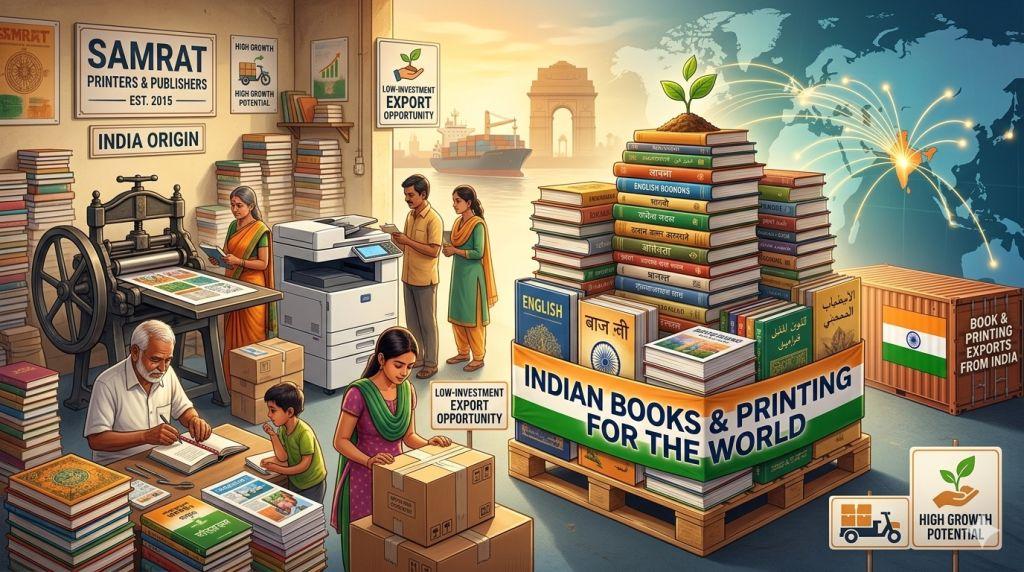
Between November 2023 and October 2024, India exported 118,112 shipments of printed books - involving 2,121 exporters and reaching 6,147 international buyers. That is a 6% year-on-year increase. And it is happening quietly, without the headline attention that gems or pharma gets.
Most people do not think of India as a book exporting country. They think of it as a publishing market - which it is, a $9.3 billion domestic one in 2024, with ~9,000 publishers, 21,000 retailers, and 250 million students generating relentless demand. But that same infrastructure, those same printing presses, that same skilled workforce, also serves publishers in the UK, the US, Germany, Africa, and the Middle East.
India's book printers produce full-color hardcover picture books for under $1 per copy at scale. They print academic textbooks for African governments that cannot afford the rates UK publishers charge. They supply European publishers who need quality at a price point that domestic European print simply cannot match. And since China remains the dominant force in complex specialty printing, India sits in a strategically useful middle position: cheaper than Western alternatives, more reliable than most people realize, and with English-language capability that makes buyer communication actually work.
This guide covers the full picture - what gets exported, who buys it, which cities produce it, what the compliance looks like, and why a printing or publishing company in India can start exporting without the capital requirements that other export categories demand.
The Numbers: India's Book and Printing Export Industry
In the financial year 2023, India's book, publications, and printing exports were approximately $382 million. By 2022, India's exports of printed books, newspapers, and pictures reached $388.61 million per UN COMTRADE data. These figures cover physical printed goods under HS Chapter 49 - the book export number itself, not the broader printing services market.
The broader picture:
- India's publishing industry grew from Rs. 50,000 crore ($5.81B) in 2019 to Rs. 80,000 crore ($9.3B) by 2024
- The print book market is forecast to reach Rs. 1,00,000 crore ($11.63B)
- Educational content is 71% of India's print market, driven by 250 million students
- 118,112 book export shipments in the 12 months ending October 2024 - up 6% YoY
- 2,121 exporters active in international book trade
- 6,147 international buyers sourcing from India in that period
India's commercial printing market reached $36.5 billion in 2025 and is expected to reach $46.7 billion by 2034, growing at a 2.80% CAGR. The export slice of this is smaller, but it is where the growth opportunity sits for exporters who want international revenue without the capital intensity of, say, pharma or diamonds.
What makes book and printing export genuinely low-investment compared to other categories:
No manufacturing license required beyond standard business registration. No CDSCO approval, no WHO-GMP certificate, no USFDA inspection. The main requirements are an IEC (Import Export Code), quality output, and the ability to deliver on time. For a printer that already has offset or digital press capacity, international orders are an incremental revenue stream, not a separate business.
What India Exports in the Book and Printing Category
Educational and Academic Books
This is the dominant export category. Educational content forms 71% of India's print market, and the textbook export to developing markets is substantial. African governments - Kenya, Nigeria, Ethiopia, Ghana, Uganda - source textbooks from India because Indian publishers produce English-medium educational content at price points that UK publishers cannot reach. India's National Education Policy (NEP) 2020, which restructured curriculum and introduced new learning frameworks, has also created fresh content that is finding international buyers in similar educational contexts.
India's competitive pricing for educational books comes from genuine economies of scale. Publishers like Arihant, S. Chand, and Ratna Sagar print millions of copies annually. The per-unit cost drops to levels that African and South Asian government procurement tenders can accommodate. UK publishers printing in India for their own developing-market distribution programs is an established practice, not a new trend.
Children's Books
India has become a global exporter of children's books, with over 2,500 shipments of children's books in 2023–2024, with the highest demand coming from the UAE, UK, Philippines, Australia, and South Africa.
The appeal of Indian children's books in international markets is partly cost and partly content. On cost: for a full-color hardcover picture book at 5,000 copies and up, the cost from an Asian printer can be under $1.00 USD per copy. That pricing is why independent publishers in the UK and US send their illustrated books to India for printing rather than using domestic printers.
On content: India's cultural diversity produces children's books that international buyers actively seek for multicultural programming. Folklore adaptations, Indian mythology retellings, multilingual board books - these sell in diaspora markets across the US, UK, Canada, and Australia, where Indian communities represent significant purchasing power and libraries are actively building diverse collections.
India's print-on-demand market is growing from $833.51 million in 2025 to a projected $5,931 million by 2033, at a 27.8% CAGR. This matters for children's book exporters because POD infrastructure removes the MOQ barrier for smaller international buyers who want Indian content but cannot commit to 5,000-copy offset runs.
Commercial Printing: Catalogs, Packaging, and Printed Collateral
This category is where Indian printers serve international businesses rather than publishers. Brands in the US, UAE, and Europe outsource catalog printing, brochure printing, and promotional material production to India because:
- India's offset printing costs are 30-60% below equivalent European or US production
- Quality from established Indian printers is consistent and internationally benchmarked
- Lead times are manageable with sea freight for non-urgent orders, and air freight for time-sensitive materials
India's digital printing market is expected to grow from $1,457 million in 2023 to $2,674 million by 2030 at a 9.1% CAGR. The digital printing segment is where short-run international orders land - businesses that need 500 catalogs rather than 50,000.
Packaging Print
India's offset packaging market was valued at $8.51 billion in 2024 and is projected to grow to $13.01 billion by 2032 at a 5.5% CAGR. The export angle here is pharma packaging (Indian pharma companies producing export-grade packaging domestically), FMCG packaging for international brands with India operations, and premium packaging for luxury goods targeting export markets.
Print-on-Demand Services for International Authors
This is a newer segment and genuinely interesting for small exporters to understand. Indian POD infrastructure - built around the domestic self-publishing boom - can serve international authors who want Indian distribution or physical copies for the South Asian diaspora market without paying Western POD prices. Platforms like Pothi.com, Notion Press, and Srishti Publishers have started handling international orders alongside domestic ones.
Why India Can Compete on Price (Without Just Being Cheap)
The cost advantage in Indian book printing is real, but it is worth understanding what drives it - because that also tells you where the limits are.
Labor costs are one factor. India's skilled press operators, bookbinders, and prepress technicians earn significantly less than their UK or US counterparts. This directly affects per-copy pricing.
Scale is the bigger factor. India's printing industry has built capacity for 250 million domestic students. When that capacity is partially idle (seasonally, or between education cycles), it runs international orders through the same presses at marginal cost. The fixed infrastructure is paid for domestically. International work is incremental profit.
Paper pricing is where India's advantage gets complicated. Indian paper mills are large but not always price-stable. Industry sources — including Ravi Shroff of Nutech, one of India's larger print exporters - note that paper mill pricing in India can be monopolistic during supply crunches. This is an honest challenge. Exporters who have locked-in paper supply agreements are more reliable partners than those who price jobs without securing paper first.
The China comparison is one buyers always ask about. For bulk orders of 500 copies or more, printing in Asia can save 30-60% compared to equivalent production in the US or Europe. India and China offer similar headline savings, but they are not identical. China has a near-monopoly on complex specialty formats - sound books, books with embedded electronics, complex pop-up mechanics. India does not credibly compete there. For standard offset printing — children's books, educational books, commercial catalogs, academic texts - India is genuinely competitive. The difference is reliability: China's COVID-era lockdowns disrupted publisher supply chains badly. India did not have the same disruption pattern. Several UK and US publishers who diversified away from China during 2020-2022 ended up staying with Indian printers after the disruption passed.
The Trump Tariff Situation - What Indian Book Exporters Need to Know
In April 2025, the Trump administration announced broad tariff increases on many import categories. For books specifically, there was an exemption: printed books were carved out from the harshest tariffs under the view that taxing educational and cultural imports was politically and practically awkward.
This exemption matters for Indian book exporters targeting the US market. Industry sources confirmed this exemption brought considerable relief at the London Book Fair, though publishers did not feel immediately compelled to shift production away from China as a result. The practical implication: Indian book exporters cannot count on tariff pressure forcing US publishers to switch from China. The opportunity exists, but it has to be won on quality, reliability, and price - not on tariff arbitrage.
For the EU and UK markets, no equivalent tariff disruption has occurred. These remain the most consistent volume markets for Indian book exports, with Germany and the UK as top buyers.
Manufacturing Clusters: Where India's Print Capacity Lives
Understanding regional specialization matters when sourcing or building an export operation.
Delhi NCR (Noida, Faridabad) - The largest hub for book printing and publishing services. Thomson Press, one of India's most prominent commercial and book printers, operates here. Strong in four-color offset, academic books, and commercial print. Several established book print exporters are based in or around Delhi NCR.
Chennai, Tamil Nadu - A significant printing hub with good port connectivity. Strong in educational publishing, with several publishers serving the South Indian market and African export programs from here.
Mumbai, Maharashtra - Commercial printing, packaging, and publishing. Repro India, a major listed book printer with significant export business, is based here. Strong in pharmaceutical packaging and commercial print alongside books.
Hyderabad, Telangana - Growing print and publishing ecosystem, particularly for academic and technical printing. Good connectivity to Europe via air freight.
Kolkata, West Bengal - Historical strength in academic publishing and printing. Several regional language publishers export from here to diaspora markets in the UK and US.
Bengaluru, Karnataka - Mix of digital and offset capability. Growing digital printing segment, particularly for short-run and customized print jobs.
Pune, Maharashtra - Mix of commercial print and publishing services. Several mid-sized printers serve international clients here.
Top Destination Countries and What Each One Buys
United Kingdom - One of the most consistent buyers of Indian print production. UK publishers have used Indian printers for decades, particularly for developing-market editions of educational books and for full-color children's books. Post-Brexit, UK buyers are also sourcing more printed collateral domestically or from India rather than EU printers. The India-UK FTA (recently signed) should reduce friction for printed goods trade between the two countries.
United States - The largest potential market but historically challenging for Indian book exporters due to shipping costs and lead time expectations. Indian printers serve US publishers primarily through intermediary arrangements - US publishers with established India print relationships, or Indian publishers with US distribution. The POD infrastructure is changing this somewhat, allowing US-based authors to order Indian printing with more manageable logistics.
Africa (Kenya, Nigeria, Ethiopia, Ghana, Uganda, South Africa) - Arguably the most strategically important growth market for Indian book exporters. African governments and NGOs sourcing educational books for national curriculum programs represent large, reliable orders. Indian publishers and printers have a geographic and cost advantage here over UK and US competitors. The African Continental Free Trade Area (AfCFTA) is increasing intra-African book distribution, which creates additional distribution infrastructure for Indian books that enter through one country and move regionally.
UAE and Middle East - Strong diaspora demand. The UAE imports significant volumes of Indian books - educational, children's, and religious/spiritual content. Sharjah International Book Fair is one of the largest book fairs globally and a key market-entry point for Indian publishers and print exporters targeting the Arab world and the South Asian diaspora.
Germany - A major buyer of printed materials including commercial print, catalogs, and specialty books. Frankfurt Book Fair (Frankfurter Buchmesse) is the world's largest book fair and the primary international rights market - Indian publishers attending Frankfurt have grown significantly over the past decade. German buyers also source specialty printing from India for sustainable/FSC-certified packaging and printed goods.
Southeast Asia (Philippines, Malaysia, Singapore) - Growing educational book imports from India. Philippines in particular has been a notable destination for Indian children's book exports.
Australia and Canada - Diaspora-driven demand for Indian content, plus mainstream interest in diverse and multicultural children's books. Both markets have strong natural language and cultural alignment with Indian English-language publishing.
What Competitors Articles Miss
Most existing content on Indian book printing exports makes three consistent mistakes. Worth flagging them.
They treat book export and printing export as the same thing. They are related but distinct. Book export (HS Chapter 49) involves finished intellectual property products - the content matters as much as the paper it is printed on. Printing export (commercial print services) is a manufacturing service where India is essentially a contract manufacturer for foreign publishers or brands. The compliance, buyer relationships, and pricing logic are different. Confusing them leads to bad advice.
They ignore the African market entirely. Almost every competitor article mentions the US and UK and stops there. The African market for Indian educational books is substantial, growing, and arguably less competitive than Western markets. African governments buying textbooks at scale are realistic, accessible buyers for Indian publishers and printers - not aspirational ones. This market deserves its own strategic attention.
They skip the honest limitations. India is not the lowest-cost book printer in Asia. For complex specialty formats - sound books, pop-up books, books with electronics - China has infrastructure India cannot match today. Indian paper pricing can be volatile. Lead times on sea freight to the US are 25-35 days, which is a real operational constraint for time-sensitive orders. Any honest guide on book printing exports should say this plainly rather than presenting India as an uncomplicated alternative to all other sources.
What You Actually Need to Start Exporting Books or Print From India
The compliance requirements for book and printing exports are genuinely lighter than most other export categories. That is part of why it is accessible.
Baseline (mandatory):
- IEC (Import Export Code) from DGFT - the starting point for any Indian exporter
- GST registration - mandatory for formal export operations
- Business registration (Pvt Ltd, LLP, or proprietorship) - standard
For books specifically:
- ISBN registration through the Raja Rammohanna Roy Library Foundation (RRRLF) or through the national ISBN agency - required if exporting books as finished publications with your own imprint
- Copyright registration is advisable (though not mandatory for export) - protects the content you are exporting
- No separate manufacturing or product license is required for printed books as a category
For commercial print export:
- No product-specific license; standard business and export registration suffices
- ISO 9001:2015 certification is valuable for credibility with international buyers - most established Indian print exporters hold this
- FSC (Forest Stewardship Council) chain-of-custody certification is increasingly required by European buyers who specify FSC-certified paper in their print orders
For export to the EU:
- CE marking is not required for books as a category
- REACH regulations do not apply to printed books in the same way as consumer products
- For children's books containing toys, stickers, or physical non-book components: the Toy Safety Directive and relevant EU product regulations may apply
For export to the US:
- CPSC regulations apply if books contain non-book components (toys, chemicals in stickers, etc.) targeting children
- For standard printed books: no specific product license; standard customs documentation applies
- HTS code accuracy matters - printed books: 4901, children's picture books: 4903, maps and charts: 4905
For the UK post-Brexit:
- Standard customs documentation, separate from EU
- UK import duty on printed books is generally 0% - confirmed under the UK Global Tariff
- For children's books with components: UK's Product Safety and Metrology legislation applies
Documentation every buyer will expect:
- Commercial Invoice with declared value, HS code, and country of origin
- Packing List
- Bill of Lading (sea freight) or Airway Bill (air freight)
- Certificate of Origin (from local Chamber of Commerce or EPC) - required for FTA tariff benefits
- For large institutional orders (government textbook procurement): quality certification from the publisher/printer, sample approval process documentation
How to Find International Buyers for Indian Books and Print
Trade fairs - the most effective channel:
- Frankfurt Book Fair (October, Germany) - the world's primary rights market; Indian publishers have a growing presence
- London Book Fair (April, UK) - strong for English-language publishing deals and print sourcing
- Sharjah International Book Fair (November, UAE) - the largest book fair in the Arab world; a key entry point for the Middle East and diaspora market
- Bologna Children's Book Fair (March/April, Italy) - the primary global market for children's book rights and licensing
Government bodies:
- National Book Trust (NBT) - India's national body for book promotion and international book fair participation; supports Indian publishers in exhibiting internationally
- Federation of Indian Publishers (FIP) - industry body; useful for connecting with established exporters
- India chapter of the International Publishers Association
B2B platforms: Navi Exports lists verified Indian publishers and printing exporters across categories. Browse the Printing, Books & Media Products category to find active exporters with credentials for international orders.
Direct outreach: International publishers, NGOs running literacy programs in Africa, government procurement agencies in developing markets, and educational distributors in the Middle East all buy directly. Trade fair contacts are the fastest route to these buyers. Email outreach after trade fair introduction has a meaningfully higher conversion rate than cold outreach.
Pre-Export Checklist for Book and Print Exporters
Before taking your first international order:
- IEC from DGFT - confirmed and current
- GST registration - in place
- Business registration matching your export entity
- ISBN registration if exporting original publications under your own imprint
- ISO 9001 certification - advisable for commercial print; check if target buyer requires it
- FSC chain-of-custody certificate - required if buyer specifies FSC paper (common in EU)
- Sample production run - send physical samples to the buyer before confirming production order; non-negotiable for first relationship
- Paper supply confirmed - do not quote without paper supply secured or a reliable price ceiling from your mill
- Freight forwarder identified - one with experience in book and print shipments (dimensional weight calculations and fragile goods handling matter here)
- HS code confirmed - 4901 for printed books; 4903 for children's picture books; 4911 for other printed matter
Related Navi Exports Categories
- Printing, Books & Media Products Exporters
- Gifts, Crafts & Home Decor
- Packaging & Packing Materials
- Agriculture & Food - Stationery and Paper Adjacent
- Office Appliances & Stationery
Book and printing export from India is genuinely low-investment relative to other categories - no manufacturing license, no product approval, no regulatory pathway that takes two years to navigate. What it requires is quality consistency, delivery reliability, and the willingness to show up at Frankfurt or London with physical samples and a price sheet that makes sense.
The 118,112 export shipments in a single year, to 6,147 buyers across the world, show that a real market already exists. It is not dominated by a handful of large players - 2,121 exporters participated in that year's trade. That is a fragmented market where a mid-sized printer or publisher with good quality and reasonable pricing can build meaningful international revenue.
Africa is the underplayed opportunity. The US is harder logistically but accessible. The UK and Germany are well-established buyers who want reliability as much as price. The UAE is the gateway to the Middle East diaspora market.
The honest limitations - paper pricing volatility, China's lead in specialty formats, sea freight lead times to North America — are real but manageable. Every supplier relationship in international trade involves trade-offs. India's book printing trade-offs are less severe than most.
If you are a printer already running presses for the domestic market, the incremental cost of pursuing international orders is low. The upside, across a decade, is not.
→ Browse verified Indian book and printing exporters on Navi Exports
Data sources: Volza Global Export Data (book shipments November 2023-October 2024), IBEF Publishing Industry Report, Statista India Book Export Data, UN COMTRADE, IMARC Group (India Commercial Printing Market), Grand View Research (India Digital Printing Market), Straits Research (India Print-on-Demand Market), Indian Printer and Publisher (book export challenges analysis, Trump tariff impact), All About Book Publishing (India children's publishing trends), UK Publishing Export Toolkit, Fortune Business Insights (India Offset Packaging Market), Ghostwriting LLC (book printing cost comparison).
Frequently Asked Questions
India exported $382-388 million in books, publications, and printing in FY23, with the UN COMTRADE figure at $388.61 million for 2022. In terms of shipment volume, India exported 118,112 book shipments between November 2023 and October 2024, a 6% year-on-year increase, reaching 6,147 international buyers. India's broader publishing industry is worth $9.3 billion domestically.
Compared to other export categories, yes. Book and print export does not require pharmaceutical manufacturing licenses, USFDA inspections, mining permits, or high-capital equipment certification. The base requirements are an IEC from DGFT, standard business registration, and GST compliance. ISBN registration is needed for publishers exporting their own titles. FSC certification is advisable for EU buyers. ISO 9001 helps with credibility. None of these carry the cost or timeline of, say, medical device certification.
The main buyers are the UK, USA, UAE, Germany, African nations (Kenya, Nigeria, Ethiopia, Ghana), Philippines, South Africa, and Australia. Africa is the fastest-growing segment for educational textbook exports. The UK and Germany are the most established commercial print buyers. The UAE is the gateway for Middle East and diaspora demand.
For bulk offset printing of 500+ copies, India and China both offer 30-60% savings over equivalent US or UK domestic production. China has an advantage in complex specialty formats (sound books, pop-up books, books with embedded components). For standard offset printing - children's books, educational texts, commercial catalogs - India is a genuine alternative at comparable price points. UK domestic printing is significantly more expensive per copy for any substantial print run.
The baseline is an IEC from DGFT and GST registration. For original publications: ISBN registration through the national ISBN agency. For EU buyers: FSC chain-of-custody certification if they specify FSC paper. For commercial print clients: ISO 9001:2015 is advisable. For children's books with physical non-book components: check CE marking requirements under EU toy safety regulations. Standard printed books without accessories have minimal specific certification requirements.
The most effective channels are international book fairs - Frankfurt Book Fair (October), London Book Fair (April), and Sharjah International Book Fair (November). The National Book Trust supports Indian publishers at international fairs. For commercial print buyers, direct outreach to publishing houses, NGOs running literacy programs, and government textbook procurement agencies. Verified B2B platforms like Navi Exports connect exporters with international buyers directly.
Printed books fall under HS Chapter 49: 4901 covers printed books in general; 4903 covers children's picture books, drawing books, and coloring books; 4911 covers other printed matter including commercial catalogs, posters, and printed photos. Accurate HS code classification affects import duty in destination countries and customs clearance speed.