 Thu, 06 Aug 2026
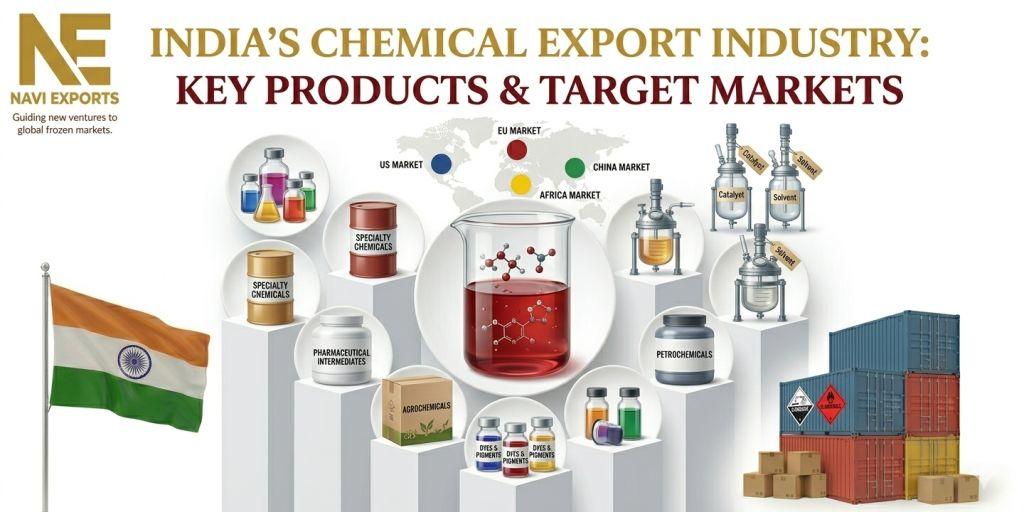
India's Chemical Export Industry: Key Products & Target Markets


Here is a number that does not get nearly enough attention: India controls 85-90% of global castor oil exports. Not 30%. Not 40%. Nearly the entire world supply routes through India. The US, EU, China, and Japan cannot meaningfully replace this - castor grows in India's semi-arid climate at commercial scale, and building equivalent capacity elsewhere takes decades.
That kind of dominant position is unusual. Most countries with a strong chemical export sector compete at the margins - offering cost advantages or niche specializations. India has those too, but it also has genuine monopoly positions in specific categories that competitors simply cannot replicate quickly.
The overall sector sits at $21.1 billion in chemical exports in FY25 - up from $20.3 billion the year before. That covers organic chemicals, inorganic chemicals, dyes and dye intermediates, agrochemicals, castor oil, essential oils, cosmetics, and specialty chemicals. India exports chemicals and chemical products to more than 175 countries. It ranks 14th globally in chemical exports (excluding pharmaceuticals), accounting for 2.5% of global chemical sales.
This guide covers the key product categories, the clusters where they are made, the markets that buy them, and what new exporters need to navigate compliance. The chemical sector is not the easiest entry point for new exporters - the compliance requirements are meaningful and the buyer relationships take time to build - but it is one of the most sustainable, with India holding structural advantages that are not going away.
India's Chemical Export Snapshot
| Category | FY26 (Apr–Jul 2025) Export Value | Key Buyers |
|---|---|---|
| Organic chemicals | $2,750 million | USA, China, Germany, Brazil, Netherlands |
| Inorganic chemicals | $726 million | USA, Brazil, Saudi Arabia |
| Agrochemicals | $1,434 million | USA, Brazil, Japan |
| Dyes and dye intermediates | $825 million | USA, China, Germany |
| Castor oil, essential oils, cosmetics | $1,446 million | USA, China, EU |
| Total chemicals FY25 (full year) | $21.1 billion |
Total chemicals and allied products (including pharmaceuticals, plastics, synthetic rubber): Rs 9,28,119 crore / $108.59 billion in FY25 - a figure that encompasses the broader industrial chemical ecosystem.
The industry itself is valued at approximately $220-250 billion domestically (2024-25), projected to reach $300 billion by 2030 and $1 trillion by 2040. FDI inflows reached $23.2 billion between April 2000 and June 2025.
Sources: IBEF Chemical Industry Report (FY26 data), Ministry of Chemicals and Fertilizers, CHEMEXCIL
1. Dyes and Dye Intermediates - Where Europe Retreated and India Advanced
FY26 (Apr-Jul) export value: $825 million India's global share: 16-18% of global dye production; ~25-30% of global dye exports Global market share: ~15% in colorants
The story of India's dye industry is partly the story of Europe's exit from it. In the 1990s, Europe produced over 300,000 metric tonnes of dyes annually. Today, that figure has dropped to 100,000-120,000 metric tonnes. Why? Tightening environmental regulations in Germany and Switzerland made dye manufacturing increasingly costly. Companies like BASF shifted away from commodity dyes toward high-value specialty chemicals where margins justified the compliance overhead.
India filled the gap. Today India produces over 200,000 metric tonnes of dyes annually. Gujarat - specifically the industrial clusters of Vapi, Ankleshwar, and Vatva near Ahmedabad - hosts the largest concentration of dye manufacturers. The Vapi industrial estate alone has hundreds of chemical units; it is one of the most concentrated chemical manufacturing zones in Asia.
What India manufactures:
Reactive dyes - the dominant category for textile applications. Used in cotton, viscose, and blended fabrics. India is the world's largest producer.
Disperse dyes - for synthetic fibers including polyester, acetate, and nylon. Strong demand from China's textile industry, which paradoxically imports Indian dye intermediates to produce finished dyes.
Vat dyes - used for high-fastness applications including denim. India's vat dye capacity is significant.
Acid dyes - for wool, silk, and nylon. Smaller volume but high value.
Dye intermediates - chemical precursors (H-acid, vinyl sulphone, J-acid, tobias acid) used by dye manufacturers globally. China is a major buyer of Indian dye intermediates. This is a telling detail: China, the world's largest dye producer, sources building blocks from India. That is the depth of India's upstream capability.
In September 2024, Sudarshan Chemical - India's largest pigment manufacturer - completed the acquisition of Germany's Heubach Group. The deal created a global pigment leader with operations across 19 sites worldwide and significantly strengthened Sudarshan's European and American market presence. It is the clearest example of Indian chemical companies moving from suppliers to global competitors.
Top buyers: USA (largest for dyes across categories), China (major buyer of intermediates), Germany, Brazil, Turkey, Netherlands.
Compliance note for EU buyers: Azo dyes banned under EU Directive 2002/61/EC cannot be sold in EU textile markets. Indian dye exporters targeting the EU need to confirm their product specifications are free from restricted azo colorants. REACH compliance documentation is required for chemical imports into the EU.
2. Agrochemicals - Third Largest Producer, Second Largest Exporter
FY26 (Apr–Jul) export value: $1,434 million India's global rank: 3rd largest producer of agrochemicals (after USA and China); 2nd largest exporter Export share: India exports nearly 50% of its total agrochemical production
India's position in global agrochemicals is quietly formidable. The country manufactures more than 50% of the world's technical-grade pesticides. It accounts for around 16% of global agrochemical production. And unlike the dye story - where India benefits from Europe's decline - India's agrochemical position is built on genuine cost advantage and process chemistry expertise.
The key categories:
Insecticides - India's largest agrochemical export segment. Chlorpyrifos, acephate, cypermethrin, profenofos. Gujarat and Maharashtra are the primary manufacturing states.
Fungicides - Mancozeb, metalaxyl, propiconazole. Growing export category as disease-resistant crop protection demand rises.
Herbicides - Glyphosate, atrazine, pendimethalin. Global herbicide demand is significant; India's manufacturing efficiency makes it competitive.
Organophosphates - A major category historically, though regulatory pressure in the EU on some organophosphate compounds is creating a gradual shift toward newer chemistry.
Bio-pesticides - The fastest-growing segment globally, and India is actively developing capacity. Biologicals (Bacillus thuringiensis, spinosad, azadirachtin) are where demand is heading as the EU and California accelerate restrictions on synthetic pesticides.
The US is the largest buyer of Indian agrochemicals. Brazil is a significant and growing market - Brazilian agriculture's scale creates enormous crop protection demand. Japan, Germany, and Australia also import substantial volumes.
One honest reality check: the agrochemical sector is navigating two simultaneous pressures. First, Chinese overcapacity in some generic active ingredients is compressing margins for commodity-grade products. Second, EU regulatory tightening under the Farm to Fork strategy is restricting categories that have historically been profitable export products. Indian companies that are moving toward complex molecules, patented formulations, and bio-pesticides are better positioned than those still focused on generic active ingredients facing Chinese price competition.
Compliance note: Pesticide export from India requires Central Insecticides Board & Registration Committee (CIBRC) registration of the product. EU exports require full REACH registration of chemical substances. US exports require EPA registration of the active ingredient and formulation. These are multi-year processes — new exporters in this category should plan for a longer runway than most other chemical segments.
3. Castor Oil - India's Near-Monopoly
Export value: ~$850 million+ annually India's global market share: 85-90% of total global castor oil exports HS code: 1515.30
This is the category with the clearest competitive moat. India grows the vast majority of the world's castor (Ricinus communis), primarily in Gujarat (Saurashtra region), Rajasthan, and Andhra Pradesh. The combination of climate, soil, and accumulated agricultural knowledge makes Indian castor fundamentally difficult to replicate at commercial scale elsewhere.
Castor oil's applications have expanded significantly beyond traditional uses:
Industrial lubricants - High-performance lubricants for aviation, automotive, and precision machinery use castor oil derivatives. 12-hydroxystearic acid (derived from castor) is a key lubricant additive.
Bioplastics - Nylon 11 (a high-performance bio-based polymer used in automotive fuel lines, oil pipelines, and medical devices) is made entirely from castor oil. There is no petroleum-based alternative with the same properties.
Pharmaceuticals - Castor oil USP is a pharmaceutical-grade excipient. Hydrogenated castor oil is used in drug delivery systems.
Cosmetics - A standard ingredient in lipsticks, mascaras, and skin care. The growing clean beauty market is driving demand for naturally-sourced castor oil specifically.
Paints and coatings - Castor oil-derived alkyds and urethane oils are used in coating formulations.
Green chemistry - As industries shift away from petroleum-based raw materials, castor oil is one of the few bio-based alternatives with commercial-scale availability and established supply chains.
The US, EU, China, and Japan are the dominant buyers. Germany imports significant volumes for industrial chemical processing. The Netherlands processes and re-distributes within the EU. China imports both crude castor oil and derivatives.
Because India controls nearly the entire global supply, pricing dynamics in castor oil are significantly influenced by Gujarat's castor crop cycle. A drought year in Saurashtra affects castor oil prices globally. Buyers in the US and EU who need consistent supply maintain long-term contracts with Indian producers rather than spot purchasing.
Essential oils alongside castor: India's essential oil exports (peppermint, sandalwood, lemongrass, vetiver, eucalyptus, rose) are included in this IBEF data category. Uttarakhand and Uttar Pradesh are the primary menthol and peppermint oil states. India is one of the world's largest menthol producers and exporters.
4. Organic Chemicals - The Broad Middle Category
FY26 (Apr-Jul) export value: $2,750 million (largest chemical export category by value) Top buyers: USA, China, Germany, Brazil, Netherlands
Organic chemicals (HS Chapter 29) cover an enormous range of products - from simple commodity chemicals to complex pharmaceutical intermediates. India's export basket within this category includes:
Pharma intermediates and APIs - The overlap between organic chemicals and pharmaceuticals is significant. Many API exports are classified under HS Chapter 29 (organic chemicals) rather than Chapter 30 (pharmaceuticals). India's strength here is well-documented.
Acetyls (acetic acid, acetic anhydride) - Used in pharmaceuticals, food preservation, and chemical manufacturing. India's large-scale acetic acid producers supply domestic and export markets.
Benzene, toluene, and xylene derivatives - Aarti Industries is India's dominant player in benzene-toluene derivative manufacturing, producing intermediates for dyes, pesticides, and pharmaceutical applications from a single integrated plant in Gujarat.
Surfactants - Used in detergents, personal care, and industrial cleaning. Strong export to the Middle East and Southeast Asia.
Specialty organics for food and flavor - Vanillin, citric acid, acetic acid for food applications.
Solvents - Acetone, methanol, isopropyl alcohol, ethyl acetate. Both pharmaceutical-grade and industrial-grade.
The notable challenge in organic chemicals: this category is where India faces the stiffest Chinese competition. China's organic chemical industry is enormous, integrated, and benefits from massive subsidies. Indian companies in commodity organic chemicals struggle on price against Chinese alternatives. The sustainable Indian position is in more complex molecules, custom synthesis, and products where quality control and regulatory compliance are differentiators.
The China+1 strategy has helped - Western pharmaceutical companies and specialty chemical buyers are deliberately adding Indian suppliers to their sourcing base as a risk mitigation move. But this is a calculated strategic decision by buyers, not an organic price-driven preference. Indian organic chemical exporters need to actively demonstrate reliability, compliance, and consistent quality to capture this trend rather than waiting for it to happen automatically.
5. Inorganic Chemicals - Caustic Soda, Soda Ash, and the Basics
FY26 (Apr-Jul) export value: $726 million Key products: Caustic soda, soda ash, chlorine compounds, sulphuric acid, sodium sulphate, sodium bicarbonate
Inorganic chemicals are bulk commodity products - high volume, lower margin, and sensitive to energy and logistics costs. India's inorganic chemical exports reflect the country's large chlor-alkali manufacturing capacity (caustic soda and chlorine produced together in electrolytic cells) and significant soda ash production.
Caustic soda (sodium hydroxide): Used in paper manufacturing, alumina processing, water treatment, and textile processing. Reliance Industries, Aditya Birla Chemicals, and DCM Shriram are major producers. The Middle East, Southeast Asia, and South Asia are the main export markets.
Soda ash (sodium carbonate): Used in glass, detergents, and chemicals. India's Tata Chemicals produces soda ash at world-scale; exports go to Southeast Asia and the Indian Ocean region.
Sodium sulphate: A byproduct of various manufacturing processes; exported for use in detergent manufacturing.
The inorganic segment is not where India's export growth story is most exciting. It is a volume business with thin margins. Energy costs - particularly for chlor-alkali, which is electricity-intensive - are the critical variable.
6. Specialty Chemicals - The Growth Category
India's current global share: ~4% China's global share: ~26% KPMG projection: India's share to reach 6% by 2026 - modest but directionally significant Specialty chemicals CAGR: 11-12% in India vs 7-8% globally
Specialty chemicals are the high-value, performance-driven products that sell on function rather than composition. A textile specialty chemical that reduces water consumption in dyeing. An agricultural adjuvant that improves pesticide penetration. A coating additive that extends outdoor durability. A semiconductor etching chemical that requires 99.999% purity.
India's specialty chemical sector is genuinely growing. Several factors are working in its favor simultaneously:
China+1 diversification: Western chemical buyers are deliberately reducing China dependency. India is the most credible alternative for many specialty categories.
Talent quality: India's engineering and chemistry graduates provide a skilled workforce for R&D-intensive specialty production. Companies like PI Industries, SRF, and Deepak Nitrite have built substantial export businesses in specialty agrochemical intermediates and fluorochemicals.
CRDMO (Contract Research, Development and Manufacturing Organizations): India's pharma CRDMO infrastructure is being replicated in specialty chemicals. Companies are offering end-to-end synthesis services - from lab-scale R&D to commercial manufacturing - for multinational chemical companies.
Green chemistry: The global push toward sustainable chemistry is creating demand for bio-based specialty chemicals where India has natural advantages (castor, neem, turmeric, plant-based feedstocks).
The honest challenge: India's specialty chemical sector has received significant investor attention and valuations that reflect optimistic growth projections. As the Swarajya Mag analysis noted: companies like Aarti Industries are "moving more product, but can't command premium prices" because Chinese overcapacity in some categories creates margin pressure even as volumes recover. The specialty chemical promise is real - but the execution gap between positioning and delivered margin is something investors and buyers are watching closely.
Key acquisitions signaling India's ambitions:
- Sudarshan Chemical acquired Heubach Group (Germany) - creating a global pigment leader with operations across 19 sites
- Aditya Birla Group acquired Cargill's specialty chemical facility in Dalton, Georgia (USA) - marking entry into the US market
These are not small companies hedging bets. These are India's largest industrial groups making strategic moves to own global market positions.
Manufacturing Clusters: Where India's Chemicals Come From
Knowing the geography matters for buyers doing sourcing due diligence and for new exporters understanding where to establish operations.
Gujarat - India's Chemical Capital Gujarat accounts for approximately 62% of India's total petrochemical and chemical production. The key clusters:
- Dahej PCPIR (Petroleum, Chemicals and Petrochemicals Investment Region): 180+ existing and 650+ under-construction industrial units; Rs 1 lakh crore (~$12 billion) in attracted investment
- Vapi: One of the world's most concentrated chemical manufacturing zones; hundreds of units, particularly strong in dyes and agrochemicals
- Ankleshwar (Bharuch): Major industrial estate; strong in specialty chemicals, bulk drugs, and dye intermediates
- Hazira (Surat): Reliance Industries' massive integrated complex; ONGC's petrochemical operations
- Vadodara: Chemical manufacturing with good rail and road connectivity
Maharashtra - Mumbai, Thane, Raigad, Pune Maharashtra hosts several chemical clusters, particularly for fine chemicals, pharma intermediates, and specialty chemicals. Navi Mumbai, Thane-Belapur, and the Mahad industrial area are important locations.
Andhra Pradesh - Hyderabad and Visakhapatnam Strong in bulk drugs and pharma intermediates (overlapping with the organic chemicals category). Hyderabad's Genome Valley and associated industrial areas have significant chemical manufacturing.
Tamil Nadu - Chennai and surroundings Chemical manufacturing for dyes, leather chemicals, and specialty products. Good port connectivity at Chennai and Ennore.
Rajasthan Growing chemical hub, particularly for mining chemicals, cement additives, and agrochemical manufacturing.
Odisha Emerging petrochemical hub - the state is targeting Rs 1.2 trillion in petrochemical investments by 2035. The Paradip PCPIR has attracted $8.84 billion in investment so far.
Target Markets: Who Buys Indian Chemicals and Why
United States - Largest Buyer US imports of chemicals from India reached $3.05 billion in FY25 - the largest single country market. The US buys across all categories: dyes ($3.54 billion historically for organic chemicals including dyes), inorganic chemicals, agrochemicals, essential oils, and specialty chemicals.
The 2025 US tariff environment created disruption, but chemicals - particularly pharmaceutical intermediates and specialty chemicals - were less severely hit than some other categories. Watch the India-US interim trade framework for developments. The US market remains the anchor.
Brazil - Second Largest $1.59 billion from India in FY25. Brazil's enormous agricultural sector drives agrochemical demand. India exports pesticide formulations, herbicides, and fungicides to support Brazil's soybean, sugarcane, and coffee industries. Brazil is one of the world's largest users of pesticides by volume, making it a structural market for Indian agrochemicals.
China - $1.48 billion in FY25 China's role in India's chemical export market is counterintuitive to many observers: China, the world's largest chemical producer, is also a significant buyer of Indian chemicals - particularly dye intermediates and castor oil. This is because India produces precursors that China then converts into finished products. As China's own environmental regulations tighten on upstream chemical manufacturing, Indian intermediates become more cost-effective to import than to produce domestically.
Netherlands and Germany - European Gateways The Netherlands is Europe's chemical distribution hub; Rotterdam handles enormous volumes of chemical imports for re-processing and distribution across the EU. German buyers are significant purchasers of dye intermediates, specialty chemicals, and essential oils.
Saudi Arabia, UAE - Middle East Industrial and petrochemical growth in the Gulf drives chemical imports. India-UAE CEPA provides preferential access. Saudi Arabia's Vision 2030 industrial diversification is creating new end-user demand for chemical inputs.
Japan, South Korea, Taiwan Important buyers for high-value specialty chemicals and fine chemicals. These markets are demanding on quality and documentation but pay premium prices. The Japan market rewards long-term relationships.
Compliance: What Chemical Exporters Must Navigate
This is the section most guides gloss over. Chemical export compliance is more complex than almost any other category — and the consequences of getting it wrong (shipment rejection, regulatory penalties, market access loss) are more severe.
CHEMEXCIL Registration (RCMC)
Basic Chemicals, Cosmetics & Dyes Export Promotion Council (CHEMEXCIL) is India's export promotion council for chemicals. CHEMEXCIL RCMC is required for chemical exporters to access CHEMEXCIL's market development assistance, trade fair participation subsidies, and buyer-seller meet programs. Registration is online. → CHEMEXCIL
PLEXCONCIL Registration (For Plastics)
Plastics Export Promotion Council handles plastic and synthetic rubber export promotion.
IEC from DGFT
Mandatory for all exporters. Standard first step.
Destination Market Compliance
EU - REACH Regulation: Registration, Evaluation, Authorisation and Restriction of Chemicals (REACH) is the EU's comprehensive chemical safety regulation. Any chemical substance manufactured or imported in volumes above 1 tonne per year into the EU must be registered with ECHA (European Chemicals Agency). For Indian exporters selling to EU buyers, the EU importer typically handles REACH registration = but buyers increasingly require Indian suppliers to provide comprehensive Safety Data Sheets (SDS) and substance dossiers to facilitate the registration process. SVHC (Substances of Very High Concern) restrictions under REACH are expanding; stay current on the ECHA candidate list.
US - EPA, TSCA, and Pesticide Regulation: The Toxic Substances Control Act (TSCA) governs chemical imports into the US. New chemicals must be reviewed by EPA before commercial use. Existing chemicals on the TSCA Inventory can be imported; exporters need to confirm their substance is listed. For pesticides: EPA registration of the active ingredient and formulation is required under FIFRA (Federal Insecticide, Fungicide and Rodenticide Act). This is a multi-year process with significant cost.
Globally - GHS/SDS Requirements: The Globally Harmonized System (GHS) of Classification and Labeling of Chemicals is now adopted by most major markets. Safety Data Sheets must be prepared per GHS format, in the language of the destination country for many markets. For any buyer sourcing chemicals from India, GHS-compliant SDS documentation is a baseline expectation - not a differentiator, just a minimum.
Hazardous Goods Shipping: Many chemicals export under IMDG (International Maritime Dangerous Goods) code classification for sea freight, or IATA DGR for air freight. Proper UN numbers, packing groups, hazard class declaration, emergency response information - all mandatory. Wrong classification of dangerous goods is a serious regulatory offense in most jurisdictions. Use a freight forwarder with specific dangerous goods competency.
India-Specific: Hazardous Chemicals Rules The Manufacture, Storage and Import of Hazardous Chemical Rules, 1989 (amended) designate specific chemicals requiring additional safety measures, site inspection, and reporting. Some chemicals are licensed in India - the industry is otherwise largely de-licensed, but exceptions matter.
What Competitors Miss
Three consistent gaps in competitor articles on Indian chemical exports:
They skip the China competition honestly. Most articles frame India's chemical exports as a straightforward growth story. The reality is more nuanced. In commodity organic chemicals and some dye categories, Chinese overcapacity is compressing margins for Indian exporters who are technically selling more volume but earning less per tonne. The strategic response - move up the value chain, focus on complex molecules, build CRDMO capabilities - is the right one. But new exporters entering commodity chemical segments should understand the competitive context.
They ignore the regulatory complexity. "REACH compliance" appears as two words in most guides. The actual process - ECHA substance registration, SDS documentation, SVHC candidate list monitoring, EU authorized representative for some categories - takes years and significant investment for new market entry. Agrochemical EPA registration is a multi-year process costing potentially $1-2 million per active ingredient. New exporters need to understand this before targeting regulated markets.
They treat Gujarat as a monolith. Gujarat is India's chemical hub, but Vapi, Dahej, Ankleshwar, Hazira, and Vatva are different clusters with different product specializations. Vapi for dyes and agrochemicals. Dahej for petrochemicals and large-scale organics. Ankleshwar for specialty chemicals and pharma intermediates. Finding the right cluster for a specific product matters more than just "sourcing from Gujarat."
Government Support for Chemical Exporters
Ministry of Chemicals and Fertilizers Union Budget 2025-26 allocated Rs 1,61,965 crore ($18.7 billion) to the Ministry of Chemicals and Fertilizers. This covers direct subsidy programs, PLI incentives, and PCPIR infrastructure investment.
PCPIR (Petroleum, Chemicals and Petrochemicals Investment Region) Policy 2020-2035 Under the PCPIR policy, combined investment targets are $142 billion by 2025, $213 billion by 2030. Key PCPIRs: Dahej (Gujarat), Paradip (Odisha), Vishakhapatnam (Andhra Pradesh), Cuddalore (Tamil Nadu). These provide plug-and-play infrastructure for new chemical manufacturing at scale.
PLI Scheme for Specialty Chemicals Extended to specialty chemicals and APIs. Supports capital investment in new capacity with performance-linked incentives.
ChemIndia Digital Platform India's first digital platform for chemical tracking (production, use, import) - a REACH-like registry aimed at improving chemical safety governance and increasing international buyer confidence.
RoDTEP for Chemicals Remission of Duties and Taxes on Exported Products applies to chemical exports. CHEMEXCIL specifically ran a session in January 2026 on updated RoDTEP data submission processes for chemical exporters - the rate structures have been recently updated.
Export Promotion Mission DGFT's NIRYAT DISHA initiative (announced early 2026) includes chemical sector market access initiatives. CHEMEXCIL actively participates in organizing market-specific export campaigns under this framework.
How to Start Exporting Chemicals from India
Step 1: IEC from DGFT - Mandatory. Without an IEC code, no export happens.
Step 2: Business registration and GST - Standard.
Step 3: CHEMEXCIL RCMC - For dyes, intermediates, basic chemicals, cosmetics. Required to access government export incentive programs.
Step 4: Identify your product's HS code - Chemicals span multiple chapters: 28 (inorganic), 29 (organic), 31 (fertilizers), 32 (dyes and pigments), 38 (miscellaneous chemical products). Correct classification affects duty structure in destination countries and eligibility for FTA benefits.
Step 5: Understand destination market compliance - Before approaching buyers in the EU, US, or Japan, know whether your product requires REACH pre-registration support, TSCA inventory confirmation, or EPA registration. This determines your timeline and cost structure for market entry.
Step 6: Safety Data Sheets - Prepare GHS-compliant SDS in the destination market's language. This is baseline documentation no serious chemical buyer will skip.
Step 7: Dangerous Goods classification - For hazardous chemicals, confirm UN number, packing group, and IMDG class. Brief your freight forwarder specifically on dangerous goods requirements.
Step 8: CHEMEXCIL trade fairs - CHEMEXCIL participates in China Interdye (Shanghai), specialty chemical trade shows in Europe (EPCA, Coatings), and agrochemical shows globally. These are the channels where international chemical buyers find Indian suppliers. CHEMEXCIL's recent "Source from India" webinar series (April 2026) is specifically designed to connect international buyers with CHEMEXCIL-registered exporters.
Pre-Export Checklist
- IEC from DGFT - active
- GST registration - in place
- CHEMEXCIL RCMC - issued
- HS code confirmed for your specific product (not just the chapter - the 8-digit code matters)
- SDS prepared per GHS format for destination market
- REACH pre-registration check completed for EU buyers
- Dangerous goods classification confirmed if product is hazardous
- Freight forwarder with DG competency identified
- Samples tested for any restricted substances per destination market requirements
- CoA (Certificate of Analysis) format agreed with buyer before first shipment
Related Navi Exports Categories
- Chemicals Exporters
- Agriculture & Food Exporters (Agrochemicals and Crop Protection)
- Industrial Equipments & Tools
- Plastic & Products
- Packaging & Packing Materials
- Rubber & Products
The Bottom Line
India's chemical export sector has a split personality. On one side: genuine monopoly positions (castor oil, some dye categories), strong cost advantages in agrochemicals and bulk organics, and a talent base that supports increasingly complex chemistry. On the other: margin pressure from Chinese overcapacity in commodity categories, regulatory complexity that raises the bar for market entry, and a specialty chemical growth story that is real but has attracted valuations that require flawless execution.
For new exporters, the honest entry strategy involves choosing the right subcategory carefully. Castor oil and derivatives - where India's position is structurally unassailable. Agrochemicals targeting Brazil and Southeast Asia - where India's cost and formulation capabilities are competitive. Dye intermediates for China and the EU - where established trade relationships exist and India's process capability is recognized. Specialty custom synthesis for Western pharmaceutical companies - where the China+1 strategy is generating genuine order diversification.
The compliance investment is real. GHS SDS, REACH pre-registration support, TSCA verification - these are not bureaucratic checkboxes. They are what separates an Indian chemical exporter that serious buyers trust from one they cannot engage commercially. Getting this right before approaching buyers is substantially cheaper than discovering the gaps after a container arrives at Rotterdam and gets turned around.
→ Browse verified Indian chemical exporters on Navi Exports
→ Chemical shipments need extra certificates on top of the standard set, listed here
Frequently Asked Questions
India's total chemical exports reached $21.1 billion in FY25, up from $20.3 billion in FY24. This covers organic chemicals, inorganic chemicals, dyes and intermediates, agrochemicals, castor oil, essential oils, and specialty chemicals, exported to more than 175 countries. India ranks 14th globally in chemical exports (excluding pharmaceuticals), accounting for 2.5% of global chemical sales.
By market dominance: castor oil (India controls 85-90% of global supply), dyes and dye intermediates (16-18% of global production), agrochemicals (3rd largest producer globally; exports nearly 50% of production).
By fastest growth: specialty chemicals (11-12% CAGR), pharma intermediates and APIs (driven by China+1 strategy), bio-based chemicals and essential oils (wellness and green chemistry demand).
In FY25, the USA was the largest importer at $3.05 billion, followed by Brazil at $1.59 billion and China at $1.48 billion. Other significant buyers include Netherlands, Germany, Saudi Arabia, Indonesia, UAE, Japan, and South Korea. China is a major buyer specifically of dye intermediates and castor oil.
Baseline: IEC from DGFT and CHEMEXCIL RCMC (for dyes, basic chemicals, cosmetics). Product-specific: CIBRC registration for agrochemicals, TSCA inventory confirmation for US market, REACH pre-registration support documentation for EU market, GHS-compliant Safety Data Sheet for all markets. For hazardous chemicals: IMDG dangerous goods classification and compliant packaging.
CHEMEXCIL (Basic Chemicals, Cosmetics and Dyes Export Promotion Council) was established by India's Ministry of Commerce and Industry in 1963. It is the primary export promotion body for Indian chemical exporters. CHEMEXCIL RCMC is required to access Market Development Assistance, trade fair subsidies, and buyer-seller meet programs. CHEMEXCIL participates in major international chemical trade shows including China Interdye and European specialty chemical fairs, providing Indian exporters with market access they could not achieve independently.
Major Western chemical buyers - particularly in specialty chemicals and pharmaceutical intermediates - are deliberately adding Indian suppliers to reduce dependency on China. This is a calculated risk mitigation strategy, not purely price-driven. Indian specialty chemical companies and CRDMO providers are the primary beneficiaries. However, capturing this demand requires demonstrating consistent quality, regulatory compliance, and supply reliability - the buyers making these decisions are sophisticated and require thorough qualification processes before switching sourcing.