 Thu, 06 Aug 2026
India's Textile Exports: The Complete Guide for New Exporters


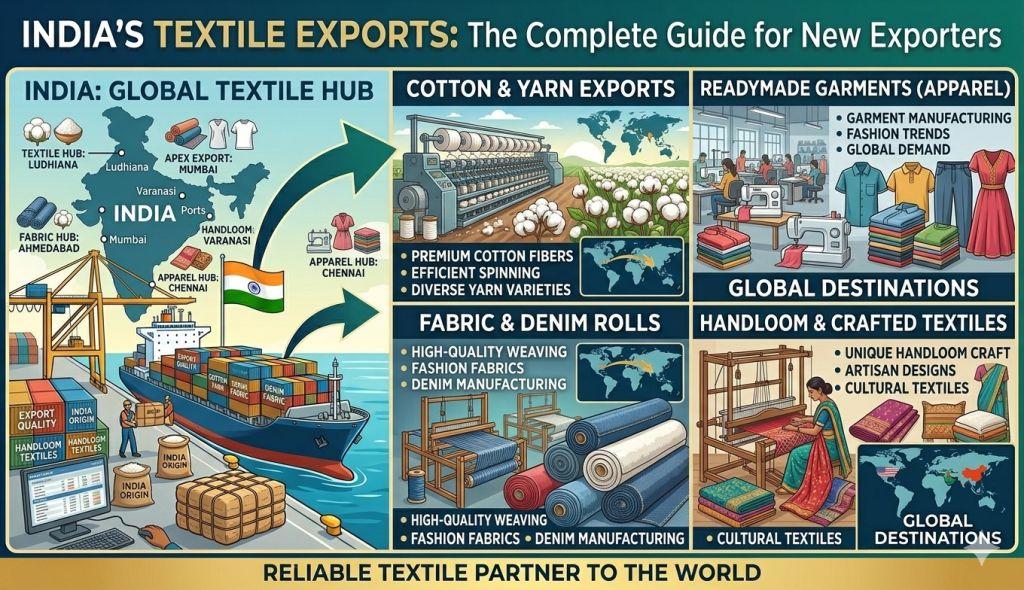
India exported $36.55 billion in textiles and apparel in FY26 - up 2.1% from FY25's $35.14 billion, which itself was up 5% from the year before that. At 5% of India's total merchandise exports, this is not a niche category. It is the country's second-largest export sector, employing 45 million people, covering everything from raw cotton grown in Gujarat to handwoven silk from Varanasi to performance sportswear manufactured in Tirupur.
The government's stated target is $100 billion by 2030. From $36.55 billion today, that requires roughly 18% annual growth - ambitious given the current pace, but the infrastructure being put in place (seven PM MITRA parks, a revised PLI scheme, RoSCTL extended to September 2026, GST rationalised on MMF fibres) suggests the policy direction is serious.
For a new exporter, though, the sector's scale can feel overwhelming. Which product category? Which cluster? Which export promotion council? Which certification does the buyer in Germany actually care about vs. the one that is just nice to have? This guide answers those questions in the order a new exporter actually needs them.
What India Actually Exports: The Product Breakdown
Not all textile export categories are equal in size or accessibility. Here is where FY26 Q1 (April-June 2025) stands:
| Category | FY26 Q1 Value | Share |
|---|---|---|
| Ready-Made Garments (RMG) | $4,193 million | 45% |
| Cotton Textiles (yarn, fabrics, made-ups) | $2,860 million | 30% |
| Man-Made Fibre (MMF) Textiles | $1,167 million | 12% |
| Handloom and Handicrafts | $903 million | ~10% |
| Technical Textiles | Growing segment | ~3% |
For the full year FY26:
- RMG exports grew 2.9% to Rs 1,39,349.6 crore
- Cotton yarn, fabrics, made-ups were broadly stable at Rs 1,02,399.7 crore
- MMF yarn, fabrics and made-ups grew 3.6% to Rs 42,687.8 crore
- Handicrafts (excl. handmade carpets) grew 6.1% - the strongest growth of any segment
ICRA forecasts Indian apparel exporters will see revenue grow 9-11% in FY26 driven by higher volumes, price recovery, and the China+1 sourcing diversification trend.
Ready-Made Garments (RMG)
The largest export category and the most accessible entry point for most new exporters. India produces approximately 22,000 million garment pieces annually. The range covers T-shirts, woven bottoms, dresses, ethnic wear, children's clothing, activewear, workwear, and occasion wear - practically every apparel category.
The US is the single largest buyer of Indian RMG. Bangladesh and Vietnam are the closest competitors. India's differentiation is in the mid-to-premium quality tier - not competing with Bangladesh on $2 T-shirts, but winning on value-added garments where craftsmanship, embellishment, or design complexity matters.
Cotton Textiles
India is the world's largest cotton producer. In FY25, cotton production was 29.42 million bales. The cotton textile export category covers raw cotton, cotton yarn, woven and knitted cotton fabrics, home textiles (bed linen, towels, curtains), and made-up items.
Bangladesh is the dominant buyer of Indian cotton yarn - over 90% of raw cotton exports go there. The US, UK, and EU are the major markets for cotton fabrics and home textiles.
Tirupur in Tamil Nadu processes most of India's cotton knitwear. It is one of the world's most concentrated textile clusters for cotton knitwear export. The Bharat Tex 2025 event - India's largest textile trade fair, held in February 2025 - hosted 5,000+ exhibitors and 1,20,000+ visitors from 120 countries, much of it centered on cotton textile categories.
Man-Made Fibre (MMF) Textiles
India exports $4.85 billion in MMF textiles annually. Polyester Filament Yarns (PFY) dominate at 48% of the category, followed by poly-cotton spun yarn at 10%. The US is the top buyer at 17.3% ($914.9 million), followed by Turkey (6.2%) and UAE (5.9%).
Surat, Gujarat, is the center of India's MMF sector. The city produces the majority of India's synthetic fabrics, polyester yarn, and man-made fibre garments. One important policy change: the 56th GST Council reduced GST on MMF fibres from 18% to 5% and on MMF yarns from 12% to 5% - a significant cost reduction that was creating an inverted duty structure, making Indian MMF less competitive. That structural problem is now largely fixed.
Technical Textiles
This is where India is playing a longer game. Technical textiles - geotextiles, meditech (medical), agrotech, mobiltech (automotive), sportech - are specialty fabrics with functional rather than decorative purposes. The National Technical Textiles Mission targets $10 billion in technical textile exports by 2026. India's mobiltech segment (automotive textiles) is projected to grow from $2.32 billion to $4.57 billion by FY33.
Technical textiles require more capital and R&D than commodity apparel, but the margins and buyer quality are substantially better. The PLI scheme specifically targets MMF apparel and technical textiles as its priority categories - and the GREAT (Grants for Research and Entrepreneurship) scheme supports startups in this space.
Handloom and Handicraft Textiles
India's handloom sector employs approximately 43 lakh weavers. Silk, cotton, and blended handloom products - including Banarasi silk, Kanchipuram sarees, Odisha ikat, Assam muga silk - carry India's strongest heritage story in textiles.
Handloom products attract premium pricing in the EU and US, where buyers value authenticity, artisan sourcing, and cultural narrative. The Handloom Mark (a government certification for genuine handloom products) is the primary credential that distinguishes machine-made from handloom for international buyers.
As of March 2025, 1.8 lakh weavers, artisans, and handloom-related entities are registered on the Government e-Marketplace (GeM) portal - indicating the government is actively integrating this sector into formal export infrastructure.
The Manufacturing Clusters: Where India's Textiles Come From
Understanding which city produces what is not background information. It directly determines which suppliers a new exporter should work with, which trade shows to attend, and which product categories are realistic for a first export business.
Tirupur, Tamil Nadu - India's knitwear capital. T-shirts, polo shirts, activewear, and cotton knits for global volume buyers. Export-oriented by design, with strong port connectivity to Chennai. Tirupur has more OEKO-TEX and GOTS certified facilities per square kilometer than almost any other cluster in India. The baseline quality and compliance infrastructure is already in place. For new exporters in knitwear, starting here reduces the learning curve.
Surat, Gujarat - India's synthetic textile hub. Polyester fabrics, georgettes, chiffons, and MMF-based fashion fabric. Also strong in sarees and ethnic fashion. The GST rationalisation on MMF is expected to make Surat's export competitiveness significantly stronger in FY26 and beyond.
Delhi NCR (Noida, Gurugram, Faridabad) - Fashion garments, woven western wear, denim. Mid-sized exporters serving international fashion brands are concentrated here. Strong in design capability. Delhi NCR is where most merchant exporters (those who source rather than manufacture) operate.
Jaipur, Rajasthan - Hand-block print textiles, ethnic cotton fashion, artisan fabrics. EU buyers - particularly German and French ones - are consistent Jaipur customers. The UNESCO Creative City of Crafts designation for several Rajasthan traditions feeds into international demand.
Ludhiana, Punjab - Knitwear and hosiery. Winter wear, woolens, thermal fabrics. Strong in the Middle East and European markets for cold-weather apparel.
Ahmedabad, Gujarat - Woven fabrics, denim. Arvind Limited and other major fabric manufacturers are based here. Strong on fabric supply, less on finished garment export.
Mumbai / Dharavi, Maharashtra - Denim, casual wear, fashion garments with direct port access. Also a commercial hub connecting manufacturers across Maharashtra to international buyers.
Kolkata, West Bengal - Jute textiles, handloom, value-added wovens. Strong historical relationship with UK and European buyers.
Varanasi, Uttar Pradesh - Silk textiles, Banarasi brocade, handloom luxury fabric. Premium pricing in diaspora and fashion markets globally.
Bengaluru, Karnataka - Technical textiles, performance fabrics, and some premium knitwear. Growing biotech and technical textile R&D presence.
Step-by-Step: How to Start a Textile Export Business in India
This is where most existing guides become vague. Here is the actual sequence:
Step 1: Register Your Business Entity
Before anything else, your business needs a legal structure. Options:
- Proprietorship - simplest, works for very small operations, but limits credibility with larger international buyers
- Limited Liability Partnership (LLP) - good balance of simplicity and credibility for SMEs
- Private Limited Company - most credible to international buyers, required by some export promotion councils for certain membership levels; also required if you plan to raise any external funding
Registration is through the Ministry of Corporate Affairs MCA21 portal.
Step 2: Get Your IEC (Import Export Code)
The IEC is a 10-digit code issued by the Directorate General of Foreign Trade (DGFT). It is mandatory for all exports. Without it, no shipment moves, no foreign payment clears, and no government incentive applies.
Application is entirely online at the DGFT portal. The cost is Rs 500. The IEC code stays with your business permanently and does not need renewal.
→ DGFT Portal - IEC Application
Step 3: Register for GST
GST registration is mandatory for textile businesses with turnover above the threshold. The good news for exporters: textile exports are treated as zero-rated supplies under GST. You either export under a Letter of Undertaking (LUT) bond without paying GST upfront, or you pay and claim a refund through the IGST refund route.
The LUT route is cleaner for working capital management. Apply for your LUT on the GST portal annually before your export season begins.
Step 4: Obtain RCMC from the Relevant Export Promotion Council
The RCMC (Registration Cum Membership Certificate) is what unlocks government export benefits under the Foreign Trade Policy - Market Development Assistance, Interest Equalisation Scheme access, trade fair participation, and others. You must get RCMC from the council relevant to your product category:
AEPC (Apparel Export Promotion Council) - for ready-made garments and apparel. Founded in 1978. Covers all types of garments except woolen knitwear, leather, and jute garments.
- Registered Exporter: basic eligibility, entry fee Rs 1,000 + GST, annual Rs 8,000 + GST
- Member Exporter: requires Rs 1 crore export turnover for three consecutive years → AEPC Registration
TEXPROCIL (Cotton Textiles Export Promotion Council) - for cotton yarn, fabrics, made-ups, home textiles. The council for fabric and yarn exporters rather than garment makers. → TEXPROCIL
SRTEPC (Synthetic and Rayon Textiles Export Promotion Council) - for MMF, polyester, viscose, and blended textiles. → SRTEPC
HEPC (Handloom Export Promotion Council) - for handloom products. → HEPC
EPCH (Export Promotion Council for Handicrafts) - for artisan textiles, embroidered goods, hand-printed scarves, fashion accessories. → EPCH
RCMC applications are online through DGFT's common platform. Documents required: business registration, IEC copy, DSC (Digital Signature Certificate), GST certificate, bank details.
Step 5: Open an Export Bank Account
Designate a bank account as your export account with an Authorised Dealer (AD) bank registered with RBI. All export proceeds must route through this account. This is also where you access pre-shipment and post-shipment export finance, which most new exporters need.
Banks offer Packing Credit in Foreign Currency (PCFC) at lower interest rates for export-oriented working capital. The Interest Equalisation Scheme provides additional interest subvention for MSME exporters at 3% and larger exporters at 2%.
Step 6: Get UDYAM Registration (if MSME)
If your business qualifies as a Micro, Small, or Medium Enterprise under the MSME classification, UDYAM registration unlocks additional benefits: priority lending from PSU banks, preference in government tenders, and access to SIDBI export financing schemes. → UDYAM Portal
Step 7: Register on ICEGATE
ICEGATE is the Indian Customs EDI Gateway - the portal through which all export documentation (shipping bills, electronic duty drawback claims) is filed. Your IEC links directly to your ICEGATE profile. → ICEGATE
Certifications: What Buyers in the US, EU, and UK Actually Require
This is the section where most export guides give you a generic list and move on. The reality is more specific - different buyers in different markets require different certifications, and getting this wrong wastes time and money.
OEKO-TEX Standard 100
Tests textiles for harmful substances - pesticide residues, heavy metals, formaldehyde, allergenic dyes. Required by virtually all European retail buyers and increasingly by US ones. Issued by the OEKO-TEX Association. Certification is per product category, not per company. Test cost: roughly Rs 25,000-50,000 per product per lab test. Annual renewal.
Who requires it: German and French retailers (DM, Rewe, E.Leclerc), UK supermarket buyers (M&S, John Lewis), US organic and natural retailers. Any buyer whose in-house ESG policy references textile safety.
GOTS (Global Organic Textile Standard)
Required for products marketed as "organic." Covers the entire supply chain - organic fiber, dyeing, finishing - and requires third-party certification at each stage. If you are exporting cotton textiles with an organic claim, GOTS is not optional. Trying to sell organic cotton fabric without GOTS certification in the EU or US will create legal liability for both you and the buyer.
India produces roughly 51% of global organic cotton. Getting GOTS certification for an Indian cotton textile operation is genuinely achievable. The cost and complexity are higher than OEKO-TEX but manageable for operations with a proper quality system in place. → GOTS Certification
BCI (Better Cotton Initiative)
Not a certification in the strict sense - it is a supply chain membership program. Major international buyers (H&M, Zara, IKEA, Gap, Walmart) require their cotton suppliers to be BCI members or to source BCI-certified cotton. If you are targeting these brands for cotton products, understanding BCI and whether your cotton supply chain qualifies is worth doing early.
WRAP (Worldwide Responsible Accredited Production)
Social compliance certification covering factory labor practices, wages, health and safety. More common as a requirement from US buyers than EU ones. Reputable factories in Tirupur and Delhi NCR hold WRAP alongside OEKO-TEX as a standard package.
SEDEX / SMETA Audit
Social audit program widely used by UK and European retailers. SMETA (Sedex Members Ethical Trade Audit) is the audit framework. Major UK supermarkets and retailers require SEDEX registration from their suppliers. For new exporters targeting the UK specifically, getting a SMETA audit done on your manufacturing facility before approaching buyers is a significant credibility step.
ISO 9001:2015
Quality management system standard. Not textile-specific, but many large international buyers run it as a baseline vendor qualification check alongside textile-specific certifications. Medium and large Indian exporters generally hold ISO 9001.
Handloom Mark
Government of India certification confirming a product is genuinely handloom-made. Required if marketing products as handloom to premium buyers in the EU and US. Issued by the Handloom Export Promotion Council.
Kasturi Cotton Bharat
India's new premium cotton branding program - launched in 2024, built on three pillars: certification, traceability, and branding. Uses blockchain-based QR-coded bales (the BITS system) to verify Indian cotton origin and quality. This is not yet a universal buyer requirement, but it is the government's strategic initiative to position Indian cotton as a premium globally-recognized brand. Exporters who adopt Kasturi Cotton now will have a story to tell buyers who are increasingly focused on traceable, origin-verified cotton.
Government Schemes New Exporters Should Know
The policy ecosystem for textile exporters has more useful schemes than most new exporters realize. Here are the ones that actually affect your P&L:
RoSCTL - Extended to September 2026
The Rebate of State and Central Taxes and Levies scheme provides rebates on state and central taxes that are not reimbursed under GST - fuel VAT, electricity cess, mandi taxes on cotton, stamp duties. The rebate is typically 5.5-7% of FOB value depending on product category, paid via duty credit scrips.
This is real money. A new exporter doing Rs 5 crore of annual RMG exports would receive Rs 27-35 lakh annually under RoSCTL. The scheme was extended to September 2026 - which gives exporters an 18-month planning window. → RoSCTL Processing
RoDTEP - Remission of Duties and Taxes on Exported Products
Broader scheme covering products not under RoSCTL. For textile products that do not qualify under RoSCTL (some fabric categories), RoDTEP provides the equivalent tax rebate mechanism.
Interest Equalisation Scheme
Provides interest subvention on pre- and post-shipment export credit - 3% for MSME exporters, 2% for others. In real terms: if your bank charges 12% on export packing credit, you effectively pay 9% as an MSME. This is meaningful for working capital management.
EPCG Scheme (Export Promotion Capital Goods)
Allows duty-free import of capital goods (machinery, equipment) used in export production. Obligation: export goods worth six times the duty saved within six years. For textile manufacturers investing in new looms, stitching machines, or quality testing equipment, EPCG reduces the capital cost significantly.
PLI Scheme for Textiles (revised)
The original PLI scheme for textiles faced criticism for high entry thresholds. The revised version (announced in late 2024, operative from 2025):
- Expanded eligible product categories
- Removed requirement to set up new companies (existing businesses can now apply)
- Reduced minimum investment thresholds
- Cut incremental turnover target from 25% to 10%
The PLI targets MMF apparel, MMF fabrics, and technical textiles specifically. Incentives of up to 15% on incremental sales for five years. Applications are open on a rolling basis. → PLI Textiles Portal
PM MITRA Parks
Seven mega textile parks across Tamil Nadu (Virudhnagar), Telangana (Warangal), Gujarat (Navsari), Karnataka (Kalaburagi), Madhya Pradesh (Dhar), Uttar Pradesh (Lucknow), and Maharashtra (Amravati). Each covers 1,000+ acres with plug-and-play infrastructure: spinning, weaving, dyeing, printing, garmenting, testing - all in one location.
For new exporters considering establishing manufacturing, locating within or near a PM MITRA park provides infrastructure cost advantages and access to shared facilities. The Competitive Incentive Support (CIS) within PM MITRA parks provides up to 3% of sales turnover for early-moving manufacturing units - additional to PLI benefits. → PM MITRA Information via AEPC
SAMARTH Scheme
Government skilling program for textile workers. Extended to FY26 with Rs 495 crore budget. As of July 2025, 4.57 lakh beneficiaries trained, 3.55 lakh placed, 88% of them women. If you are building a manufacturing operation in a Tier 2 or 3 city and need a trained workforce, SAMARTH-connected training centers are worth engaging.
Who Buys Indian Textiles - The Destination Markets
United States - Largest Market
The US takes approximately 27% of India's total textile and apparel exports. For cotton fabrics, it is 29% of the export total. For MMF textiles, 17.3%.
Indian textile exporters to the US in 2025 navigated a difficult tariff environment. The Trump administration imposed broad tariffs, but apparel was partially protected relative to other categories. The India-US interim trade framework announced in February 2026 is expected to provide clearer duty structures as negotiations continue. ICRA expects Indian apparel exporters' revenue to grow 9-11% in FY26 partly because US buyers pre-stocked during tariff uncertainty.
US buyers require: OEKO-TEX (often), GOTS (for organic claims), WRAP (for social compliance), CPSC compliance for children's garments, accurate fiber content labeling per FTC Textile Products Identification Act.
European Union - Germany, Netherlands, France, Italy, Spain
The EU is India's second-largest market for textiles. Germany alone took Rs 5,890 crore in Indian textile exports in FY25. The EU's Carbon Border Adjustment Mechanism (CBAM) comes into full effect in 2026 - Indian textile manufacturers using renewable energy and clean processes will have a cost advantage over competitors who do not.
EU buyers are more focused on sustainability credentials than US buyers. GOTS, OEKO-TEX, and increasingly, REACH compliance for chemical substances in textiles, are standard requirements. SMETA audit or equivalent social audit is expected.
UAE - Hub and Consumer Market
The UAE functions both as a consumer market (large South Asian expat population drives apparel demand) and as a re-export hub for the GCC. The India-UAE CEPA gives Indian textile exporters preferential tariff access. RMG exports to the UAE showed strong growth in FY26.
UAE buyers want quality presentation, consistent supply, and are more flexible on documentation than EU buyers. Good market for initial export steps before tackling the stricter EU.
Bangladesh - Cotton Yarn and Fabric Buyer
Bangladesh is a massive buyer of Indian cotton yarn and raw cotton (to process into its own garments for export). This is a pure B2B commodity trade — not brand-to-retailer. For Indian yarn and fabric manufacturers, Bangladesh is one of the largest accessible markets with short shipping distance and cultural familiarity.
UK - Post-FTA Opportunity
India-UK FTA recently signed. The UK previously maintained 12% tariff on Indian garments. Under the FTA, this reduces to 0% over an implementation period. For Indian apparel exporters, the UK is a meaningful opportunity that was previously handicapped by this tariff asymmetry (Bangladesh and some other LDC countries had 0% access). UK buyers require: SMETA or equivalent, GOTS for organic claims, UKCA (replacing CE) for certain textile accessories.
Africa - Growing, Underserved, Underestimated
Most textile export guides ignore Africa. They should not.
Kenya, Nigeria, Ethiopia, Ghana, and Egypt are growing markets for Indian cotton fabrics, apparel, and home textiles. African governments' African Continental Free Trade Area (AfCFTA) implementation is integrating markets in ways that make pan-African distribution more feasible. Indian textile products - particularly value-for-money cotton fabric and readymade garments - are competitive in African markets where European product is too expensive and Chinese product faces perception issues in some segments.
The China+1 Factor - Why New Exporters Have a Tailwind
Major global brands - H&M, Zara, Walmart, Gap, Target - are publicly committed to reducing China sourcing concentration. This is both for geopolitical risk management and for supply chain resilience (the COVID-era disruptions affected China-concentrated supply chains more severely). India is the primary beneficiary of this diversification.
ICRA explicitly cites the China+1 strategy as one driver of the projected 9-11% revenue growth for Indian apparel exporters in FY26. Foreign investment in Indian textile manufacturing rose 45% in 2025, led by firms from Vietnam, South Korea, and Taiwan that are building dual-country production to serve Western buyers looking for China alternatives.
For a new exporter, this means large brands are actively looking for credible Indian suppliers - not just theoretically open to it. The work is to meet the compliance and quality bar those brands set.
How to Find International Buyers
Trade fairs — the most effective channel:
- India International Garment Fair (IIGF, Delhi NCR, twice yearly - AEPC organized) — the primary India trade fair for garment and apparel buyers
- Bharat Tex (New Delhi, biennial) - India's mega textile trade fair; 5,000+ exhibitors, 120+ countries at the February 2025 edition
- Texworld Paris (twice yearly) - major international sourcing fair where Indian textile exhibitors target EU buyers
- MAGIC Las Vegas - US market entry for apparel
- Munich Fabric Start - EU fabric sourcing show; Indian fabric manufacturers exhibit here
- Première Vision Paris - premium fabric trade fair where high-end Indian silk and specialty fabric exporters participate
B2B platforms: Navi Exports lists verified Indian textile and apparel exporters across all categories. Browse the Apparel & Accessories category and Textile Products & Fabric category to connect with credentialed exporters.
AEPC and TEXPROCIL buyer-seller meets: Both councils organize international buyer-seller meets specifically connecting Indian exporters with pre-qualified international buyers. These events are underused by new exporters and are worth attending — the buyers in the room are there specifically for Indian product.
Amazon Global Selling: For finished garments and home textiles, Amazon's Global Selling program is a viable channel for smaller exporters who cannot immediately qualify for large B2B orders. It has lower MOQ requirements than traditional wholesale and provides data on which Indian textile products have proven demand in specific markets.
What Competitor Guides Miss
The competitor landscape for this keyword has three consistent blind spots:
They skip the GST rationalisation impact on MMF. The 56th GST Council's decision to cut MMF fibre GST from 18% to 5% and MMF yarn from 12% to 5% directly changes the cost competitiveness of Surat's textile sector for exporters. Guides that do not mention this are working from outdated cost models.
They treat RoSCTL as optional background information. RoSCTL at 5.5-7% of FOB value is potentially one of the largest line items improving exporter margins. For a new exporter trying to price competitively while maintaining margin, understanding and claiming RoSCTL is not optional. It is the difference between a competitive FOB price and an uncompetitive one.
They do not mention the PLI revision that removed the hardships. The original PLI scheme had thresholds that excluded most small and medium manufacturers. The revised scheme = with lower investment thresholds, removal of the new-company requirement, and reduced incremental turnover targets = opens the PLI to a much broader exporter base. New exporters reading guides written before the revision are missing a changed policy reality.
Pre-Export Checklist for New Textile Exporters
Before approaching your first international buyer:
- Business entity registered (Pvt Ltd or LLP recommended)
- IEC from DGFT - issued and current
- GST registration - in place; LUT bond applied for before first export
- UDYAM registration - if qualifying as MSME
- RCMC from the appropriate EPC (AEPC / TEXPROCIL / SRTEPC / HEPC / EPCH depending on product)
- ICEGATE registration - for customs filing
- AD bank account designated for export proceeds
- OEKO-TEX Standard 100 - for your main product categories (if targeting EU/US)
- GOTS - if making any organic fiber claim in your product marketing
- WRAP or SMETA audit booked - if targeting US or UK retail buyers
- HS code confirmed for your product - textile HS codes span chapters 50-63; getting this right before your first shipment avoids duty overpayment and customs delay
- Sample production runs completed - no serious international buyer will place an order without physical samples
Related Navi Exports Categories
- Apparel & Accessories Exporters
- Textile Products & Fabric Exporters
- Yarn, Threads & Fiber Exporters
- Fashion Accessories
- Leather & Leather Products
- Gifts, Crafts & Home Decor
India's textile export sector posted 2.1% growth in FY26 in a year when global trade was disrupted by tariff volatility, geopolitical turbulence in West Asia, and continued Bangladesh competition. That resilience reflects structural depth: the India-UAE CEPA opened new markets, the RoSCTL extension gave exporters planning certainty, the GST rationalisation on MMF cut embedded costs, and the China+1 trend generated genuine order diversification toward Indian suppliers.
For new exporters, the sector is not easy - it never has been. The compliance expectations from US and EU buyers have risen, not fallen. The competition from Bangladesh on commodity garments is real. Lead times, working capital requirements, and quality consistency are ongoing operational challenges.
But the policy ecosystem has genuinely improved. The PLI revision made incentives accessible to smaller operations. RoSCTL at 5.5-7% of FOB is real margin support. Seven PM MITRA parks are under construction, building the integrated infrastructure that cuts per-unit logistics costs. And major global brands are actively looking for credible India suppliers as part of China diversification - which means the buyer intent is there. The question is whether the exporter infrastructure (compliance, quality systems, documentation) is in place to meet it.
Getting registered, certified, and connected to verified buyers is the work that precedes everything else. That is what this guide is designed to help with.
→ Browse verified Indian textile exporters on Navi Exports
→ New to export paperwork? this covers everything you need before your first shipment
Data sources: IBEF Textile and Apparel Industry Report (February 2026), Ministry of Textiles Year-End Review 2025 (PIB India), Ministry of Textiles FY26 textile export announcement (April 22, 2026, Blitz India Media), ICRA Apparel Exporter Revenue Forecast, SRTEPC MMF Textile Export Data FY25, Edunovations RoSCTL Extension Report, AEPC PM MITRA documentation, PLI Textiles Portal (pli.texmin.gov.in), DGFT IEC Registration data, Kasturi Cotton Bharat programme documentation.
Frequently Asked Questions
India's textile and apparel exports (including handicrafts) reached $36.55 billion in FY2025-26, up 2.1% from FY25's $35.14 billion. RMG (ready-made garments) is the largest segment at 45% of total exports. The government's target is $100 billion in textile exports by 2030.
The practical sequence: register your business entity (Pvt Ltd or LLP), obtain an IEC from DGFT (Rs 500, entirely online, 5-7 days), register for GST, get RCMC from the relevant export promotion council (AEPC for garments, TEXPROCIL for cotton textiles, SRTEPC for MMF), designate an AD bank account, register on ICEGATE, get product certifications required by your target market (OEKO-TEX, GOTS), and register on UDYAM if qualifying as MSME.
It depends on the product and destination market. For EU buyers: OEKO-TEX Standard 100 (chemical safety), GOTS (organic fiber claims), SMETA audit (social compliance). For US buyers: OEKO-TEX, WRAP (social compliance), CPSC compliance for children's garments. For organic claims anywhere: GOTS is mandatory. The Handloom Mark is required for handloom products. RCMC from the relevant export promotion council is required for accessing government export incentives.
RoSCTL (Rebate of State and Central Taxes and Levies) refunds embedded state and central taxes that are not reimbursed under GST - fuel VAT, electricity cess, mandi taxes, stamp duties. The rebate is typically 5.5-7% of FOB value, paid as duty credit scrips. It has been extended until September 2026. For a new exporter, RoSCTL can meaningfully improve export margin or allow more competitive FOB pricing.
It depends on the product category: Tamil Nadu (Tirupur for knitwear), Gujarat (Surat for MMF/synthetic textiles, Ahmedabad for woven fabrics and denim), Delhi NCR (fashion garments and western wear), Rajasthan (Jaipur for hand-block print and artisan textiles), Punjab (Ludhiana for knitwear and woolens), Uttar Pradesh (Varanasi for silk, Noida/Kanpur for garments and leather), West Bengal (Kolkata for handloom and jute).
Major global brands - H&M, Zara, Walmart, Gap - are actively reducing their sourcing concentration in China for geopolitical risk management and supply chain resilience. India is the primary alternative beneficiary. ICRA cites China+1 as a driver of the projected 9-11% revenue growth for Indian apparel exporters in FY26. Foreign investment in Indian textile manufacturing rose 45% in 2025. New exporters who can meet compliance standards (OEKO-TEX, GOTS, social audit) are positioned to capture some of this order flow.