-
-
-
Ayurvedic Beauty Products Export: How India Is Winning Global Shelves
 Tue, 14 Apr 2026
Ayurvedic Beauty Products Export: How India Is Winning Global Shelves


In March 2026, Estee Lauder announced it was buying full ownership of Forest Essentials - an Indian ayurvedic skincare brand founded in New Delhi in 2000. They had first invested as a minority shareholder back in 2008. After 18 years, they decided to buy the whole thing.
That is not a small signal. Estée Lauder owns La Mer, MAC, and Clinique. When they write a check for an Indian herbal brand - a real one, not a licensing deal - the global beauty industry pays attention.
They were not alone. L'Oreal put € 326 million into a beauty-tech hub in Hyderabad. Spanish luxury house Puig had already acquired a majority stake in Kama Ayurveda. IndeWild, another India-based brand built around Ayurvedic actives, launched at Sephora in the US in early 2026.
If you are an Indian exporter of ayurvedic beauty products trying to find international buyers, this is the context you are operating in. The world is not just curious about Indian herbal beauty anymore. It is acquiring it.
The Numbers Behind the Trend
India's AYUSH and herbal exports reached $688.89 million in FY2024–25, up 6.11% from $649.2 million the year before. That covers the full AYUSH export category - but beauty, skincare, and personal care are its fastest-growing segment.
The global picture:
- The global ayurvedic beauty market was valued at $12.4 billion in 2024 and is projected to reach $32.7 billion by 2033, growing at an 11.4% CAGR
- India's domestic ayurvedic beauty products market alone reached $3.2 billion in 2025, expected to hit $8.5 billion by 2032 at a 14.98% CAGR
- The ayurvedic skincare segment in India sat at $1.8 billion in 2024, projected to reach $5.4 billion by 2033 at a 13% CAGR
- India's total beauty and personal care market was $28 billion in 2024, with forecasts past $48 billion by 2033
- Europe is the fastest-growing export region for ayurvedic beauty, projected at 13.2% CAGR through 2033 - faster than Asia-Pacific
(Sources: Vyansa Intelligence, IMARC Group, MarketIntelo, Ministry of Commerce & Industry / PIB India)
The acquisitions are the confirmation. The numbers are the context.
Why Global Buyers Want Indian Ayurvedic Beauty Right Now
The Clean Beauty Shift Hit a Ceiling - And Opened a Door
For about a decade, "clean beauty" meant removing bad stuff. No parabens. No sulfates. No synthetic fragrance. Consumers in the US, UK, and Germany got very good at reading labels and rejecting ingredients they did not recognize.
The problem is that "clean" is now crowded. Every mid-range brand has a botanical serum. "Natural" has become meaningless as a claim because everyone uses it. A $30 drugstore moisturizer calls itself clean. So does a $200 luxury serum. The consumer who actually cares has stopped finding the label useful.
What that consumer is now looking for is specificity. A product with a real reason to exist - a tradition, a source, a knowledge system behind it. Not "contains aloe vera." Kumkumadi tailam, formulated from 26 herbs according to Ashtanga Hridayam, pressed with sesame oil for 30 days. That is a story. No European or American brand can manufacture that.
India is the only country with this. The biodiversity, the classical texts, the practitioner lineages, the raw material supply chains - it is not something that can be copied. Korean beauty is excellent. French pharmacy skincare is excellent. Neither of them has 5,000 years of documented botanical formulation science.
Premium Buyers Are Paying More, Not Less, for Indian Products
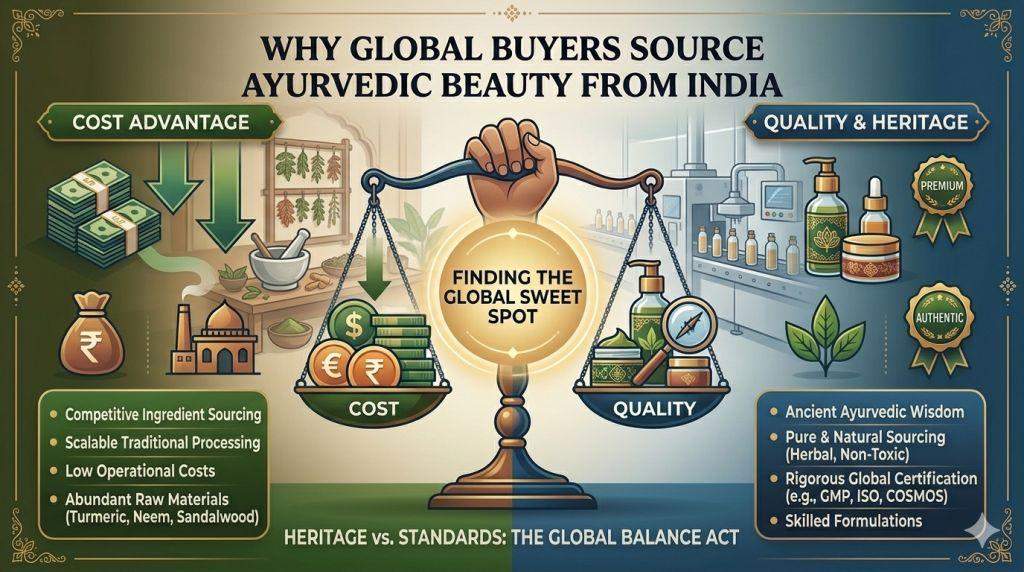
The data on this is worth sitting with. US retail pricing for "Made in India" beauty products - particularly in the premium segment - is running lower than comparable "Made in China" products but significantly higher than products from Bangladesh or Vietnam. That is a specific pricing position: India is not competing on price, it is competing on quality differentiation.
Forest Essentials retails alongside Aesop and Tata Harper, not alongside mass-market natural brands. Kama Ayurveda is in Heathrow duty-free. IndēWild got Sephora US placement in 2026.
The pricing confirms what the acquisitions confirm: Indian ayurvedic beauty is not a budget category. It is a premium category for buyers who want something they cannot get from anyone else.
The Diaspora Opens Doors. The Mainstream Walks Through Them.
Indian ayurvedic beauty tends to enter foreign markets through the diaspora. The Indian communities in the US, UK, UAE, Canada, and Australia know these products. They trust them. They are willing to pay. They bring products to the attention of non-Indian friends, introduce them to local retailers, and create the initial commercial base that makes the category visible.
What has changed in the last five years is the second step: mainstream consumers are following. Forest Essentials ships to over 100 countries. Kama Ayurveda opened in international markets. IndeWild's Sephora entry was explicitly attributed to increased demand from non-South-Asian consumers. The diaspora opened the channel; the channel is now much broader than the diaspora.
What Global Buyers Are Actually Sourcing
Not everything in the ayurvedic beauty category travels equally well. Here is what actually moves, based on export data and buyer signals:
Face and body oils - Kumkumadi, nalpamaradi, rose and sandalwood variants. These are the highest-margin products in ayurvedic export. The UAE and US are the largest buyers. Shelf life, packaging, and stability documentation are what differentiate serious exporters from small-scale producers here.
Hair oils and scalp treatments - Bhringraj, neem, brahmi, amla. Indian hair oil broke into mainstream Western beauty in a major way. Fable & Mane, founded by Indian siblings in the UK, built a $100M+ brand almost entirely on this premise. The category is large and still growing.
Face masks and ubtans - Traditional formulations with turmeric, rose, and chickpea flour. These have strong demand in EU natural beauty retail: organic pharmacies, bio stores, and specialty wellness shops in Germany and France. They travel well, shelf life is manageable, and the formulations are not easy to replicate with synthetic alternatives.
Essential oils - Rose otto, sandalwood, vetiver, patchouli. India exports significant volumes to aromatherapy markets in Germany, France, Japan, and the US. This is a commodity-adjacent category where certification and traceability matter more than branding.
Herbal serums and hybrid formats - The fastest-growing subcategory internationally. The formula is Ayurvedic actives in modern delivery formats: bakuchiol (a plant-based retinol alternative from babchi) in a serum base, ashwagandha adaptogens in a moisturizer, saffron extract with hyaluronic acid. These products get premium retail placement in markets where pure-traditional formats have not broken through.
Ayurvedic soaps and cleansers - High volume, lower price point. Strong demand in the Middle East and Southeast Asia. This is the entry-level export category for smaller manufacturers getting their first international orders.
Top Markets and What Each One Actually Wants
United Arab Emirates - The single largest importer of Indian ayurvedic products by volume, taking 65% of shipments in the most recent 12-month period per Volza export data. Demand comes from the large South Asian diaspora, the region's wellness and hospitality industry (Dubai's hotel and spa sector is substantial), and the UAE's role as a re-export hub for the GCC. Buyers here want consistent supply, premium presentation - glass packaging, not plastic - and GMP documentation.
United States - The highest-value target for brand-led exporters. US buyers want FDA-compliant labelling, proper INCI ingredient listing, cruelty-free certification if claimed, and stable supply. Getting into specialty natural retail (Whole Foods, Erewhon, independent organic beauty shops) requires solid documentation and usually a US-based responsible party. The diaspora market alone generates hundreds of millions of dollars annually - and mainstream is growing faster.
Germany and EU - Europe's fastest-growing region for ayurvedic beauty. German and French consumers read labels carefully and respond to evidence-based claims. The EU Cosmetics Regulation (EC 1223/2009) requires a full ingredient safety assessment and CPNP notification - this is where many Indian exporters fall short, and where better-prepared ones have a clear opening. The organic beauty retail channel (Alnatura in Germany, Naturalia in France, organic pharmacies across the bloc) is highly receptive to authentic Indian herbal brands with proper paperwork.
United Kingdom - Strong diaspora base with fast mainstream crossover. Requires CPSR (Cosmetic Product Safety Report), a UK Responsible Person post-Brexit, and SCPN portal notification. Holland & Barrett actively stocks Indian herbal and ayurvedic products. Kama Ayurveda has Heathrow duty-free placement, which signals the category's premium credibility in this market.
Japan - Small volume, high value, demanding on quality. Japanese buyers need precise formulations, stability testing data, and comprehensive allergen declarations. Entry takes patience. But the Japanese consumer's appetite for wellness-adjacent premium beauty is real, and Indian botanical ingredients - particularly sandalwood, rose, and turmeric-based formulations - have a documented following.
Australia and Canada - Mid-tier volume, strong growth, diaspora-driven with mainstream following. Australia requires ARTG listing for any therapeutic claims. Canada requires bilingual (English/French) labelling. Both markets have well-developed natural beauty retail sectors that are actively looking for differentiated sourcing.
The Competitor Gaps: What Other Articles Are Not Telling You
Most content on ayurvedic beauty export covers the basics - which certifications to get, how to register. What is missing from the conversation is the strategic picture. Here is what the data actually shows:
India is dramatically underpowered in EU herbal cosmetic retail. Europe is the fastest-growing export region at 13.2% CAGR, but very few Indian ayurvedic brands have formal distribution in Germany, France, or the Netherlands. The EU buyer is looking - pharmacies, organic food stores, wellness chains - and not finding enough credible Indian suppliers with proper CPNP documentation. This is a structural gap that exporters with good compliance can fill right now.
The men's segment is nearly untouched. India's domestic ayurvedic personal care market is 65% women. Globally, male grooming is shifting towards chemical-free. Indian beard oils, ashwagandha-based face washes, neem aftershave balms - practically no export-oriented ayurvedic brand has properly entered this space. The shelf space exists, particularly in the US and UK premium grooming market. The formulations already exist. The bridge has not been built.
Hybrid products are outperforming pure-traditional in international retail. The brands getting mainstream shelf placement internationally are not the ones selling pure classical Ayurveda - they are the ones combining traditional actives with modern cosmetic delivery. Bakuchiol with squalane. Ashwagandha in a lightweight serum. Turmeric with vitamin C at a stable pH. Indian exporters who frame their products as "ancient science, modern format" are getting placements that strict traditionalists cannot.
Private label is a large opportunity that is under-served. Hundreds of Western "natural beauty" brands want to source formulations from India and white-label them. They want GMP-certified facilities, INCI documentation, batch consistency, and the ability to do small initial runs. Most Indian ayurvedic manufacturers are set up for large domestic orders, not export-format private label. The few who are set up for this are doing well. Most of the demand is going unmet.
Government Support for Ayurvedic Beauty Exporters
The AYUSH infrastructure for export is more developed than most people realize. Here is what exists:
WHO-GMP Certification (Schedule T compliance) - Mandatory for all AYUSH manufacturers. This is what international buyers ask for first. A GMP certificate issued by the DCGI confirms your facility meets World Health Organization manufacturing standards. Missing this is the most common reason Indian ayurvedic products get rejected at customs.
AYUSH Premium Mark - Voluntary certification from the Quality Council of India, confirming products meet international quality benchmarks. Only eight companies hold it as of writing, which means the mark carries real weight with informed buyers. The Premium Mark plus GMP together are the combination that opens premium retail doors.
Ayush Quality Mark (launched December 2025) - Formally launched at the Second WHO Summit on Traditional Medicine, this mark provides an internationally-aligned quality assurance framework. It is still new, but international buyers are beginning to recognize it.
WHO Global Centre for Traditional Medicine, Gujarat - India is hosting this globally. The institutional credentialing it provides will become increasingly relevant as the EU and US tighten regulations around botanical claims.
Free Trade Agreement benefits - India-UAE CEPA and India-Oman CEPA include recognition of traditional medicine. The India-EU and India-UK FTAs (recently signed) reduce tariff barriers in India's two largest export markets. India-New Zealand FTA similarly includes traditional medicine provisions.
Ministry of AYUSH Budget 2025-26 - ₹3,992.90 crore allocated, up from ₹3,497.64 crore the previous year. Export promotion receives a dedicated portion.
Key links: → Ministry of AYUSH - Official Site → AYUSH Export Promotion → Invest India — AYUSH Sector → DGFT — IEC Registration → Quality Council of India — AYUSH Mark
What You Actually Need Before Your First Export Shipment
Baseline documents (all markets):
- Import Export Code (IEC) from DGFT - without this nothing moves
- AYUSH Manufacturing License under the Drugs and Cosmetics Act, 1940
- GMP Certificate (Schedule T) - mandatory and checked at most borders
- Certificate of Free Sale from your State Licensing Authority
- Certificate of Analysis per batch: heavy metals, pesticide residues, microbial counts
- INCI ingredient list in the format the destination market requires
US-specific:
- FDA registration for your facility
- INCI-compliant labelling per 21 CFR Part 701
- Cruelty-free certification if you are making that claim (PETA, Leaping Bunny)
EU-specific:
- EU Responsible Person (a company or individual based in the EU who takes regulatory responsibility)
- CPNP notification through the EU Cosmetics Notification Portal
- Full Cosmetic Product Safety Report from an approved assessor
- Compliance with EU Cosmetics Regulation EC 1223/2009
UK-specific (post-Brexit, separate from EU):
- UK Responsible Person
- Separate SCPN portal notification
- CPSR under UK regulation
Japan:
- Pre-notification through Ministry of Health, Labour and Welfare
- Stability testing data
- Full allergen declaration
One thing most export guides skip: for ayurvedic beauty and skincare products, destination countries generally regulate them as cosmetics, not drugs - which means faster and cheaper compliance pathways. But the labelling has to be careful. Any claim that sounds therapeutic ("treats eczema," "reduces inflammation," "heals wounds") can trigger reclassification as a drug or supplement, which means pharmaceutical-level approval processes. Keep the copy focused on beauty outcomes. Leave the clinical language out.
Two Paths to Global Market - Which One Fits You
There are two real routes for Indian ayurvedic beauty exporters.
Brand-led export means building your own brand story and taking it to foreign markets - like Forest Essentials or Kama Ayurveda did. It takes years and capital. The payoff is defensible brand equity and pricing power. Estee Lauder's 18-year investment in Forest Essentials is the extreme example of what this path looks like at the top end.
Ingredient and formulation supply means selling bulk ayurvedic actives, base formulations, or finished private-label products to international brands. Ashwagandha extract, bakuchiol oil, neem powder, turmeric CO2 extract - India dominates the global supply of these. Many Western "clean beauty" brands are sourcing Indian botanicals already; they just do not call it Ayurveda on the label.
The formulation supply route is faster to revenue. The brand route is more defensible long-term. Neither is wrong. What is wrong is trying to do the brand route without the documentation infrastructure, or the formulation route without batch consistency and proper testing.
For exporters on Navi Exports, the honest question is: are you selling a product or a story? Products need rock-solid certification. Stories need that plus a pitch that survives five minutes with a buyer in Hamburg or Los Angeles.
How to Connect With International Buyers
B2B verified platforms - Navi Exports lists certified Indian beauty exporters across product categories. Browse the Beauty & Body Fitness Products section to connect with active, credentialed exporters.
Trade shows worth attending:
- Vivaness (Nuremberg, Germany) - the main natural cosmetics trade fair in the EU
- Cosmoprof (Bologna; also Las Vegas and Hong Kong) - mainstream beauty, large buyer attendance
- Natural Products Expo West (Anaheim, US) - strong channel for herbal and wellness beauty
AYUSH Buyer-Seller Meets - The Ministry runs international BSMs specifically for AYUSH products in target markets. These are genuinely underused by smaller exporters. The buyers in the room are there specifically for Indian products.
Amazon Global Selling - Direct DTC export without needing a distributor. For smaller initial orders and market testing, it is often the fastest path to first revenue. The US, UAE, UK, and Japan storefronts all have established Indian herbal beauty demand.
Specialist distributors - In the US and EU, a specialist natural beauty distributor (rather than cold-approaching retailers directly) is usually the faster path to retail placement. Look for distributors who already carry Indian or Asian natural beauty lines - they have existing retailer relationships in the category.
Pre-Shipment Checklist
Before your first export batch ships, confirm:
- IEC issued and current
- AYUSH Manufacturing License covering your specific product category
- GMP Certificate (Schedule T) current - check the expiry date
- Certificate of Free Sale from State Licensing Authority
- CoA completed for this batch: heavy metals, pesticide screen, microbial count
- INCI ingredient list finalized for destination market format
- Packaging reviewed for destination country label compliance (claims, language, warnings)
- HS code confirmed - 3304 for beauty/skincare preparations, 3305 for hair products; wrong codes cause customs delays and overpayments
- Freight forwarder briefed on product category and destination regulations
Related Navi Exports Categories
For buyers and exporters in adjacent categories:
- Beauty & Body Fitness Products Exporters
- Agriculture & Food - Herbs, Botanicals, and Spices
- Gifts, Crafts & Home Decor - Wellness and Artisan Products
- Packaging & Packing Materials
- Fashion Accessories
- Textile Products & Fabric
Where This Is All Going
Estee Lauder spent 18 years as a minority investor in Forest Essentials before deciding to buy it outright. That tells you something about how global beauty majors view Indian ayurvedic brands: not as trends to exploit quickly, but as assets worth holding.
For Indian exporters, that is useful context. The demand is real. The acquisitions, the shelf placements, the EU growth numbers, the US Sephora launches - they all point the same direction. But the exporters who will capture that demand are not the ones who just have good products. They are the ones who show up with complete documentation, consistent batches, packaging that speaks to the destination market, and a product story that does not fall apart in a buying meeting.
India has everything required: the raw material base, the knowledge systems, the manufacturing scale, and increasingly the government infrastructure to back it up. The question is whether individual exporters are organized enough to meet the buyer where they are.
→ Browse verified Indian ayurvedic beauty exporters on Navi Exports
Frequently Asked Questions
Face and body oils (Kumkumadi, nalpamaradi, rose and sandalwood variants), hair oils, herbal serums, ubtans and face masks, and essential oils are the top export categories. In the US and EU premium segment, hybrid formats - bakuchiol serums, ashwagandha adaptogens, turmeric-vitamin C formulations - are growing faster than traditional formats because they fit existing retail formats.
The UAE leads by volume - 65% of shipments per Volza's July 2024 to June 2025 data - followed by the United States at 11% and Bahrain at 7%. For premium brand placement and long-term brand building, the UK, Germany, Japan, Australia, and Canada are the key target markets.
You need an IEC from DGFT, an AYUSH Manufacturing License, GMP certification under Schedule T of the Drugs and Cosmetics Act, and a Certificate of Free Sale. US exports additionally require FDA-compliant labelling. EU exports require CPNP notification and an EU Responsible Person. The AYUSH Premium Mark is voluntary but signals quality to international buyers who know to look for it.
Most destination markets - the US, EU, and UK - regulate ayurvedic beauty products as cosmetics rather than drugs. This makes compliance faster and cheaper than pharmaceutical export pathways. The exception: any product that makes therapeutic claims ("treats," "heals," "cures") can be reclassified as a drug, which triggers a much harder approval process. Keep your labelling focused on beauty and cosmetic benefits.
$12.4 billion in 2024, projected to reach $32.7 billion by 2033 at an 11.4% CAGR. India dominates production and export. The domestic Indian market alone reached $3.2 billion in 2025.
Verified B2B platforms like Navi Exports connect Indian exporters with international importers directly. AYUSH-organized Buyer-Seller Meets in target markets, trade shows like Vivaness and Cosmoprof, and Amazon Global Selling are additional active channels. For premium retail entry, working with a specialist natural beauty distributor in the destination country is usually faster than approaching retailers directly.