-
-
-
Medical Device & Pharma Exports from India: Opportunity & Compliance
 Fri, 08 May 2026
Medical Device & Pharma Exports from India: Opportunity & Compliance


India is called the pharmacy of the world. That phrase gets used so often it has started to feel like a slogan. But sit with the actual numbers for a moment and it stops feeling like marketing.
India's pharmaceutical exports reached $30.47 billion in FY2024-25 - up 9.4% from the year before. The country supplies more than 200 markets worldwide. Over 60% of those exports go to highly regulated markets - the US, EU, UK, Japan - where compliance standards are among the strictest on earth. India has more USFDA-compliant manufacturing plants outside the United States than any other country. More than 2,000 of its facilities hold WHO-GMP certification.
The medical device side is smaller - $4.1 billion in exports in FY25 against $8.6 billion in imports - but a sector targeting $50 billion by 2030 with dedicated PLI funding behind it.
If you are an Indian manufacturer looking to export, or an international buyer trying to source from India, there is a lot to navigate here. Regulatory pathways differ by product and destination. The compliance requirements for exporting a generic tablet to the US are entirely different from exporting a Class D cardiac device to the EU. This guide covers both - the opportunity and the compliance, in enough detail to actually be useful.
The Numbers: What India Exports and to Whom
Pharmaceuticals
| Metric | FY25 | FY26 (Apr–Feb) |
|---|---|---|
| Total pharma exports | $30.47 billion | $28.29 billion (+5.6% YoY) |
| Formulations & biologics share | ~75% | ~75% |
| Bulk drugs / API share | ~16% | ~16% |
| AYUSH products | Growing segment | Included in YoY growth |
India's pharma export basket breaks down roughly as:
Drug formulations and biologics - tablets, capsules, injectables, biologicals, vaccines. This is the dominant export category at $22.92 billion in FY25 (formulations + biologics). Generics are the core: India supplies approximately 20% of global generic drug volume.
Active Pharmaceutical Ingredients (APIs) and bulk drugs - the raw chemical inputs that pharmaceutical manufacturers worldwide use to make finished medicines. India exported $4.87 billion of APIs in FY25. It accounts for 57% of the WHO's prequalified API list - which tells you exactly how foundational Indian API supply is to global medicine production.
Vaccines - India's vaccine manufacturing infrastructure is extensive. Serum Institute of India is the world's largest vaccine manufacturer by volume. India supplied vaccines to 170+ countries, including the bulk of COVAX supplies during COVID-19.
AYUSH products — growing export segment included in the broader pharma basket; covered in a separate blog.
Top buyers in FY25: USA ($10.5B+ / ~34.5% share), UK ($784M / ~3%), South Africa ($718M / ~2.4%), Netherlands ($699M), France ($667M), Brazil ($2.56%), Germany, Japan, Australia, and Canada rounding out the top 10.
The US concentration is worth noting. One-third of India's pharma exports go to a single market. That creates exposure — and it was tested in 2025, when US tariff uncertainty prompted buyers to pre-purchase an estimated $1.6 billion above normal levels, which will suppress FY26 figures artificially. The underlying demand has not gone away.
Pharmexcil's target: $65 billion in pharma exports by 2030, from $30.47 billion today. That requires roughly 13-14% annual growth - ambitious given FY26 headwinds, but the direction is right.
Medical Devices
India's medical device sector tells a more complicated story. Exports in FY25 reached $4.1 billion. That looks reasonable until you see the import figure: $8.6 billion. The country is importing more than twice what it exports in medical devices, with 70-80% of domestic demand for technologically advanced devices still met through imports.
What India exports well:
- Disposables and consumables - syringes, gloves, bandages, IV bags. High volume, competitive pricing.
- Surgical instruments - Sialkot and Delhi NCR clusters; India exports significant volumes to US, EU, and Middle East hospitals.
- Diagnostic equipment - some in-vitro diagnostics and point-of-care testing kits.
- Orthopedic implants - a growing export category, particularly to developing markets.
- Patient monitoring equipment - basic monitoring devices at competitive price points.
What India still imports heavily:
- MRI and CT scan equipment
- Linear accelerators (oncology)
- Advanced imaging systems
- High-end cardiac devices (pacemakers, stents - increasingly made here but still imported significantly)
The government's PLI scheme for medical devices - with a ₹3,420 crore outlay - specifically targets closing this gap. It covers linear accelerators, MRI machines, CT scans, mammograms, C-arms, ultrasound machines - the high-value equipment India has historically imported. The industry target is $50 billion by 2030. From $12 billion in 2024, that means roughly 15% CAGR for six years.
That is a gap between ambition and current execution. Worth being honest about.
Why the World Buys Pharma from India
The short answer is price and compliance - in that order for most buyers, though the two are more connected than they appear.
Price. An Indian generic manufacturer can produce a drug at 30-80% less than comparable US or European manufacturers. This is not just about cheaper labor. It reflects vertical integration (many Indian companies manufacture their own APIs), scale (facilities producing for 100+ countries simultaneously), and decades of accumulated manufacturing knowledge.
Compliance track record. This is where competitors from other low-cost countries often fall short. India has the most USFDA-approved manufacturing plants outside the US - over 600 USFDA-inspected facilities. When a US or European buyer sources from India, they are not taking a regulatory gamble on an uninspected factory. They are sourcing from facilities that have passed some of the world's most rigorous pharmaceutical inspections.
Therapeutic range. India manufactures across virtually every therapeutic category - cardiovascular, oncology, anti-infectives, diabetes, CNS, respiratory, generics, biosimilars, vaccines. The range is broader than any other single-country supplier.
COVID-19 proved it. During 2020-2022, India supplied vaccine components, finished vaccines, and essential medicines to countries that could not get them elsewhere. The reliability under extreme stress conditions was noticed. Countries that had not historically prioritized India in their pharmaceutical sourcing strategies quietly started paying more attention afterward.
There is also a China-plus-one dynamic playing out in APIs. India still imports 65-70% of its own API intermediates from China - a vulnerability the PLI scheme is specifically designed to address. But from the perspective of international buyers looking to diversify away from China as an API source, India is the clearest alternative. The shift is gradual, not abrupt, but it is happening.
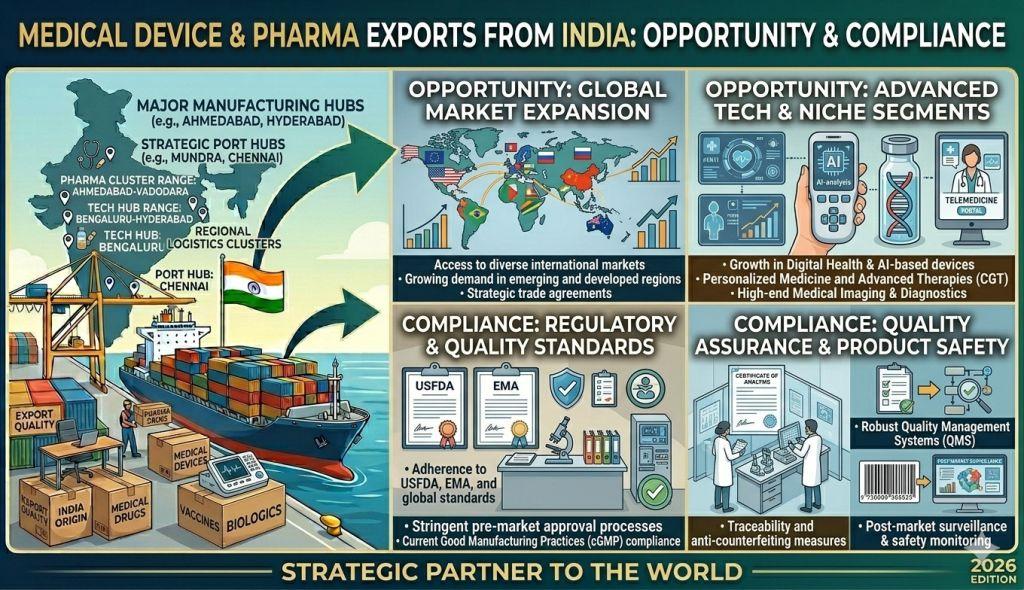
Manufacturing Clusters: Where India's Pharma Is Made
Understanding which cluster produces what saves significant time for international buyers doing sourcing due diligence.
Hyderabad, Telangana - India's Pharma Capital The largest pharmaceutical manufacturing cluster in the country. Major companies including Dr. Reddy's, Aurobindo Pharma, Hetero, Divis Laboratories, and Laurus Labs all have significant operations here. Strong in APIs, formulations, and bulk drugs for regulated markets. Genome Valley within Hyderabad is a dedicated biotech cluster.
Ahmedabad / Vadodara / Ankleshwar, Gujarat Gujarat generates roughly 35% of India's total pharmaceutical market. The Ahmedabad-Vadodara corridor is strong in chemical synthesis APIs and pharmaceutical intermediates. Ankleshwar (Bharuch district) is one of India's largest chemical manufacturing zones with significant API capacity. One of the three mega Bulk Drug Parks being built with central government support is in Gujarat.
Pune / Mumbai, Maharashtra Maharashtra hosts the broadest mix of formulation and specialty pharma companies. Pune has a significant concentration of pharmaceutical R&D and contract manufacturing. Mumbai is a trading and logistics hub for international pharma shipments.
Baddi / Nalagarh, Himachal Pradesh India's largest formulations manufacturing hub by number of facilities. Tax incentives historically attracted significant investment here. Strong in tablets, capsules, and OTC formulations. One of the three mega Bulk Drug Parks is in Himachal Pradesh.
Vizag (Visakhapatnam), Andhra Pradesh Growing pharmaceutical hub with strong port connectivity. The third mega Bulk Drug Park is in Andhra Pradesh. Aurobindo Pharma has a major presence here.
Delhi NCR Medical device manufacturing alongside pharma. Strong in surgical instruments, diagnostic equipment, and specialty devices. Also a commercial hub connecting manufacturers across north India to international buyers.
Bengaluru, Karnataka Biotech-focused cluster. Strong in biologics, biosimilars, and vaccine manufacturing. Biocon is headquartered here.
Sialkot model replication - surgical instruments India's surgical instrument cluster is primarily in and around Delhi NCR and Jalandhar. These manufacturers supply hospitals across the US, UK, Middle East, and Africa.
Pharma Compliance: What You Need to Export
This is where most export guides fail their readers. They list "FDA approval" and "WHO-GMP" as if those are single steps. They are not. Here is the actual breakdown by destination market.
Exporting to the United States
The US is India's largest pharma market and also has the most detailed compliance requirements.
For generic drugs (small molecules):
- File an ANDA (Abbreviated New Drug Application) with USFDA demonstrating bioequivalence to the reference listed drug
- Manufacturing facility must be USFDA-registered and compliant with 21 CFR Parts 210/211 (Current Good Manufacturing Practice regulations)
- Pre-approval inspection (PAI) by USFDA before first commercial batch
- US agent appointment required for foreign manufacturers
- Ongoing post-market reporting: Field Alert Reports (FARs), Annual Product Reviews
For new drugs / biologics:
- Full NDA (New Drug Application) or BLA (Biologics License Application) - much more resource-intensive
- Clinical trial data requirements
- This pathway is for Indian innovator companies, not generics
For medical devices:
- Device classification under 21 CFR Part 882 (Class I, II, or III)
- Class I: Most exempt from premarket notification; general controls apply
- Class II: Requires 510(k) Premarket Notification - demonstrating substantial equivalence to a predicate device
- Class III: Requires PMA (Premarket Approval) - full clinical evidence of safety and effectiveness
- FDA Establishment Registration (annually renewed)
- Device Listing with USFDA
- US Agent appointment (mandatory for foreign manufacturers)
- QSR compliance - Quality System Regulation under 21 CFR Part 820
Key fact: India has filed more Type II Drug Master Files (DMFs) with the USFDA than any other country - 4,505 cumulative filings as of January 2023. This number signals the depth of the US-India pharma relationship.
Exporting to the European Union
The EU runs a different regulatory system, and the compliance pathway is distinct from the US.
For pharmaceuticals:
- Marketing Authorisation through EMA (European Medicines Agency) - for new drugs, biologics, or medicines requiring EU-wide approval
- Alternatively, national procedures through individual member state authorities (for country-specific market entry)
- EU-GMP compliance - facilities must meet EU GMP Annex requirements, confirmed by inspection from an EU member state regulatory authority
- Qualified Person (QP) - every batch of medicine sold in the EU must be certified by an EU-based Qualified Person before release
- Pharmacovigilance: post-marketing safety monitoring, adverse event reporting through EudraVigilance
For medical devices:
- CE marking under EU Medical Device Regulation (EU MDR 2017/745), which replaced the older Medical Devices Directive
- Route through a Notified Body (EU-recognized third-party conformity assessment body) for Class IIa, IIb, and III devices
- Technical Documentation (TD) including clinical evaluation, risk management per ISO 14971, and Declaration of Conformity
- EUDAMED registration (EU medical device database)
- EU Authorized Representative appointment for non-EU manufacturers
One honest note: EU MDR has been more demanding than the old MDD, with stricter clinical evidence requirements and more rigorous Notified Body assessments. Indian device manufacturers targeting the EU need to budget significantly more time and money for this pathway than they may have under the previous directive.
Exporting to the UK (Post-Brexit)
The UK now has its own regulatory framework, separate from the EU. Medicines and Healthcare products Regulatory Agency (MHRA) governs both pharmaceuticals and medical devices.
- UK Marketing Authorisation required for medicines (separate from EU MA)
- UKCA marking for medical devices (equivalent to CE marking; full implementation timeline has been extended)
- CE marking continues to be accepted in the UK through a transition period - check MHRA for current dates
- UK Responsible Person (RP) required for medicines
- UK Authorised Representative for devices
Exporting to Other Key Markets
WHO Prequalification - required for exports to WHO-procurement markets (many African and developing nations, UNICEF, GAVI, MSF). India accounts for 57% of WHO-prequalified APIs. Prequalification requires: quality dossier submission, GMP inspection by WHO inspectors, and bioequivalence data. Products with WHO-PQ can be procured by international agencies without additional country-level approval in many cases.
Australia (TGA): ARTG (Australian Register of Therapeutic Goods) listing required. Australian Sponsor required for foreign manufacturers.
Japan (PMDA): One of the most demanding regulatory pathways in the world. Japanese GMP standards are rigorous, and the documentation requirements are extensive. A local Marketing Authorization Holder is mandatory.
Gulf Cooperation Council (GCC): Gulf Central Committee for Drug Registration (GCC-DR) manages registration across Saudi Arabia, UAE, Kuwait, Bahrain, Qatar, and Oman. Saudi FDA (SFDA) for Saudi market. Health authorities in each country for country-specific registration.
Africa: Regulatory standards vary dramatically by country. South Africa has SAHPRA (one of Africa's more rigorous authorities). Many African markets accept WHO-PQ or rely on certificates of pharmaceutical product (CPP) issued by Indian authorities.
What CDSCO Does - and Why It Matters for Exporters
Most international buyers focusing on Indian pharmaceutical exports know about USFDA approvals and WHO-GMP. Fewer understand CDSCO - India's Central Drugs Standard Control Organisation - and why it matters even for export-focused operations.
CDSCO, under India's Ministry of Health and Family Welfare, is the regulatory body that:
- Issues manufacturing licenses for drugs and medical devices in India
- Maintains the Schedule M GMP standards (currently being upgraded to align with WHO-GMP and ICH guidelines)
- Issues Certificate of Pharmaceutical Product (CoPP) - required by many importing countries as proof that the product is approved for manufacture and sale in India
- Regulates medical devices under MDR 2017 across four risk classes (A, B, C, D)
- Manages the SUGAM online portal for product approvals and registrations
For exporters, CDSCO matters in two ways:
First, your manufacturing license and Schedule M compliance are the baseline. Without a valid CDSCO manufacturing license and Schedule M GMP compliance, you cannot legally manufacture for export. Many importers will ask for your CDSCO license as part of vendor qualification.
Second, the CoPP issued by CDSCO (called Form 50) is what many African and developing country regulators ask for as part of their registration dossier. It confirms that the product is manufactured in an approved facility, meets Indian standards, and is approved for sale in India.
CDSCO has an online portal - SUGAM - where manufacturers can apply for licenses, submit product dossiers, and track application status. It has improved significantly in the last three years, though it still has friction points that slow down new applicants.
→ CDSCO Official Site → SUGAM Portal
Medical Device Classification in India: The Four-Class System
This matters both for Indian manufacturers and for international buyers trying to understand what documentation to expect.
India's Medical Devices Rules 2017 (MDR 2017) classifies devices into four risk-based classes:
Class A - Low Risk Examples: Thermometers, blood pressure cuffs (manual), bandages, simple surgical instruments. License: State Licensing Authority (SLA) for Class A non-sterile; CDSCO for Class A sterile. Timeline: 3–6 months for new manufacturers.
Class B - Low to Medium Risk Examples: Needles, syringes, suction cannulae, IVD reagents for general chemistry. License: SLA with CDSCO involvement for some products.
Class C - Medium to High Risk Examples: Ventilators, joint implants, IVD devices for blood group typing, hemodialysis equipment. License: CDSCO (Form MD-9 for manufacturing). Requires ISO 13485 Quality Management System certification. Timeline: 6-12 months.
Class D - High Risk Examples: Pacemakers, heart valves, implantable cardioverter defibrillators, spinal implants. License: CDSCO (Form MD-9). Requires ISO 13485, full clinical data, and intensive technical dossier. Timeline: Can exceed 12 months.
For exporters in Class C and D categories, ISO 13485 certification is mandatory — not optional. If you are targeting the EU, your ISO 13485 needs to be certified by an ISO 13485-accredited certification body (not just self-declared).
Government Support: Real Policy With Real Money
The Indian government has been consistent about backing pharma and medical device exports with meaningful schemes - not just statements.
PLI Scheme for Pharmaceuticals (₹15,000 crore outlay) Covers high-value pharmaceuticals: patented/off-patent drugs, biopharmaceuticals, complex generics, anti-cancer drugs, autoimmune drugs, orphan drugs, and IVD devices. 55 selected applicants manufacturing across three categories for six years (FY2022-23 to FY2027-28). In FY25, the government disbursed ₹604 crore under PLI in the first half of the year. → Department of Pharmaceuticals
PLI Scheme for Bulk Drugs / APIs (₹6,940 crore outlay) Targets 41 critical APIs that India was importing heavily from China - antibiotics, vitamins, analgesics, cardiovascular APIs, fermentation-based molecules. 48 projects selected; 34 commissioned. Cumulative investment of ₹4,155 crore (above target). Import savings of ₹1,330 crore by March 2025. The sixth application round opened November 2025 for additional APIs including Meropenem and Ritonavir.
PLI Scheme for Medical Devices (₹3,420 crore outlay) 5% incentive on incremental sales for companies manufacturing high-value devices: linear accelerators, MRIs, CT scans, mammograms, C-arms, ultrasound machines. Production tenure: FY2022-23 to FY2026–27. This is the scheme targeting the devices India currently imports heavily.
Three Mega Bulk Drug Parks Andhra Pradesh, Gujarat, and Himachal Pradesh. Combined project outlay of ₹63.06 billion, supported by ₹30 billion in central government incentives. The parks provide plug-and-play common infrastructure for API and bulk drug manufacturing - shared utilities, waste treatment, testing labs - reducing entry costs for manufacturers. Expected to become operational progressively through 2025-2027.
Strengthening of Pharmaceutical Industry (SPI) Scheme ₹500 crore to support pharma clusters and MSMEs in productivity, quality, and sustainability. Specifically supports small manufacturers who may not qualify for PLI but need quality infrastructure upgrades to compete for export markets.
Jan Aushadhi Programme (PMBJP) 16,912 Jan Aushadhi Kendras as of June 2025, targeting 25,000 by March 2027. While primarily a domestic access program, it builds the generic manufacturing base that also supplies export markets.
Pharmexcil (Pharmaceuticals Export Promotion Council of India) The primary export promotion body for pharma. Runs Buyer-Seller Meets, international trade participation, and market intelligence. Maintains an accredited exporter database used by international buyers for initial supplier identification. → Pharmexcil
EEPC India (Engineering Exports Promotion Council) For medical device manufacturers in the engineering-intensive device segment - diagnostic machines, imaging equipment.
The US Tariff Situation - What Pharma Exporters Need to Know
The India-US tariff situation in 2025 was complicated for most Indian export sectors. For pharmaceuticals specifically, it was more nuanced than headlines suggested.
For most of 2025, pharmaceuticals were carved out from the harshest tariff increases - the Trump administration recognized that restricting Indian pharma access would raise medicine prices for American consumers and disrupt supply chains that the US literally cannot replace domestically. This is different from how, say, textiles or jewelry were treated.
That said, the pre-tariff stockpiling dynamic caused a real distortion. US buyers purchased an estimated $1.6 billion above normal levels in early 2025, anticipating potential tariff changes. This compressed orders later in the year. FY26 pharma export figures to the US are softer partly because demand was pulled forward into FY25.
The broader India-US trade framework announced in February 2026 - which addressed diamonds and other sectors - is expected to provide clearer certainty for pharma trade terms as negotiations continue. Watch Pharmexcil communications for sector-specific updates.
Gaps in What Competitors Are Telling You
Most articles on India's pharma and medical device exports commit the same three mistakes:
They lump pharma and medical devices together as one story. They are not. India is a $30+ billion pharma exporter with world-class FDA-compliance infrastructure. India's medical device sector is a $4.1 billion exporter in a market where it imports $8.6 billion - a completely different competitive position that requires different strategic framing. Treating them as one "healthcare exports" category misses this fundamental distinction.
They skip the compliance details entirely or make them vague. "You need FDA approval" is not useful information. The difference between an ANDA pathway for a generic, a 510(k) for a Class II device, and a PMA for a Class III device involves entirely different timelines, costs, and clinical evidence requirements. Buyers and exporters making decisions based on vague compliance guidance will hit expensive surprises.
They ignore the China dependency problem in APIs. India exports $4.87 billion in APIs but still imports 65-70% of its own API intermediates from China. This is both a risk for India's export reliability and an opportunity - the PLI-funded Bulk Drug Parks are specifically designed to close this gap. International buyers who understand this dynamic can make better sourcing decisions about which Indian API suppliers are on the right side of this shift versus which ones remain China-dependent.
How to Find Verified Indian Pharma and Medical Device Exporters
For pharmaceutical products:
- Pharmexcil's accredited exporter list - the most credible starting point for international buyers. Pharmexcil membership and accreditation indicates a baseline of compliance and export experience.
- Pharmexcil Buyer-Seller Meets - run globally, these structured events put international buyers directly in front of verified Indian exporters.
- Navi Exports Medical & Health Care category - lists verified Indian exporters with credentials across pharmaceutical and medical device categories.
For medical devices:
- FICCI Medical Device Forum - the industry body that can provide supplier references by product category.
- CPhI India (annual trade show, December, Mumbai) - pharma and medical device combined; major international buyer attendance.
- Medical Devices Conclave (organized by AIMED - Association of Indian Medical Device Industry) - more device-specific, useful for device-category sourcing.
Due diligence every buyer should do:
- Verify CDSCO manufacturing license and Schedule M compliance certificate
- For US-targeted products: check USFDA's Drug Establishment Database (FEI database) for the facility's inspection history
- For EU-targeted products: confirm EU-GMP certificate from a European regulatory authority
- For devices: confirm ISO 13485 certification from an accredited body (not self-declared)
- Request copies of WHO-GMP, USFDA warning letters history, and Pharmacopoeial conformance certificates (USP, BP, or IP as applicable)
Pre-Export Checklist for Indian Pharma Manufacturers
Before approaching international buyers or filing in export markets:
Baseline (mandatory for all markets):
- IEC (Import Export Code) from DGFT
- CDSCO manufacturing license, current and covering your product category
- Schedule M GMP compliance certificate
- Pharmexcil membership (RCMC) for pharma products
- Certificate of Pharmaceutical Product (CoPP / Form 50) from CDSCO - many importing countries require this
For the US:
- Facility registration with USFDA (annual renewal; DUNS number required)
- ANDA filed and approved for each generic product
- US Agent appointed (required for all foreign manufacturers)
- 21 CFR Parts 210/211 GMP compliance documented
For the EU:
- EU-GMP certificate from an EU member state authority
- EU Qualified Person (QP) arrangement for batch release
- Marketing Authorisation through EMA or national procedure
- EudraVigilance enrolment for pharmacovigilance
For WHO-procurement markets:
- WHO Prequalification - separate process with WHO inspectors
- Products without WHO-PQ can still access some African/Asian markets using CoPP + local registration
For medical devices (any market):
- ISO 13485 certification (for Class C and D devices in India; required for EU and US)
- 510(k) clearance or PMA (US)
- CE marking under EU MDR (EU)
- Technical dossier: clinical evaluation, risk management, labeling per destination market
Related Navi Exports Categories
- Medical & Health Care Exporters
- Chemicals Exporters
- Industrial Equipments & Tools
- Measure Meter & Analytic Products
- Processing Services & Equipments
India's pharmaceutical export sector is exactly what its reputation suggests: genuinely world-class, deeply compliant with international standards, and competitively priced in ways that other countries struggle to match. The $30.47 billion in FY25 exports, the 600+ USFDA-inspected facilities, the 57% share of WHO-prequalified APIs, these are not marketing figures. They are operational facts that international buyers rely on every time they fill a hospital dispensary, a pharmacy shelf, or a government medicine tender.
The medical device sector is honest-to-goodness a work in progress. The $4.1 billion vs. $8.6 billion import-export gap is real. The PLI scheme for high-value devices is the right response, but the gap between PLI targets and actual commissioned capacity is also real. For international buyers sourcing medical devices from India, the sweet spot today is disposables, consumables, basic surgical instruments, and some diagnostic categories. High-end imaging and complex implantable devices are coming, India is building toward them - but five years out, not today.
The compliance piece is where Indian pharma exporters most consistently underinvest. Not in actually achieving compliance, India's top manufacturers have some of the most rigorous internal quality systems in the world. But in understanding exactly what each destination market requires and getting documentation in order before approaching buyers. A facility that has done everything right internally but cannot produce a clean CoPP, a current Schedule M certificate, and an auditable USFDA establishment registration history will lose business to a competitor that can.
That documentation readiness is the difference between an Indian pharma exporter that grows international revenue and one that does not.
Browse verified Indian medical and healthcare exporters on Navi Exports
Data sources: IBEF India Pharmaceuticals Industry Report, Pharmexcil FY26 export data, Ministry of Commerce & Industry (PIB India), Department of Pharmaceuticals (pharma-dept.gov.in), CDSCO (cdsco.gov.in), The Hans India / The Tribune FY26 pharma export data, India Briefing PLI Scheme Analysis, PharmaManufacturing-India PLI API Report, USFDA Drug Establishment Database, WHO Prequalification Programme data, KPMG India Tariff Impact Report.
Frequently Asked Questions
India's pharmaceutical exports reached $30.47 billion in FY2024-25, up 9.4% year-on-year. The April-February period of FY26 recorded $28.29 billion, a 5.6% increase over the same period of FY25. India ranks third globally in pharmaceutical production by volume and exports to over 200 countries. The USA accounts for approximately 34% of total exports.
India has over 600 USFDA-inspected manufacturing facilities - the most of any country outside the United States. It also holds over 2,000 WHO-GMP approved manufacturing facilities. More than 6,316 market authorizations have been granted to Indian formulation companies by USFDA.
Medical device exports from India reached $4.1 billion in FY25. However, imports were $8.6 billion, reflecting continued dependence on foreign suppliers for advanced devices. The industry is targeting $50 billion by 2030, with the government's PLI scheme for medical devices (₹3,420 crore outlay) specifically aimed at closing this gap.
For generic pharmaceuticals: ANDA (Abbreviated New Drug Application) approval from USFDA, facility registration under 21 CFR Parts 210/211, USFDA facility registration (annual), and appointment of a US agent. The manufacturing facility must have passed USFDA inspection or be pre-approval inspected before commercial export. You also need a current CDSCO manufacturing license and Schedule M GMP compliance.
510(k) is a Premarket Notification for Class II devices - you demonstrate that your device is substantially equivalent to a legally marketed predicate device. It does not require clinical trials in most cases. PMA (Premarket Approval) is for Class III devices - those that sustain life or present high risk - and requires full clinical evidence of safety and effectiveness. Class I devices are mostly exempt from premarket notification. Correct device classification is the first step before choosing the pathway.
The three main PLI schemes: PLI for Bulk Drugs/APIs (₹6,940 crore, targeting 41 critical APIs); PLI for Pharmaceuticals (₹15,000 crore, covering biologics, complex generics, anti-cancer drugs); PLI for Medical Devices (₹3,420 crore, covering high-value imaging and diagnostic equipment). Additionally, three Mega Bulk Drug Parks in Andhra Pradesh, Gujarat, and Himachal Pradesh provide common infrastructure. Pharmexcil facilitates international market access and buyer connections. SPI Scheme (₹500 crore) supports MSMEs in improving quality and compliance.
Pharmexcil's accredited exporter list is the most authoritative starting point. Pharmexcil-organized Buyer-Seller Meets connect international buyers with verified exporters. The Navi Exports Medical & Health Care category lists Indian exporters with documented credentials across pharmaceutical and medical device categories. For due diligence, verify CDSCO licenses, check USFDA's Drug Establishment Database for inspection history, and request WHO-GMP and Schedule M certificates.