-
-
-
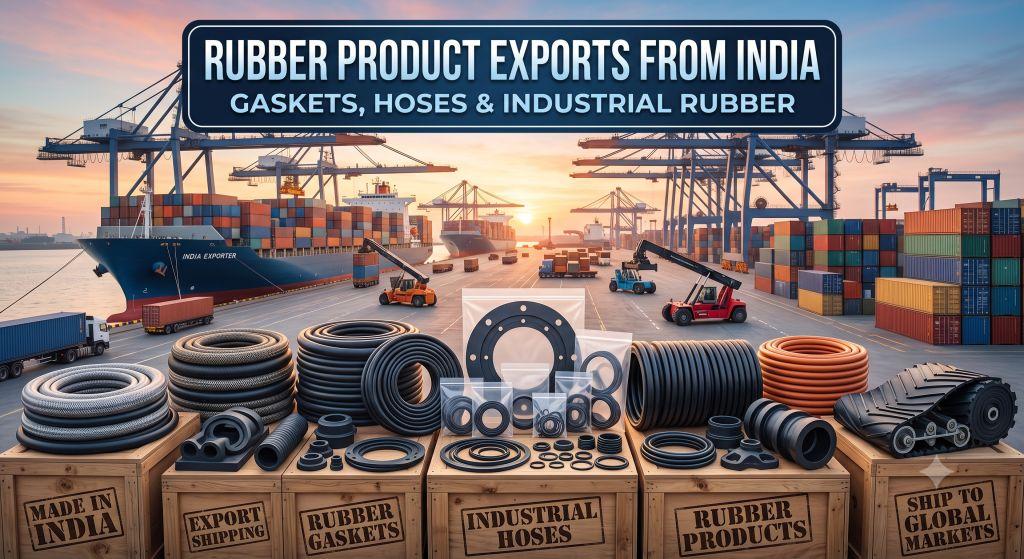
Rubber Product Exports from India: Gaskets, Hoses & Industrial Rubber
 Wed, 02 Sep 2026
Rubber Product Exports from India: Gaskets, Hoses & Industrial Rubber


India shipped $912.59 million worth of rubber products to the United States alone in 2024. Tyres accounted for the biggest single line at $504.38 million, but the breakdown underneath that headline number is where the real export story sits: $149.25 million in other vulcanized rubber articles, $92.88 million in hoses and pipes, $74.47 million in conveyor and transmission belts, and smaller but real figures in sheets, reclaimed rubber, and retreaded tyres. That is not a country exporting one product. It is a full industrial rubber supply chain, and most of it has nothing to do with tyres at all.
This guide focuses on that non-tyre side, the gaskets, hoses, belts, and molded industrial rubber components that automotive and industrial buyers actually source India for. It covers where these products get made, what a buyer needs to check before ordering, and the government schemes actually shaping the industry right now.
The Numbers
| Metric | Data |
|---|---|
| India's rubber exports to the US, 2024 | $912.59 million (total, all rubber categories) |
| New pneumatic tyres, US exports | $504.38 million |
| Other vulcanized rubber articles, US exports | $149.25 million |
| Tubes, pipes, and hoses of vulcanized rubber, US exports | $92.88 million |
| Conveyor and transmission belts, US exports | $74.47 million |
| India's global rank in natural rubber production | 3rd largest |
| India's global rank in natural rubber consumption | 4th largest |
| India's global rank in combined natural and synthetic rubber consumption | 5th largest |
| India industrial rubber market volume, 2024 | 4.93 lakh tonnes |
| Kottayam integrated rubber industrial complex investment | Rs 335.05 crore (~$35 million) |
Sources: Trading Economics via UN Comtrade database (2024 data, updated April 2026), Research and Markets India Industrial Rubber Market report, InfraPPP World reporting on the Kottayam rubber complex (2026).
That US export breakdown is worth sitting with. Tyres get the most attention in trade coverage because they are the single largest line item, but hoses, belts, and vulcanized rubber articles together add up to more than half of what tyres alone bring in. A buyer sourcing industrial rubber components from India is tapping into a genuinely large, established supply chain, not a niche corner of the tyre industry.
The Product Categories
Industrial Rubber Products
The broadest category and the one with the deepest supplier base. Industrial rubber products cover everything from vibration dampeners and anti-vibration mounts to specialized components for heavy machinery, serving automotive, construction, and general manufacturing buyers.
Rubber Gaskets and Seals
The fastest-growing segment within industrial rubber globally, and a category where compound selection really matters. EPDM (ethylene propylene diene monomer) is favored for automotive and environmentally exposed applications, while NBR (nitrile rubber) and increasingly FKM and FFKM fluoroelastomers serve higher-temperature and chemical-resistant needs. Rubber gaskets and seals buyers should always confirm the specific compound rather than accepting a generic "rubber gasket" description, since the wrong compound in the wrong application is a failure waiting to happen.
Rubber Hoses and Pipes
The single largest product category within industrial rubber globally, holding roughly 24% of the global industrial rubber market by product type. Demand is essentially irreplaceable across automotive, oil and gas, construction, and agricultural equipment, where hydraulic and pneumatic hose assemblies generate steady replacement-cycle orders independent of new equipment production. Rubber hoses and pipes represented $92.88 million of India's rubber exports to the US alone in 2024.
Rubber Belts
Conveyor and transmission belts serve mining, manufacturing, and material handling buyers, and represented $74.47 million of India's rubber exports to the US in 2024. Rubber belts are a truly global category, with conveyor belts specifically holding close to a third of the entire global industrial rubber product-type segment.
Rubber Components for Machinery
Custom-molded parts built to a buyer's specific machinery requirements rather than off-the-shelf standard products. Rubber components for machinery is where India's molding capability and engineering support matter more than raw material cost, since buyers in this category are usually solving a specific application problem, not price-shopping a commodity.
Rubber Molding Products
Injection and compression molded rubber goods spanning automotive, industrial, and consumer applications. Rubber molding products demand depends heavily on tooling investment, which is why buyers placing recurring orders on the same mold generally get meaningfully better pricing than one-off custom runs.
Reclaimed Rubber
This is a genuinely distinctive category, and one most competitor content ignores. Reclaimed rubber, processed from scrap tyres and rubber waste back into usable raw materia, represented $10.67 million of India's exports to the US in 2024 on its own. It is a smaller line item than finished products, but it reflects a real circular-economy capability that buyers focused on recycled-content sourcing should specifically ask about.
Rubber Sheets and Mats
Flooring, lining, and general-purpose sheet rubber for industrial and construction applications. Rubber sheets and mats contributed $41.08 million to India's US rubber exports in 2024.
Rubber Raw Materials
This subcategory covers compounded and semi-processed rubber material feeding India's own manufacturing base, distinct from bulk natural rubber traded as a raw agricultural commodity, which is covered separately under Raw Materials & Bulk Commodities. Buyers sourcing rubber raw materials here are typically looking for processed or compounded rubber ready for further manufacturing, not raw plantation-grade natural rubber.
Rubber Footwear
A smaller but steady export category, rubber footwear draws on the same SBR and reclaimed rubber compounds used in industrial applications, giving manufacturers in this space genuine crossover capacity with the industrial rubber side of the business.
The Manufacturing Base
Kottayam, Kerala: The Natural Rubber and R&D Center
Kottayam is where India's rubber industry actually starts. It hosts the Rubber Board of India's headquarters, established under the Rubber Act of 1947, and the Rubber Research Institute of India (RRII), the country's primary rubber R&D facility. A Rs 335.05 crore integrated rubber industrial complex is under development at Velloor, Kottayam, targeted for completion in 2027-28, specifically designed to encourage value-added rubber manufacturing rather than raw material export. Kottayam-based manufacturers produce an unusually wide range, from automotive and oil seals to molded goods, drawing on both centrifugal processing (for tyres, tubes, and molded goods) and latex-based manufacturing (for gloves, foam, and bands).
Automotive OEM Hubs (Pune, Chennai, NCR)
Rubber component manufacturing for gaskets, hoses, seals, and vibration dampeners is heavily concentrated near India's automotive manufacturing clusters rather than existing as a separate geography, since proximity to the OEM buyer and just-in-time delivery requirements matter more in this segment than raw material access.
Northeast India and West Bengal: The Emerging Cultivation Base
The Rubber Board's iSPEED project, run jointly with the Automotive Tyre Manufacturers' Association (ATMA), is a five-year initiative aimed at over two lakh smallholder rubber farmers and nursery owners across the Northeast and West Bengal, expanding cultivation beyond Kerala's traditional dominance and building a second raw material base for the industry.
Compliance: What Automotive and Industrial Buyers Actually Check
IATF 16949 for Automotive OEM Supply
Suppliers targeting automotive OEM contracts, as opposed to the aftermarket, generally need IATF 16949 certification, the automotive-specific quality management standard built on top of ISO 9001. Aftermarket and general industrial buyers may not require it, but OEM-level buyers almost always will.
REACH Compliance for EU-Bound Rubber
The EU restricts certain nitrosamine-forming chemicals historically used in rubber compounding, particularly relevant for gaskets, seals, and any rubber product in prolonged contact with skin. Exporters targeting European automotive or consumer-adjacent buyers need REACH-compliant formulations, not just general quality certification.
Compound Specification, Not Generic Descriptions
EPDM, NBR, FKM, FFKM, and SBR all behave completely differently under heat, chemical exposure, and mechanical stress. A buyer asking for "rubber gaskets" without specifying the compound is leaving a critical decision to the supplier, which is rarely the safer choice for a technically demanding application.
Testing and Material Certification
For hoses, seals, and safety-relevant components, request specific test data (pressure rating, temperature range, chemical compatibility) rather than a general product datasheet, particularly for hydraulic and pneumatic hose assemblies where failure carries real operational consequences.
Government Support
Rubber Board of India Schemes
Beyond cultivation support, the Rubber Board has expanded its focus toward value-added manufacturing and export promotion, working alongside industry bodies like ATMA on skill development and infrastructure projects specifically aimed at strengthening the domestic supply chain feeding rubber goods manufacturers.
Cultivation Subsidy Expansion
Farmers in Kottayam, Ernakulam, Pathanamthitta, Kannur, Malappuram, and Thiruvananthapuram districts receive financial assistance of up to Rs 75,000 per hectare for rubber cultivation, part of a broader push to stabilize the raw material base that downstream manufacturers depend on.
KERA Project (World Bank Assistance, 2025-2029)
The Kerala Climate Resilient Agri-Value Chain Modernization project, backed by World Bank funding, supports climate-resilient rubber cultivation practices, addressing supply chain risk from increasingly variable growing conditions in Kerala.
RoDTEP
Standard export incentive applicable to rubber product exports, offsetting embedded taxes not otherwise refunded, with the specific rate depending on HS classification.
How to Source or Export Rubber Products from India
Step 1: IEC from DGFT
Mandatory before any export shipment.
Step 2: Identify your buyer segment
Automotive OEM buyers require different certification (IATF 16949) than aftermarket or general industrial buyers. Confirm which segment you are serving before selecting a supplier.
Step 3: Specify the compound, not just the product
EPDM, NBR, FKM, and SBR all serve different applications. Confirm the exact compound in writing for any technically demanding order.
Step 4: Confirm REACH compliance for EU-bound shipments
Particularly relevant for gaskets, seals, and skin-contact rubber products, given EU restrictions on certain nitrosamine-forming compounding chemicals.
Step 5: Request specific test data for safety-relevant components
Pressure ratings, temperature range, and chemical compatibility data for hoses and seals, not just a general product datasheet.
Pre-Export Checklist
- IEC from DGFT
- GST registration in place
- RoDTEP rate confirmed for your specific HS code
- IATF 16949 certification confirmed if targeting automotive OEM buyers
- REACH compliance confirmed for EU-bound gaskets, seals, or skin-contact products
- Exact rubber compound specified and confirmed in writing (EPDM, NBR, FKM, SBR, etc.)
- Test data and material certification arranged for hoses, seals, and other safety-relevant components
The Bottom Line
India's rubber export story is bigger than tyres, even though tyres get most of the trade-press attention. Hoses, gaskets, belts, and vulcanized rubber articles together add up to more export value to the US alone than tyres do on their own, and each of those categories runs on its own compound science and its own buyer relationships. Kottayam remains the industry's research and raw material anchor, backed by a genuine Rs 335 crore infrastructure investment aimed at pushing the industry up the value chain rather than staying a raw material exporter. Automotive component manufacturing, meanwhile, has settled near India's OEM hubs rather than clustering separately, since proximity to the buyer matters more than proximity to the plantation once you are making finished parts.
The compliance picture splits cleanly by buyer type. OEM automotive buyers want IATF 16949. EU buyers want REACH-compliant compounds. Everyone benefits from a supplier who specifies the actual compound rather than a generic "rubber" description, since EPDM and NBR are not interchangeable no matter how similar they look on a spec sheet.
Frequently Asked Questions
India exported $912.59 million in rubber products to the United States alone in 2024, according to UN Comtrade data. Tyres accounted for $504.38 million of that, with the remainder split across vulcanized rubber articles, hoses and pipes, conveyor belts, sheets, and other categories.
Yes. India is the world's third-largest natural rubber producer, fourth-largest consumer of natural rubber, and fifth-largest consumer of combined natural and synthetic rubber. Cultivation is concentrated in Kerala, with the Rubber Board actively expanding production into the Northeast and West Bengal.
Suppliers targeting automotive OEM contracts generally need IATF 16949 certification, the automotive-specific quality management standard. Aftermarket and general industrial buyers may not require it, though it remains a strong credibility signal regardless of buyer type.
EPDM, NBR, FKM, FFKM, and SBR each perform differently under heat, chemical exposure, and mechanical stress. A generic "rubber gasket" order without a specified compound leaves a critical technical decision to the supplier, which creates real failure risk in demanding applications.
Reclaimed rubber is processed from scrap tyres and rubber waste back into usable raw material. India exported $10.67 million worth to the US in 2024 alone, reflecting a genuine circular-economy manufacturing capability that buyers focused on recycled content should specifically source for.
Yes. The EU restricts certain nitrosamine-forming chemicals historically used in rubber compounding, particularly relevant for gaskets, seals, and any product with prolonged skin contact. REACH-compliant formulations are necessary for these applications, separate from general quality certification.
Kerala, particularly Kottayam, anchors the natural rubber cultivation and R&D side of the industry, home to the Rubber Board and the Rubber Research Institute of India. Component manufacturing for automotive gaskets, hoses, and seals is concentrated near India's automotive OEM hubs, including Pune, Chennai, and the Delhi NCR region.