 Thu, 03 Sep 2026
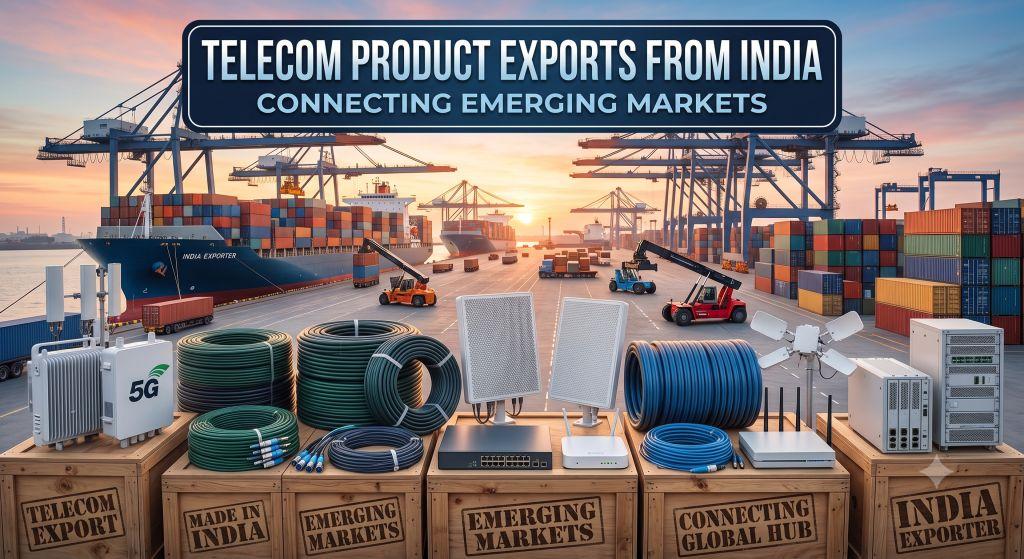
Telecom Product Exports from India: Connecting Emerging Markets


On July 30, 2026, India signed its first dedicated Telecom Manufacturing Zone agreement in Gwalior, backed by $493 million in central funding and anchored by six companies: Dixon Technologies, HFCL, VVDN Technologies, Lava Mobile, Optimus Electronics, and Tejas Networks. That is not a routine policy announcement. It is a direct response to a $112 billion trade deficit with China in telecom equipment, and it tells you something the export statistics alone do not: India's telecom manufacturing base is still being actively built, not something that finished forming years ago.
That matters for how you read the rest of this guide. India's telecom PLI scheme has driven real export growth, but the sector is genuinely mid-transition, moving from an import-dependent market toward a manufacturing and export base, with specific product categories further along than others. This piece covers which telecom products India actually exports at scale, where they get made, who is buying them, and how the certification rules actually work, which is more nuanced than most guides make it sound.
This guide covers telecom infrastructure and network equipment specifically: antennas, towers, fiber, VoIP systems, and related hardware. General office telecommunication equipment is a distinct, smaller category covered separately in our IT Hardware guide.
The Numbers
| Metric | Data |
|---|---|
| Telecom PLI scheme export sales (as reported to Parliamentary Committee) | Over Rs 23,500 crore |
| Telecom PLI net sales, as of May 2025 | Rs 85,391 crore |
| Telecom PLI investment attracted | Rs 4,305 crore |
| Manufacturing units established under Telecom PLI | 22 units across 10 states |
| Jobs created under Telecom PLI, as of February 2026 | Nearly 32,500 |
| Import substitution achieved in antennae, GPON, and CPE | 60% |
| Telecom sector trade deficit reduction (5-year) | From roughly ₹68,000 crore to ₹4,000 crore |
| Gwalior Telecom Manufacturing Zone funding | $493 million |
| India's mobile tower infrastructure | Over 700,000 towers deployed |
The 60% import substitution figure in antennae, GPON, and CPE (Customer Premises Equipment) is worth sitting with. It means India has genuinely closed the gap in specific network access categories, while other segments, particularly higher-value 5G radios and core network platforms, remain the harder frontier the PLI scheme is still working to build out. Buyers sourcing in the categories where substitution is strongest will find a more mature supplier base than buyers looking for cutting-edge core network equipment.
The Product Categories
Fiber Optic Equipment
India's fiber optic manufacturing capacity has expanded significantly, led by companies like HFCL, which has been scaling capacity from roughly 14 million fiber-kilometers toward a targeted 34 million. Sterlite Technologies (STL) operates as one of the world's leading optical fiber and cable manufacturers from its Maharashtra facility. Fiber optic equipment demand has been driven domestically by the BharatNet rural broadband project, building manufacturing scale that now supports export capacity.
Telecommunication Towers
India's over 700,000 deployed towers point to a mature domestic steel tower fabrication industry that has moved into exporting ground-mounted towers, rooftop towers, and guyed mast structures to network builders in Africa and Southeast Asia building out their own infrastructure. Telecommunication towers buyers are typically telecom operators and infrastructure developers rather than end consumers, making this a longer sales cycle but a higher-value one.
Telecom Antennas
One of the categories where PLI-driven import substitution has been strongest, with India now close to self-reliant in domestic antenna production. Telecom antennas span everything from base station antennas to smaller access-point hardware, feeding both India's own 4G and 5G rollout and export orders to operators expanding coverage elsewhere.
Network Cables
A high-volume, steady export category supporting telecom infrastructure buyers who need reliable, standards-compliant cabling at scale. Network cables sit alongside fiber optic equipment as part of the same physical infrastructure buildout most export orders are actually funding.
Switches and Modems
Core networking hardware where India's manufacturing base is still building toward the higher end of the category. Switches and modems demand comes from both telecom operators and enterprise network buyers, with the PLI scheme's product list explicitly covering routers, switches, and customer-premises equipment.
Wireless Routers
Wireless routers span consumer, small business, and carrier-grade categories, with WPC (Wireless Planning and Coordination) approval required in addition to TEC certification for any device transmitting on radio frequencies, a distinction worth confirming with your supplier before ordering.
VoIP Equipment
Voice-over-IP hardware serving enterprise communications buyers and telecom operators building out IP-based voice infrastructure. VoIP equipment is a smaller category by volume than towers or fiber, but a steady one tied to enterprise telecom modernization projects.
Telephone Instruments
A more mature, lower-growth category compared to newer network infrastructure, but telephone instruments still see consistent demand in markets where fixed-line and PBX systems remain in active use alongside mobile infrastructure.
Mobile Signal Boosters
A genuinely practical export category for a specific buyer profile: markets with real coverage gaps rather than aspirational upgrades. Mobile signal boosters go to Sub-Saharan African markets, rural South Asian operators, and island network operators where signal amplification solves an actual infrastructure problem.
Telecom Testing Equipment
Supporting the installation and maintenance side of every other category on this list. Telecom testing equipment buyers are typically network operators, installation contractors, and telecom service companies rather than end consumers, and demand for this category grows in step with new network buildouts anywhere in the world.
A quick flag on scope: set-top boxes are sometimes grouped with telecom products in generic trade coverage, but on Navi Exports they sit under the Electronic Products & Components category as consumer electronics, not under Telecom Products. If you're sourcing set-top boxes specifically, that's the more accurate category to browse.
The Manufacturing Base
Bengaluru, Karnataka
Home to Tejas Networks, a Tata Group subsidiary and one of India's few companies with genuine optical networking engineering depth, serving telecom operators in 75 countries with high-bandwidth optical transport and 5G backhaul solutions. Tejas has active partnerships including a 5G rollout project with FibreConnect in Italy and a long-term infrastructure agreement with Telecom Egypt.
Chhatrapati Sambhaji Nagar, Maharashtra
Home to Sterlite Technologies' optical fiber and cable manufacturing operations, positioning the state as a key node in India's fiber supply chain alongside its broader industrial base.
Gwalior, Madhya Pradesh
India's newly designated Telecom Manufacturing Zone, backed by $493 million in central funding and a plug-and-play cluster model, targeting both current 5G network equipment production and 6G standards participation. The anchor companies span the value chain: HFCL and Tejas Networks for core network engineering, Dixon Technologies moving up from consumer electronics EMS into telecom network equipment, and VVDN Technologies and Lava Mobile rounding out the manufacturing base.
Delhi NCR, Pune, Hyderabad, and Chennai
The broader established manufacturing spread for telecom hardware, network cables, and related components, feeding both domestic telecom operators and export orders alongside the newer, more specialized clusters above.
Compliance: What Actually Applies to Exporters
This is where a lot of generic guides get something important wrong, so it's worth being precise.
TEC/MTCTE certification is a domestic market-entry requirement, not an export certification.
The Telecommunication Engineering Centre's Mandatory Testing and Certification of Telecom Equipment scheme governs what can be legally sold, imported, or deployed within India. It does not certify a product for export to another country. A supplier's MTCTE compliance is a genuine quality signal, since it confirms the equipment meets network integrity, safety, and RF emission standards broadly aligned with international practice, but it is not what a foreign buyer's own customs authority will be checking.
The actual certification a buyer needs depends entirely on the destination market.
CE marking for the European Union, FCC certification for the United States, and compliance with relevant ITU-T and ETSI standards are the certifications that actually matter for clearing telecom equipment into most major export markets. Confirm with your supplier which of these they hold, rather than assuming domestic TEC certification covers it.
Trusted Telecom certification signals security-vetted manufacturing.
Companies like HFCL hold Trusted Telecom status under India's telecom security framework, a designation that matters most for buyers who are themselves government or critical-infrastructure telecom operators concerned about supply chain security, an increasingly relevant consideration for international buyers as well, not just domestic Indian telecom operators.
WPC approval for radio-frequency transmitting devices.
Wireless routers, signal boosters, and any equipment transmitting on radio frequencies need Wireless Planning and Coordination approval in addition to TEC certification, a separate process specifically for RF-emitting devices.
Government Support
PLI Scheme for Telecom and Networking Products
Launched in 2021 with an initial outlay of Rs 12,195 crore, the scheme has driven Rs 85,391 crore in net sales and over Rs 23,500 crore in exports as of the most recent reporting, with amended guidelines adding a 1% additional incentive, expanded eligible products, and quarterly incentive claims to keep participants moving from investment into commercial production faster.
Telecom Manufacturing Zone (Gwalior)
India's first dedicated zone of its kind, launched July 2026 with $493 million in funding, specifically targeting the higher-value segments the PLI scheme has found hardest to build domestically: 5G radios, core network platforms, and 6G standards participation.
Trade Deficit Reduction as Explicit Policy Goal
The government has been explicit that reducing the roughly $112 billion telecom trade deficit with China is a strategic priority, not just an economic one, which is the actual policy logic behind both the PLI scheme and the new manufacturing zone.
How to Source or Export Telecom Products from India
Step 1: IEC from DGFT
Mandatory before any export shipment.
Step 2: Identify the destination market's actual certification requirement
CE for the EU, FCC for the US, relevant ITU-T or ETSI standards elsewhere. Do not assume a supplier's TEC/MTCTE certification satisfies this, since it is a separate, India-specific domestic requirement.
Step 3: Confirm WPC approval for any RF-transmitting product
Wireless routers, signal boosters, and similar equipment need this specifically, separate from TEC certification.
Step 4: Match your product to the right cluster
Fiber and optical networking toward Bengaluru or Maharashtra-based suppliers, tower and infrastructure hardware toward the established fabrication base, and newer 5G-focused network equipment toward the Gwalior zone's anchor companies as that cluster matures.
Step 5: For security-sensitive buyers, ask about Trusted Telecom status
Particularly relevant if you are a telecom operator or critical-infrastructure buyer concerned about supply chain vetting.
Pre-Export Checklist
- IEC from DGFT, active
- GST registration in place
- RoDTEP rate confirmed for your specific HS code
- Destination market certification confirmed (CE, FCC, ITU-T, or ETSI as applicable), not assumed from domestic TEC/MTCTE status
- WPC approval confirmed separately for any RF-transmitting product
- Trusted Telecom status checked if your buyer is a telecom operator or critical-infrastructure entity
- Supplier's PLI scheme participation confirmed where relevant, as an indicator of manufacturing scale and quality investment
Related Navi Exports Categories
The Bottom Line
India's telecom product export story is a mid-transition story, not a finished one, and that is exactly what the new Gwalior Telecom Manufacturing Zone announcement confirms. The PLI scheme has done real work: 60% import substitution in antennae, GPON, and CPE is a genuine achievement, and the trade deficit reduction from ₹68,000 crore to ₹4,000 crore over five years is backed by actual manufacturing capacity, not just policy intent. But the harder segments, 5G radios, core network platforms, higher-value optical transmission, are still the frontier the new manufacturing zone is specifically trying to close.
For buyers, that means different product categories are at different levels of supplier maturity right now. Antennas, towers, and fiber optic equipment sit on a more established supplier base. Advanced network equipment is newer and worth extra diligence on supplier track record. And the certification question has a clean answer once you separate it correctly: TEC/MTCTE is what makes equipment legal to sell in India, not what gets it through your own country's customs.
Data sources: Communications Today reporting on Telecom PLI scheme performance (August 2026), Press Information Bureau press releases on Telecom PLI achievements, Invest India Telecom PLI Scheme briefing, Tech Times reporting on the Gwalior Telecom Manufacturing Zone (August 2026), Tejas Networks investor relations and corporate disclosures, Fibconet reporting on Indian fiber optic cable manufacturers (2026), UL Solutions and TEC/DoT official guidance on MTCTE certification (2026).
Frequently Asked Questions
The Department of Telecommunications reported export sales exceeding Rs 23,500 crore under the Telecom PLI scheme, with total net sales reaching Rs 85,391 crore as of May 2025, against an investment of Rs 4,305 crore across 22 manufacturing units in 10 states.
India's first dedicated Telecom Manufacturing Zone, signed on July 30, 2026, backed by $493 million in central funding. It targets 5G network equipment production and 6G standards participation, anchored by six companies including Dixon Technologies, HFCL, VVDN Technologies, Lava Mobile, Optimus Electronics, and Tejas Networks.
No. TEC (Telecommunication Engineering Centre) certification under the MTCTE scheme governs what can legally be sold or deployed within India. It does not certify equipment for export. Buyers need to confirm the destination market's own requirement, typically CE marking for the EU, FCC certification for the US, or relevant ITU-T and ETSI standards elsewhere.
Antennae, GPON (Gigabit Passive Optical Network) equipment, and CPE (Customer Premises Equipment) have seen roughly 60% import substitution under the PLI scheme, making these categories among the most mature in India's domestic telecom manufacturing base.
Southeast Asia and Africa are established markets for Indian telecom infrastructure, with companies like Tejas Networks serving telecom operators in 75 countries including Egypt. Made-in-India 5G equipment has also reached markets in North America and Europe, reflecting a genuine expansion beyond traditional developing-market buyers.
Trusted Telecom is a security-vetting designation under India's telecom security framework, held by companies like HFCL. It matters most for buyers who are themselves telecom operators or critical-infrastructure entities concerned about supply chain security, a consideration increasingly relevant for international buyers as well as domestic Indian operators.
No. Set-top boxes are categorized under Electronic Products & Components as consumer electronics rather than under Telecom Products, since they function primarily as consumer entertainment hardware rather than network infrastructure.