-
-
-
Gems & Jewelry Exports from India: The World's Largest Market Share
 Wed, 02 Sep 2026
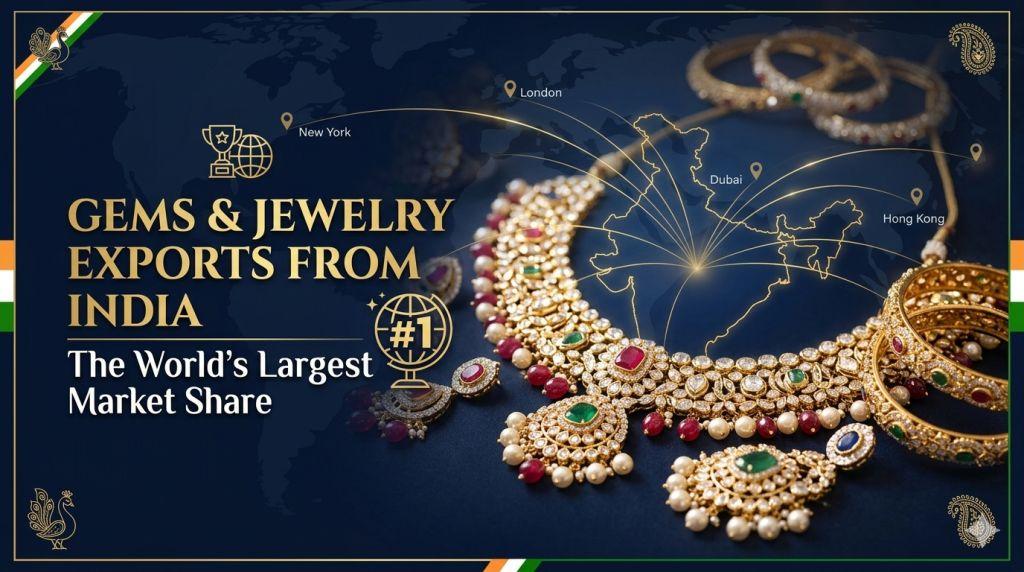
Gems & Jewelry Exports from India: The World's Largest Market Share


Nine out of every ten polished diamonds sold anywhere in the world were cut in Surat. Not designed there, not sold there. Cut there, by hand and machine, in a city most jewelry buyers outside India could not point to on a map.
That single fact tells you more about how this industry actually works than most export guides manage in a full article. India does not just supply gems and jewelry. It is the workshop floor for a category most of the world assumes is European or purely mined-and-sold.
India's gem and jewelry exports reached $27.72 billion in FY 2025-26, a figure that held broadly steady despite a rough year for the sector's biggest market. The industry supports millions of jobs across three very different manufacturing traditions: Surat's diamond cutting floors, Mumbai's studded gold jewelry houses, and Jaipur's centuries-old coloured gemstone trade. Each cluster serves a different buyer and runs on different rules, and that is where this guide differs from most of what is written on the topic. It goes cluster by cluster and compliance requirement by compliance requirement, rather than treating "gems and jewelry" as one undifferentiated export category.
The Numbers
| Metric | Data |
|---|---|
| India gem and jewelry exports, FY 2025-26 | $27.72 billion |
| Exports, April 2025 to January 2026 | $23.19 billion |
| Cut and polished diamonds' share of exports | Approximately 47% |
| Share of world's diamonds cut and polished in India | Around 90%, mostly in Surat |
| Diamond processing capacity | Around 150 million carats a year |
| India's gem and jewelry domestic market, Jan 2026 | $85 billion |
| Domestic market forecast by 2030 | $130 billion |
| Jaipur's gem and jewelry exports, FY 2024-25 | Over $2 billion |
| UAE export growth, April 2025 to Feb 2026 | Over 22% |
| Australia export growth, FY 2025-26 | 38.33% |
| Long-term industry export target | $100 billion by 2047 (GJEPC) |
Sources: GJEPC FY26 export statements, IBEF Gems & Jewellery Industry Report, GJEPC Solitaire magazine, JewelBuzz reporting on the Jaipur Gems and Jewellery Bourse.
Those UAE and Australia growth rates matter more than they look at first glance. GJEPC's chairman has called FY26 a "structural reset," a shift away from leaning on one dominant buyer country. That is the real story hiding inside this year's numbers. The headline dollar figure barely moved. Where the money is coming from moved a lot.
The Product Categories
Cut and Polished Diamonds
This is India's largest gem and jewelry export category by value, running close to half of total sector exports. Surat processes the overwhelming majority of it. Rough diamonds arrive from mines in Russia, Botswana, Canada, and Angola, get cut and polished by an estimated 700,000 workers concentrated in the Varachha district, then move through the Surat Diamond Bourse to buyers worldwide. Finished pieces feed into diamond jewelry collections sold across every major buyer market.
The category took a real hit in FY26. US tariffs on Indian goods, combined with a consumer shift toward lab-grown stones and an EU and G7 ban on Russian-origin diamonds, pushed natural diamond polishing revenue down sharply. The India-US trade framework announced in early 2026, which brought jewelry tariffs down to 18% and set diamonds and coloured gemstones at zero duty, is the development that matters most here going forward. GJEPC's chairman has said this could recover as much as $3 billion in lost US trade over time.
Lab-Grown Diamonds
The fastest-growing segment inside the diamond category. India already accounts for a meaningful and rising share of global lab-grown diamond production, and Surat's existing infrastructure (skilled cutters, testing labs, export documentation networks) transferred almost directly into CVD and HPHT lab-grown manufacturing. The government has backed this shift with research funding to IIT for lab-grown diamond technology, treating it as a strategic hedge against the natural diamond market's exposure to mining-country politics and tariff swings.
Coloured Gemstones
Emeralds, rubies, sapphires, tanzanite, tourmaline, and a long list of semi-precious stones. Jaipur is the global center for this category and has been since the 1700s, when Maharaja Sawai Jai Singh II brought craftsmen into the city he had just founded. Unlike Surat's diamond-only focus, Jaipur cutters work a wide range of stones, and the city has increasingly moved up the value chain from raw stone cutting into finished gemstone jewelry manufacturing.
The Jaipur Gems and Jewellery Bourse, backed by GJEPC, the Jewellers Association Jaipur, and the Rajasthan government, is under construction to formalize this trade further. It is planned to house more than 1,750 trading offices, gem-testing labs, and customs facilitation services, and is expected to create around 60,000 jobs once operational. The Sitapura Export Promotion Industrial Park in Jaipur, where RIICO has developed dedicated gem and jewelry zones, already houses export-oriented cutting and manufacturing units.
Gold and Studded Jewelry
Mumbai is the center of gravity for finished gold jewelry and diamond-studded manufacturing, though production also happens across Delhi NCR, Kolkata, and Jaipur. A large share of this output ends up in bridal jewelry sets, which remain one of the most consistent demand categories for buyers sourcing from India. This category depends heavily on the government's duty-free gold replenishment scheme, which lets registered exporters draw gold from a nominated agency without paying full import duty upfront, provided the finished jewelry is exported.
Silver Jewelry
A distinct and often overlooked export line, particularly strong out of Jaipur, which is a major supplier of silver jewelry to European and US buyers. Lower per-unit value than gold or diamond jewelry, but higher volume and generally simpler compliance requirements.
A quick note on scope: this guide covers fine jewelry, diamonds, and gemstones under HS Chapter 71. If you're sourcing costume jewelry, scarves, belts, or other non-precious fashion accessories, those run on a different supply chain and different clusters. That ground is covered separately in Fashion Accessories Export from India.
The Manufacturing Clusters
Surat, Gujarat: The Diamond Cutting Capital
Surat cuts and polishes somewhere between 80% and 90% of the world's diamonds by volume, depending on which year's data you look at. The industry has operated there for close to a century, and it now runs on a mix of massive export houses and thousands of small polishing units, most concentrated in the Varachha neighborhood. The Surat Diamond Bourse anchors the trading side of the business.
The honest challenge for new buyers: much of Surat's daily operation runs on informal, relationship-based trading networks that took decades to build. International buyers usually work through established export houses rather than trying to source directly from individual polishing units.
Jaipur, Rajasthan: The Coloured Gemstone and Craft Jewelry Hub
Jaipur's strength is different from Surat's. Where Surat is diamonds and volume, Jaipur is coloured stones, craftsmanship, and design. The city cuts and trades emeralds, rubies, sapphires, and semi-precious stones, and its jewelry manufacturers have built a reputation for combining traditional Rajasthani enameling and stone-setting techniques with modern export-ready production standards. Jaipur's gem and jewelry exports crossed $2 billion in FY 2024-25, and the sector employs close to two lakh people directly and indirectly across the city and state.
Manufacturers based in the Sitapura EPIP zone run vertically integrated operations, casting, stone-setting, and finishing under one roof, built specifically for export compliance and quality control.
Mumbai, Maharashtra: Studded Jewelry and Trading
Mumbai handles the bulk of India's studded gold and diamond jewelry manufacturing and is home to the Bharat Diamond Bourse, one of the largest diamond trading complexes in the world. Most large export houses maintain a Mumbai trading presence even if manufacturing happens elsewhere.
Kolkata, West Bengal
A smaller but established center for gold jewelry manufacturing, with trade relationships that in some cases predate independence.
Who Buys Indian Gems and Jewelry
United States
Historically India's largest single market, though FY26 saw a sharp contraction of over 45% due to tariffs before the India-US framework agreement brought relief with an 18% jewelry tariff and zero duty on diamonds and coloured gemstones. Around 30% of India's total gem and jewelry exports go to the US, roughly half of that in cut and polished diamonds.
United Arab Emirates
The fastest-growing major market, up over 22% in the ten months to February 2026 and reaching $8.70 billion for the full financial year. The India-UAE CEPA has been central to this, and GJEPC expects bilateral trade to double toward $10 billion as the agreement matures further.
Hong Kong
Grew over 33% in the same period, functioning as both a direct buyer and a re-export hub into wider Asian and Western markets.
Australia
Up 38.33% in FY26, the strongest growth rate of any major market, supported by the India-Australia ECTA.
Belgium
A long-established diamond trading hub and a natural counterpart to Surat's cutting industry, with double-digit growth in the same period.
United Kingdom and European Union
FTAs with both are expected to come into force this year and are seen by GJEPC as the next major lever for export growth, following the pattern set by the UAE and Australia agreements.
Compliance: What Each Market Actually Requires
Most guides to this sector list certifications without saying which market requires which one and why. Here is the accurate version.
Kimberley Process Certificate (Rough Diamonds)
Every shipment of rough diamonds crossing an international border must travel with a valid Kimberley Process Certificate confirming the stones are conflict-free. In India, GJEPC is the designated authority that issues and validates these certificates. This applies specifically to rough, uncut diamonds. Cut and polished stones do not require a KP certificate themselves, though buyers increasingly want supply chain documentation showing the rough source was KP-compliant. India currently holds the KP chairmanship for the third time, which GJEPC has pointed to as a credibility marker for the country's ethical sourcing claims.
BIS Hallmarking (Gold Jewelry)
Hallmarking is mandatory for gold jewelry sold domestically in India under the BIS Hallmarking Order. Export-only jewelry can be exempt in specific cases, but the practical reality is that international buyers, especially in the US, UAE, and UK, increasingly treat BIS hallmark compliance as a baseline supplier credibility signal even when it is not strictly required for the shipment itself. Exporters who maintain hallmark-compliant production tend to clear buyer audits faster.
Responsible Jewellery Council Certification
Not a legal requirement, but increasingly expected by major international jewelry retailers and luxury brands as proof of responsible sourcing and ethical labor practices across the supply chain. Many GJEPC member exporters now carry RJC Code of Practices certification specifically because Western retail buyers ask for it during supplier onboarding.
GJEPC RCMC and KYC
Registration cum Membership Certificate from GJEPC is mandatory for anyone exporting products under HS Chapter 71: diamonds, gemstones, precious metals, and jewelry, including imitation jewelry under HS 7117. GJEPC applies strict KYC requirements given the high value and liquidity of the goods involved, including PAN, Aadhaar, passport, and stock proof documentation. RCMC is valid for one year and needs annual renewal.
Duty-Free Gold Access
Exporters holding GJEPC RCMC and a one-time customs certificate can draw duty-free gold from a nominated agency for jewelry manufacturing intended for export, which meaningfully improves working capital compared to paying full import duty upfront.
Government Support
India-US Trade Framework (2026)
Brought jewelry tariffs down to 18% and set zero duty on diamonds and coloured gemstones, reversing a sharp US export decline caused by earlier tariff increases.
Free Trade Agreements
India-UAE CEPA and India-Australia ECTA are already driving double-digit export growth in those markets. FTAs with the UK and EU are expected to take effect this year and are seen as the next major growth lever, potentially doubling UAE trade alone toward $10 billion.
Kimberley Process Chairmanship
India holds the KP chairmanship for the third time in 2026, a position GJEPC has used to reinforce the country's positioning on ethical sourcing in international buyer conversations.
Lab-Grown Diamond Research Support
The government has funded IIT research grants specifically to build domestic lab-grown diamond manufacturing capability, recognizing the segment as the fastest-growing part of the diamond trade.
Customs Duty Reductions
Basic customs duty on gold and silver sits at around 6% and on platinum at about 6.4%, unchanged in the 2026 budget, reducing input costs for jewelry manufacturers who import raw precious metal.
AEO Status
The sector holds Authorised Economic Operator status from the finance ministry, which speeds up cargo clearance and cuts required bank guarantees roughly in half for compliant exporters.
Jaipur Gems and Jewellery Bourse
A dedicated infrastructure project for the coloured gemstone trade, backed by GJEPC, the Jewellers Association Jaipur, and the Rajasthan government, expected to formalize Jaipur's trading ecosystem and create around 60,000 jobs.
How to Start Exporting Gems and Jewelry from India
Step 1: IEC from DGFT
Mandatory before any export shipment, same as every other export category.
Step 2: GJEPC RCMC
Apply through GJEPC with PAN, Aadhaar, passport, and stock proof documentation. This is a stricter KYC process than most export promotion councils run. Gems and jewelry are high-value, easy to move, and easy to fake, so GJEPC checks harder than most.
Step 3: HS code classification
Gems and jewelry fall under Chapter 71. Get the 8-digit sub-heading right, since it determines both destination country duty treatment and your RoDTEP category. GJEPC publishes a product-wise HS classification list for exactly this purpose.
Step 4: ICEGATE and e-Sanchit registration
Register your IEC on the ICEGATE portal for electronic document filing with Indian customs.
Step 5: Map your compliance path
Rough diamonds need a Kimberley Process Certificate. Gold jewelry benefits from BIS hallmark compliance even where not strictly mandatory for export. Buyers working with major retail chains will often expect RJC certification.
Step 6: Decide on duty-free gold access
If you are manufacturing gold jewelry for export, apply for the one-time customs certificate that lets you draw duty-free gold from a nominated agency, rather than importing gold at full duty and claiming it back later.
Step 7: Trade shows and buyer connections
IIJS (India International Jewellery Show) and IIJS Signature, both organized by GJEPC, are the primary domestic B2B events for connecting with international buyers. GJEPC also facilitates participation in overseas fairs including Hong Kong's major jewelry shows.
Pre-Export Checklist
- IEC from DGFT
- GJEPC RCMC
- GST registration in place
- HS code confirmed at the 8-digit level under Chapter 71
- RoDTEP rate confirmed for your specific HS code
- Kimberley Process Certificate arranged if exporting rough diamonds
- BIS hallmark compliance assessed, even if not strictly mandatory for your export
- RJC Code of Practices certification considered if targeting major Western retail buyers
- One-time customs certificate applied for if using duty-free gold replenishment
- ICEGATE and e-Sanchit registration complete
- Certificate of origin arranged for FTA markets, particularly UAE and Australia
Related Navi Exports Categories
The Bottom Line
India's gem and jewelry trade is really three separate industries sharing one export category as a label. Surat cuts diamonds at a volume nowhere else comes close to. Jaipur has been shaping coloured stones since before the word "export" meant anything close to what it does now. Mumbai turns a lot of both into finished jewelry.
FY26 was rough on paper. The US tariff shock exposed exactly how much risk sits in leaning on one buyer country. What actually saved the year was the UAE, Hong Kong, and Australia picking up the slack, plus a trade framework that eventually brought US tariffs back down. That is the diversification GJEPC has been talking about for a while, and this was the year it got tested for real.
For new exporters, the compliance path is clearer than it looks once you separate it by product. Rough diamonds need a Kimberley Process Certificate. Gold jewelry benefits from hallmark compliance even when not legally required. Everyone benefits from GJEPC RCMC and a correctly classified HS code from day one.
The FTAs with the UK and EU, once they take effect, are worth watching closely. If they follow the pattern set by the UAE and Australia agreements, they could be the next major growth driver for a sector that is already targeting $100 billion in exports by 2047.
Frequently Asked Questions
India's gem and jewelry exports totaled $27.72 billion in FY 2025-26. Cut and polished diamonds account for roughly 47% of that figure, the single largest product category. The industry is targeting $100 billion in exports by 2047, according to GJEPC.
Surat cuts and polishes an estimated 80% to 90% of the world's diamonds by volume, depending on the measurement period. The industry has operated there for close to a century, concentrated heavily in the Varachha district, and processes rough stones sourced from mines in Russia, Botswana, Canada, and Angola before they move to jewelry manufacturers worldwide.
Jaipur specializes in coloured gemstones, emeralds, rubies, sapphires, and semi-precious stones, rather than diamonds. The city has been a gemstone cutting and trading center since the early 1700s and has increasingly moved into finished jewelry manufacturing. Jaipur's gem and jewelry exports crossed $2 billion in FY 2024-25, and a dedicated Jaipur Gems and Jewellery Bourse is under development to further formalize the trade.
Only if you are exporting rough, uncut diamonds. Every rough diamond shipment must carry a valid Kimberley Process Certificate, issued in India by GJEPC, confirming the stones are conflict-free. Cut and polished diamonds do not require the certificate itself, though buyers increasingly ask for documentation about the rough source.
Hallmarking is legally mandatory for gold jewelry sold within India. Export-only jewelry can qualify for exemption in specific cases, but many international buyers, particularly in the US, UAE, and UK, now treat BIS hallmark compliance as a standard supplier credibility check even when it is not strictly required for that shipment.
The United States has historically been the largest single market, though it saw a sharp decline in FY26 due to tariffs before a trade framework brought relief. The UAE, Hong Kong, and Australia posted the strongest growth in FY26, up 22%, 33%, and 38% respectively, helped by free trade agreements with the UAE and Australia.
Start with an IEC from DGFT, mandatory for all exporters. Then register with GJEPC for your RCMC, which requires PAN, Aadhaar, passport, and stock proof documentation as part of GJEPC's KYC process. Confirm your HS code under Chapter 71 at the 8-digit level, and register on ICEGATE for electronic customs filing.
Natural diamonds are mined and then cut and polished, primarily in Surat. Lab-grown diamonds are grown using CVD or HPHT technology and then cut using much of the same Surat infrastructure. Lab-grown diamonds are the fastest-growing segment of India's diamond export category, and the government has funded IIT research specifically to build domestic lab-grown manufacturing capability.