 Mon, 07 Sep 2026
Exporting Jute & Canvas Bags from India: Eco Market Opportunity


On August 12, 2026, the European Union's Packaging and Packaging Waste Regulation entered application across all 27 member states, replacing three decades of fragmented national rules with one binding framework. It requires packaging to be recyclable by 2030, bans certain PFAS chemicals in food-contact packaging immediately, and makes producers financially responsible for the entire lifecycle of what they put on the market. That is not background context for a jute bag export guide. That is the actual regulatory event driving the demand this article is about.
India produces over 60% of the world's jute and has been the largest jute goods exporter for decades. That capacity existed before the PPWR. What changed on August 12 is that the EU just made reusable, biodegradable packaging a legal requirement rather than a brand preference for a large share of the products entering its market. This guide covers what that actually means for Indian jute and canvas bag exporters, where the manufacturing happens, and what buyers need to verify before ordering.
This piece covers finished jute and canvas bags as manufactured products. Raw jute fiber traded as a bulk commodity is a separate category, covered under Cotton & Jute in Raw Materials & Bulk Commodities.
A quick note on scope, worth being upfront about: Navi Exports' Bags, Boxes, Cases & Luggage category is organized by bag type (backpacks, briefcases, duffel bags), not by material. The genuine product match for jute and canvas eco-bags is Shopping Tote Bags, since that's the format the vast majority of export-grade jute and canvas bags actually take. This guide links there rather than forcing connections to unrelated subcategories like laptop sleeves or jewelry cases.
The Numbers
| Metric | Data |
|---|---|
| India's share of global jute production | Over 60% |
| Jute goods export volume, FY 2022-23 | 177,270 metric tonnes (up 56% from FY 2019-20) |
| India's total jute exports, FY26 (April-July 2025) | US$79 million |
| Jute Hessian exports (same period) | US$38 million |
| Jute flooring cover exports (same period) | US$27 million |
| India's domestic jute bags market, 2025 | US$106.4 million |
| Projected domestic jute bags market, 2034 | US$213.8 million (7.82% CAGR) |
| Share of India's jute mills based in West Bengal | 86 of 116 (74%) |
| Direct jute industry employment | 4 lakh workers |
| Farming households supported by jute cultivation | Approximately 40 lakh |
| EU PPWR application date | August 12, 2026 |
Sources: GMI Insights Jute Market Report (2025), IBEF Jute Industry Export briefing (2026), IMARC Group India Jute Bags Market report (2026), European Commission PPWR announcement (August 2026).
That gap between the domestic jute bags market figure ($106.4 million) and the broader jute export figure ($79 million in just four months) tells you the finished bag category and the broader jute goods trade, including hessian, sacking, and flooring materials, are genuinely different markets with different buyers. A buyer sourcing branded retail tote bags is not competing with a buyer sourcing agricultural sacking, even though both trace back to the same raw fiber.
The Product Categories
Jute Shopping and Tote Bags
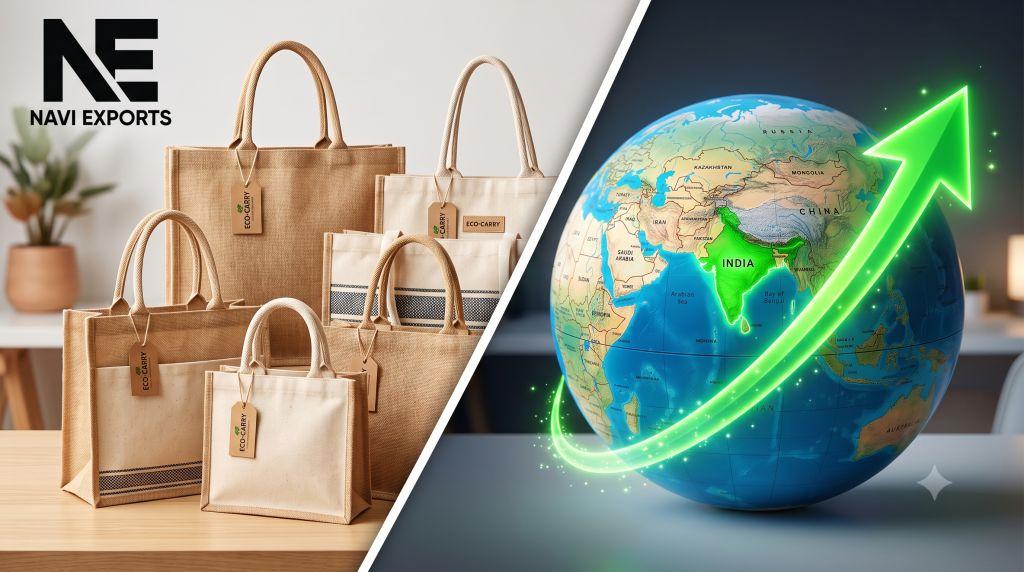
The core export category this guide is actually about. Plain, printed, and laminated jute tote bags serve retail chains, grocery stores, and promotional product buyers directly responding to plastic bag restrictions in their own markets. Shopping tote bags is the correct subcategory for this product, whether in jute, canvas, or jute-cotton blends.
Canvas Tote and Shopping Bags
Cotton canvas bags serve a similar end use to jute bags but appeal to a different segment of buyer, generally those wanting a softer hand-feel, more consistent print surface for branding, or a lighter-weight bag than jute typically offers. Canvas bags fall under the same shopping tote bags subcategory, and buyers should specify jute, canvas, or a blend clearly, since the compliance and pricing profile differs between them.
Jute Hessian and Sacking
Industrial and agricultural packaging, not retail bags. This is the traditional backbone of India's jute export trade, feeding food grain packaging (backed by India's own Jute Packaging Materials Act, which mandates jute for certain domestic foodgrain packaging) and industrial bulk material handling. Buyers in this category are typically agricultural commodity traders and industrial packagers, a distinct buyer profile from the retail eco-bag buyers driving the PPWR-related demand.
Custom Printed and Branded Jute Bags
A growing segment as corporate buyers, retailers, and event organizers move away from single-use plastic promotional items. Screen printing, digital printing, embroidery, and heat transfer are all commonly available finishing options from Indian manufacturers, and buyers should request physical samples of the actual print method they need rather than assuming all finishing techniques are equally durable on jute's coarser weave.
The Manufacturing Base
West Bengal: The Jute Industry's Center of Gravity
West Bengal hosts 86 of India's 116 jute mills, close to three-quarters of the country's total capacity, concentrated heavily around Kolkata. This is where the deepest manufacturing expertise sits, from raw fiber processing through to finished retail bag production, and it is the natural first stop for any buyer sourcing jute products from India at meaningful volume.
Bihar and Andhra Pradesh: The Secondary Producing States
Smaller but real jute cultivation and processing bases exist outside West Bengal, part of a broader industry footprint spanning roughly 6.62 lakh hectares of jute and mesta cultivation nationally.
MSME and Cottage-Level Production
A meaningful share of India's finished jute bag output, particularly reusable shopping bags, decorative packaging, and lifestyle products, comes from MSMEs, cottage units, and women-led rural enterprises rather than large mills. For buyers sourcing customized, lower-volume, or design-forward jute products, this is often the more relevant supplier tier than the large industrial mills that dominate hessian and sacking production.
Compliance: What EU-Bound Buyers Actually Need to Know
The PPWR Applies to Non-EU Manufacturers Selling Into the EU
This is the detail worth getting right. The regulation covers all packaging placed on the EU market regardless of where it was manufactured, including non-EU producers. It does not apply to packaging manufactured for export outside the EU, but if your jute or canvas bags are entering the EU market, whether as the product itself or as packaging for other goods, PPWR compliance is not optional.
Conformity Assessment and Declaration of Conformity
From August 12, 2026, manufacturers placing packaging on the EU market must complete a conformity assessment, compile technical documentation, and issue an EU declaration of conformity before the product enters the market. This is a real administrative step, not a formality, and buyers should confirm with their supplier or importer of record who is handling this requirement.
Recyclability and Material Requirements
The PPWR requires packaging to be recyclable by 2030 in an economically viable way, with waste reduction targets of 5% by 2030, 10% by 2035, and 15% by 2040 against a 2018 baseline. Jute and canvas bags, as natural, biodegradable, and reusable materials, are structurally well positioned against these requirements compared to synthetic alternatives, which is a genuine part of why demand is shifting toward them, not just marketing framing.
PFAS Restrictions in Food-Contact Packaging
If your jute or canvas bags are used in food-contact applications, PFAS restrictions apply from August 12, 2026. Confirm with your supplier what dyes, coatings, or treatments are used, since some water-resistant or stain-resistant treatments historically relied on PFAS compounds now restricted under the regulation.
GOTS and OEKO-TEX for Organic and Chemical-Safe Claims
For canvas bags specifically, GOTS certification is required for any organic cotton claim, and OEKO-TEX Standard 100 covers harmful substance testing more broadly. Neither is automatically implied by "eco-friendly" marketing language, and buyers making sustainability claims to their own customers should verify these certifications directly rather than accepting a supplier's general assurance.
BIS Quality Specifications
The Bureau of Indian Standards maintains quality specifications for jute goods domestically, which, while not an export requirement itself, functions as a reasonable baseline quality signal when evaluating an Indian jute manufacturer.
Government Support
Jute ICARE and National Jute Board Schemes
Government support for the jute sector spans cultivation assistance, technology upgradation, and market development. A recent five-year initiative committed roughly $13.4 million specifically toward marketing lifestyle and packaging jute products, aimed directly at growing the branded, export-facing segment of the industry rather than just traditional sacking.
Jute Packaging Materials Act
Domestically mandates jute packaging for certain foodgrain categories, which has the practical effect of guaranteeing baseline mill utilization and keeping India's jute processing capacity active and export-ready even independent of international demand cycles.
Raw Jute Minimum Support Price
The government's MSP framework for raw jute supports the roughly 40 lakh farming households whose livelihoods depend on the crop, stabilizing the raw material base that finished-goods exporters depend on.
How to Source or Export Jute and Canvas Bags from India
Step 1: IEC from DGFT
Mandatory before any export shipment.
Step 2: Confirm the exact material and construction
Jute, canvas, or a jute-cotton blend each carry different pricing, durability, and compliance profiles. Specify this in writing before production, not after receiving a sample.
Step 3: If targeting the EU, plan for PPWR compliance now
Confirm who handles the conformity assessment and declaration of conformity, whether that's you, your supplier, or an EU-based importer of record, before committing to a large order.
Step 4: Verify certifications directly rather than trusting marketing language
GOTS for organic cotton claims, OEKO-TEX for chemical safety, and BIS specifications as a general quality baseline for jute goods specifically.
Step 5: Match your buyer segment to the right supplier tier
Large-volume hessian and sacking orders toward established West Bengal mills, customized or design-forward retail tote bags toward MSME and cottage-level manufacturers who specialize in that segment.
Pre-Export Checklist
- IEC from DGFT
- GST registration in place
- RoDTEP rate confirmed for your specific HS code
- Material specification (jute, canvas, or blend) confirmed in writing
- PPWR conformity assessment and declaration of conformity arranged for any EU-bound shipment
- GOTS certification verified if making any organic cotton claim
- OEKO-TEX Standard 100 confirmed if chemical safety claims are part of your marketing to buyers
- PFAS-free dyes and treatments confirmed for any food-contact application
Related Navi Exports Categories
- Bags, Boxes, Cases & Luggage (main category)
- Shopping Tote Bags
- Cotton & Jute (Raw Material Commodity)
The Bottom Line
The EU's Packaging and Packaging Waste Regulation taking effect on August 12, 2026 is the actual news event behind the "eco-packaging surge" that gets mentioned constantly and explained rarely. It requires recyclability by 2030, restricts PFAS in food-contact packaging immediately, and makes producers financially responsible for their packaging's full lifecycle. India's jute industry, with over 60% of global production and 86 of its 116 mills concentrated in West Bengal, was already positioned for this shift before the regulation existed. What changed is that demand for genuinely biodegradable, reusable packaging just moved from consumer preference to legal requirement across a market of 27 countries.
The compliance side is real, not just marketing. Conformity assessment and a declaration of conformity are administrative steps that need an owner before a large EU order ships, and PFAS-free treatments matter specifically for any food-contact application. Buyers who verify GOTS and OEKO-TEX certifications directly, rather than accepting "eco-friendly" as a self-explanatory label, will be the ones actually positioned to meet their own downstream compliance obligations.
Data sources: GMI Insights Jute Market Report (2025), IBEF Jute Industry Export briefing and IBEF sustainable packaging blog (2026), IMARC Group India Jute Bags Market report (2026), European Commission Packaging and Packaging Waste Regulation announcement and Freshfields PPWR legal summary (August 2026), MarkWide Research Jute Bags Market report (2026).
Frequently Asked Questions
The EU's Packaging and Packaging Waste Regulation (PPWR) entered application on August 12, 2026, requiring packaging to be recyclable by 2030 and restricting certain PFAS chemicals in food-contact packaging immediately. This shifts biodegradable, reusable materials like jute and canvas from a marketing preference to a practical compliance advantage for EU-bound buyers.
India produces over 60% of the world's jute and has been the largest jute goods exporter for decades, with 86 of its 116 jute mills concentrated in West Bengal.
Jute bags, particularly tote and shopping bags, serve retail and promotional buyers responding to plastic restrictions. Jute hessian and sacking serve agricultural commodity and industrial bulk packaging buyers, a distinct market with different pricing and volume characteristics, even though both come from the same raw fiber.
It applies to any packaging placed on the EU market regardless of where it was manufactured, including non-EU producers like Indian jute bag exporters. It does not apply to packaging manufactured specifically for export outside the EU.
GOTS certification for any organic cotton claim, and OEKO-TEX Standard 100 for chemical safety testing. Neither is automatically implied by general "eco-friendly" marketing language, so these should be verified directly with the supplier.
Genuinely biodegradable. Independent research, including a TERI study cited by IBEF, confirms jute functions as a 100% recyclable natural material with real environmental advantages over polymer-based alternatives, requiring less fossil fuel input and generating minimal waste.
Europe, particularly Germany, has been a strong and growing market, alongside North America, Australia, and the Middle East. Retail chains, grocery stores, and promotional product companies are the primary buyer types, distinct from the agricultural and industrial buyers sourcing jute hessian and sacking.