 Sat, 03 Oct 2026
How India Is Becoming a Hub for Electronic Component Exports


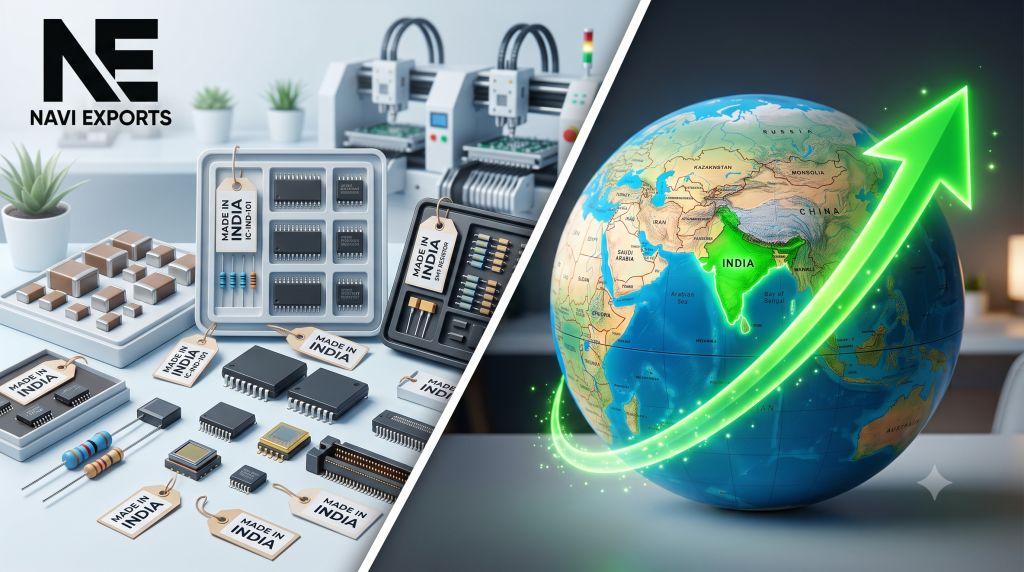
India's exports of printed circuit board assemblies to China rose more than 40-fold in FY26, reaching $1.5 billion, up from just $36 million a year earlier. Read that sentence again. China, the country every electronics guide describes as the world's manufacturing benchmark, is now buying circuit boards from India in meaningfully growing volume. Total PCBA exports from India hit $1.9 billion in FY26, a 20-fold jump, with nearly 80% of that going to China alone.
That is not a rounding error or a one-off trade anomaly. It is a real, if early, signal that India's electronic component manufacturing base has crossed a threshold most coverage of India's electronics sector hasn't caught up to yet. This guide covers what is actually happening across PCBs, semiconductors, sensors, and passive components: where India's real capability sits today, where it is still genuinely behind, and what that means for a buyer sourcing components rather than finished devices.
This piece covers upstream electronic components: PCBs, semiconductors, ICs, sensors, and passive components. Finished computing devices are covered in our IT Hardware guide, and finished mobile phone accessories in our dedicated Mobile Accessories guide. This category also technically lists Mobile Phones & Accessories as a subcategory, a cross-listing with that dedicated guide, so we're not re-covering that ground here.
The Numbers
| Metric | Data |
|---|---|
| India's total PCBA exports, FY26 | $1.9 billion (up 20-fold year-on-year) |
| India's PCBA exports to China specifically, FY26 | $1.5 billion (up 40-fold from $36 million) |
| Share of India's PCBA exports going to China | Nearly 80% |
| India's smartphone exports, FY26 | $29.4 billion (up 22%), India's single largest export item |
| Electronics sector export rank | 3rd largest and fastest-growing export category, FY24-25 |
| India's PCB market size, 2026 | $8.35 billion, projected to reach $25.48 billion by 2034 |
| Semiconductor projects approved under India Semiconductor Mission | 12 commercial facilities, 3 operational and producing |
| Approved semiconductor investment | Around ₹1,65,685 crore across six states |
| Kaynes Circuits India Tamil Nadu PCB investment (announced Aug 2026) | ~$570 million over six years |
| Semicon 2.0 outlay | ₹1,27,500 crore |
Sources: Business Standard and Communications Today reporting on India's PCBA export data (July 2026), IMARC Group Indian PCB Market Report (2026), Blitz India Media reporting on India Semiconductor Mission progress (August 2026), OpenPR/IMARC reporting on Kaynes Circuits India's Tamil Nadu investment (August 2026).
The China detail is worth sitting with rather than skimming past. It suggests Beijing is increasingly sourcing simpler, lower-value electronic assemblies from India as Chinese manufacturing moves further up its own value chain toward more advanced production. That is a genuinely different dynamic than the usual "India competing with China" framing, and it is a real opening for Indian PCB and component exporters specifically in the mid-complexity assembly segment.
The Product Categories
Printed Circuit Boards (PCBs)
The category behind the headline number. India's PCB market is growing at close to 15% annually, with bare PCBs making up 74% of manufacturing type and Maharashtra holding a dominant 29% regional share. Recent investment has moved beyond basic boards: Kaynes Circuits India's ~$570 million Tamil Nadu commitment, announced August 4, 2026, targets 74-layer PCBs, HDI (high-density interconnect) boards, flexible PCBs, and high-performance laminates, the more technically demanding end of the category that India has historically imported rather than made domestically. Printed circuit boards buyers should note that a genuine milestone landed in April 2026: copper-clad laminates, a key PCB input, began domestic commercial production in India for the first time.
Semiconductors and Microchips
This is where the front-end versus back-end distinction matters, and where most coverage of India's "semiconductor boom" gets imprecise. Of the 12 approved commercial semiconductor facilities under the India Semiconductor Mission, 3 are operational: Micron's ATMP facility in Sanand (inaugurated February 2026), Kaynes Semicon's OSAT unit in Sanand (commercial production from March 2026, 6 million chips per day capacity), and CG Power's OSAT facility in Sanand, built with Japan's Renesas Electronics. All three are back-end operations: assembly, testing, marking, and packaging of chips fabricated elsewhere. The front-end fab, the facility that actually manufactures silicon wafers, is Tata Electronics' partnership with Taiwan's PSMC at Dholera, targeting 50,000 wafers a month at the 28-nanometre node, with first silicon targeted for December 2026. Semiconductors and microchips buyers should understand this distinction clearly: India currently has real assembly, test, and packaging capacity, and is close to but not yet producing wafers domestically.
Electronic Components (ICs, Transistors, Diodes)
The broader passive and active component category feeding into both PCB assembly and finished electronics manufacturing. Electronic components demand has grown alongside the PLI-driven expansion of India's finished electronics manufacturing, since every smartphone, laptop, and appliance assembled domestically pulls component demand along with it.
Resistors, Capacitors and Inductors
Passive components represent some of the highest-volume, lowest-margin parts feeding electronics assembly, and a category where component makers from Japan, South Korea, and Taiwan have been filing expressions of interest to establish Indian manufacturing under ECMS specifically because of proximity to India's growing semiconductor assembly base. Resistors, capacitors, and inductors sourced domestically reduce a manufacturer's exposure to import lead times on parts that, individually, are inexpensive but collectively represent real supply chain risk if sourced entirely from abroad.
Sensors and Modules
A genuinely earlier-stage category compared to PCBs or semiconductor assembly. India's sensors and modules manufacturing base is growing alongside automotive electrification and IoT device demand, but detailed export-specific data for this category is thinner in public reporting than for PCBs or chips, which tells you something about where it sits in India's electronics manufacturing buildout.
Microcontrollers and Processors
Sits closer to the semiconductor design and packaging side of the industry. Microcontrollers and processors demand is being pulled directly by India's embedded systems and IoT device manufacturing growth, and by the broader shift toward domestically assembled automotive and industrial electronics.
Power Electronics Components
Directly tied to India's electric vehicle and renewable energy manufacturing growth. Power electronics components is one of the categories explicitly named in current semiconductor investment plans, since automotive-grade and power management chips are a stated target of India's current fab capacity, including the Dholera facility's intended end markets.
Electronic Displays, Connectors, Enclosures, and Embedded Systems
Electronic displays, connectors and terminals, electronic enclosures and housings, and embedded systems round out the component ecosystem, each feeding into the same broader trend: as India's PCB and chip assembly capacity has grown, the surrounding component categories that turn a bare board into a functioning device have grown alongside it.
Finished Consumer Electronics
A separate but related product tier: consumer electronics, audio devices and accessories, smart home devices, television and home entertainment, wearable electronics, media storage devices, remote controls and modules, and electronic repair tools. These are finished products built from the components covered above rather than components themselves, and buyers sourcing set-top boxes specifically should look under Consumer Electronics or Television & Home Entertainment here, since set-top boxes are not a Telecom Products category item despite sometimes being grouped there in generic trade coverage.
The Manufacturing Base
Sanand, Gujarat: India's Semiconductor Back-End Hub
Sanand now hosts three operational semiconductor facilities: Micron's ATMP plant, Kaynes Semicon's OSAT unit, and CG Power's OSAT facility built with Renesas. All three handle assembly, testing, and packaging rather than wafer fabrication, but together they represent India's first genuinely operational semiconductor manufacturing presence, not just approved investment on paper.
Dholera, Gujarat: The Front-End Fab
Tata Electronics' partnership with Taiwan's PSMC is building India's first true wafer fabrication facility here, a 300mm, AI-enabled fab targeting 50,000 wafer starts per month at the 28 to 110 nanometre node range, covering automotive, industrial, and consumer electronics applications rather than cutting-edge mobile processors. First silicon is targeted for December 2026.
Jagiroad, Assam
Home to Tata Electronics' Semiconductor Assembly and Test (TSAT) facility, extending India's back-end semiconductor capacity beyond the Gujarat cluster.
Bhubaneswar, Odisha
Site of SiCSem's Silicon Carbide fabrication facility, India's first commercial compound semiconductor fab, targeting power electronics applications in EVs and renewable energy systems specifically.
Tamil Nadu
Emerging as a major PCB manufacturing state following Kaynes Circuits India's ~$570 million investment commitment for high-layer-count and HDI PCBs, and Tata Electronics' separate $1.6 billion commitment including an internal rigid-flex PCB line intended to cut reliance on imported Vietnamese and Thai boards.
Maharashtra and Noida
Maharashtra holds close to 29% of India's PCB market by region, an established base predating the current wave of semiconductor investment. Dixon Technologies' Noida complex has been boosting domestic PCB sourcing ratios for its own electronics assembly operations since 2024.
Compliance: The Distinction That Actually Matters
Front-End Versus Back-End Is Not a Technicality
Most coverage of India's "semiconductor manufacturing boom" uses "semiconductor plant" to describe both wafer fabrication and chip assembly/testing/packaging, treating them as interchangeable. They are not. A back-end (ATMP or OSAT) facility takes chips fabricated elsewhere and assembles, tests, and packages them. A front-end fab actually manufactures the silicon wafer itself, a far more capital and technology-intensive process. As of current reporting, India has real, operational back-end capacity. Front-end fabrication is still under construction at Dholera. A buyer or investor evaluating "India semiconductor capability" needs to know which layer of the supply chain they are actually looking at.
RoHS and REACH for EU-Bound Electronic Components
Restriction of Hazardous Substances (RoHS) compliance and REACH chemical safety requirements apply to electronic components entering the EU market. These are baseline, well-established requirements, and any exporter without them in place is not export-ready for European buyers regardless of product quality.
Quality Certification for Automotive and Industrial Buyers
IATF 16949 matters specifically for components supplying automotive OEM buyers, similar to the standard covered in our Hardware & Mechanical Parts guide. General industrial and consumer electronics buyers typically look for ISO 9001 as a baseline instead.
The Import Dependency Layer Beneath the Fabs
Even India's operational semiconductor facilities depend heavily on imported ultra-pure chemicals, specialty gases, photoresists, masks, and precision equipment. This is the layer of the supply chain that remains the genuine bottleneck, not the headline fab announcements, and it is worth watching over the next several years as the real indicator of how self-sufficient India's semiconductor ecosystem actually becomes.
Government Support
India Semiconductor Mission and Semicon 2.0
The original mission committed ₹76,000 crore starting in December 2021. Semicon 2.0, approved more recently, adds a further ₹1,27,500 crore, a sign of both the scale of ambition and an acknowledgment that the first phase alone would not be sufficient to build a complete domestic semiconductor ecosystem.
Electronics Component Manufacturing Scheme (ECMS)
Covered in more depth in our IT Hardware and Mobile Accessories guides, ECMS specifically targets the component layer, PCBs, passive components, camera modules, and semiconductor substrates, that finished-device manufacturers need to source domestically to meet their own PLI local-content requirements.
State-Level Incentives
Gujarat's 2022-2027 Semiconductor Policy offers a 40% capital subsidy, stamp duty exemption, concessional utilities, and 75% land subsidy, explaining why the state has attracted four of the ten currently approved government semiconductor projects.
How to Source or Export Electronic Components from India
Step 1: IEC from DGFT
Mandatory before any export shipment.
Step 2: Identify which layer of the supply chain you actually need
Bare PCBs, populated PCBAs, back-end chip assembly and testing, or passive components each come from different supplier types and different clusters. Confirm this before sourcing rather than treating "electronic components" as one undifferentiated request.
Step 3: Confirm RoHS and REACH compliance for EU-bound orders
Baseline requirements, not optional extras, for any electronic component entering the European market.
Step 4: Match your product to the right cluster
PCBs toward Tamil Nadu's newly expanding base or Maharashtra's established one, semiconductor assembly and testing toward Sanand, passive components toward suppliers positioning specifically for ECMS-driven localization.
Step 5: For automotive-grade components, confirm IATF 16949
Particularly relevant for power electronics and components feeding EV manufacturing, one of the explicit target markets for India's current semiconductor investment.
Pre-Export Checklist
- IEC from DGFT
- GST registration in place
- RoDTEP rate confirmed for your specific HS code
- RoHS and REACH compliance confirmed for EU-bound components
- IATF 16949 confirmed if supplying automotive OEM buyers
- Correct supply chain layer identified (bare PCB vs. populated PCBA vs. back-end assembly vs. passive components)
- Supplier's ECMS or PLI scheme participation checked as an indicator of manufacturing scale and investment
Related Navi Exports Categories
The Bottom Line
India's electronic component export story genuinely turned a corner in FY26, and the PCBA export numbers to China are the clearest evidence of it: a 40-fold jump is not incremental growth, it is a real shift in where mid-complexity electronics assembly happens. But the semiconductor side of the story needs the front-end and back-end distinction to be read correctly. India has real, operational chip assembly, testing, and packaging capacity now. It does not yet have operational wafer fabrication, though Dholera is close, with first silicon targeted for December 2026.
For buyers, that means the mature, ready-now categories are PCBs, passive components, and back-end semiconductor services. The categories still building toward maturity are front-end chip fabrication and sensors. Knowing which category you're actually sourcing in, and which layer of the supply chain your supplier genuinely operates in, matters more here than in almost any other export category on this site, given how easily "semiconductor manufacturing" gets used loosely to describe very different capabilities.
Frequently Asked Questions
India's PCBA exports to China rose more than 40-fold in FY26, from $36 million to $1.5 billion, reflecting both India's growing PCB manufacturing capacity and China's own shift toward sourcing simpler, lower-value electronic assemblies as its domestic manufacturing moves up the value chain.
As of current reporting, India has operational back-end capacity, assembly, testing, and packaging, at three facilities in Sanand, Gujarat. Front-end wafer fabrication, the actual manufacturing of silicon wafers, is still under construction at Tata Electronics' Dholera facility, with first silicon targeted for December 2026.
Front-end fabrication manufactures the actual silicon wafer, a highly capital and technology-intensive process. Back-end operations (ATMP or OSAT) take wafers or chips fabricated elsewhere and handle assembly, testing, marking, and packaging. India currently has real operational back-end capacity but is still building its first front-end fab.
RoHS (Restriction of Hazardous Substances) compliance and REACH chemical safety requirements are baseline expectations for electronic components entering the EU market, regardless of the specific component category.
Maharashtra currently holds close to 29% of India's PCB market by region, an established base. Tamil Nadu is rapidly emerging following major investment commitments from Kaynes Circuits India (~$570 million) and Tata Electronics ($1.6 billion, including a dedicated rigid-flex PCB line).
Not fully. While assembly, testing, and packaging capacity is real and operational, India still imports most of the specialty chemicals, gases, photoresists, and precision equipment that fabs depend on, and front-end wafer fabrication is not yet in commercial production. This upstream supply chain layer remains the genuine constraint to watch.
Set-top boxes fall under Consumer Electronics or Television & Home Entertainment within the Electronic Products & Components category, since they function as consumer entertainment hardware rather than network infrastructure.