-
-
-
India's IT Hardware Export Potential: Laptops, Peripherals & Beyond
 Wed, 02 Sep 2026
India's IT Hardware Export Potential: Laptops, Peripherals & Beyond


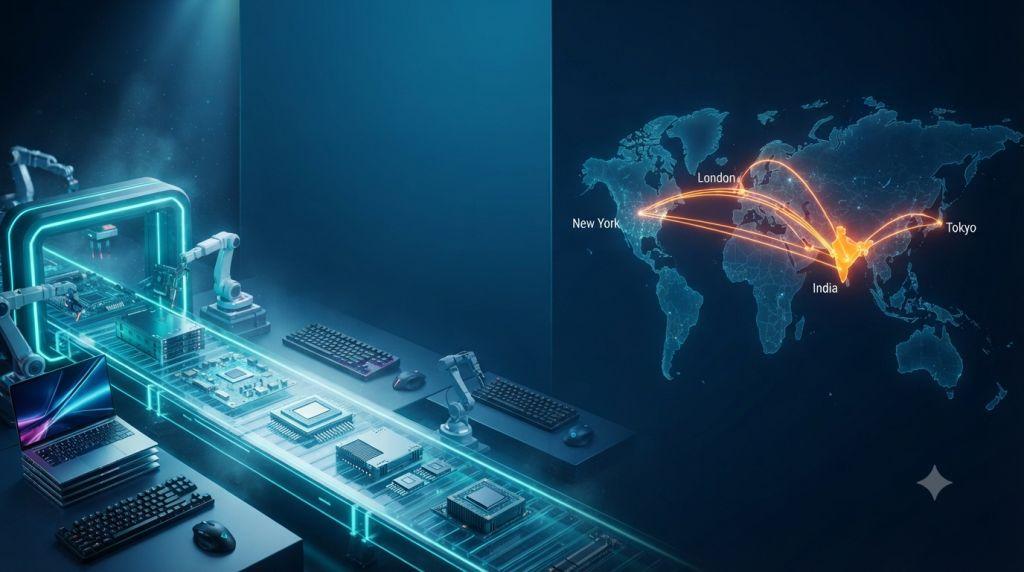
India currently makes enough laptops domestically to cover 10% to 20% of what it imports. The other 80% to 90% still comes from abroad, on an import bill that hit roughly $11 billion in FY24 alone. That gap, not some abstract "India is rising" narrative, is the actual story behind every laptop PLI announcement, every Tamil Nadu factory opening, and every trade headline about global brands eyeing India as a China alternative. The gap is real, it is large, and closing it is now explicit government policy backed by real money.
This piece covers where that gap actually stands today, the policy tools being used to close it (including a licensing saga that briefly rattled every major laptop brand selling in India), which clusters are doing the manufacturing, and where the genuine export opportunity sits for hardware, components, and peripherals over the next few years.
This guide focuses specifically on IT hardware: laptops, desktops, tablets, servers, and computer peripherals. Broader electronic components, PCBs, and semiconductor manufacturing are a distinct, larger story covered separately in a future guide on India's electronic components export sector.
The Numbers
| Metric | Data |
|---|---|
| India's laptop import bill, FY24 | Approximately $11 billion |
| Domestic capacity offset of laptop imports | 10% to 20% |
| PLI 2.0 for IT Hardware budgetary outlay | Rs 17,000 crore over six years |
| PLI 2.0 IT Hardware production so far (as of 2026) | Rs 24,385.89 crore cumulative |
| PLI 2.0 IT Hardware jobs created so far | Around 5,000 to 5,200 direct jobs |
| India's total electronics production, FY26 | Rs 13.11 lakh crore |
| Electronics production growth since 2014-15 | Nearly 7x (from Rs 1.9 lakh crore) |
| PLI for large-scale electronics (mobile-led) exports | Rs 6.43 lakh crore, 30%+ above original target |
| Tamil Nadu's share of India's electronics exports | Around 30% |
Sources: Business Standard reporting on PLI 2.0 laptop manufacturing (2025-2026), DD News and Indian Television reporting on Ministry of Electronics and IT (MeitY) data, EE Times reporting on PLI scheme investment figures, Indian Defence News Lok Sabha data (2026).
The gap between the Rs 17,000 crore allocated to IT hardware PLI and the Rs 24,385.89 crore already in cumulative production tells its own story. The scheme is producing more than its own incentive budget would suggest at this stage, which is a genuinely good sign for a program that, by most accounts, started slowly after its 2023 launch.
The Products in Scope
Laptops and Notebooks
The flagship product under PLI 2.0, and the one carrying the biggest import-substitution target. Syrma SGS, in partnership with Taiwan's MSI, now runs laptop production out of its Chennai Unit 3. Dell, HP, and Lenovo have all begun local production runs, with several international brands actively shifting capacity away from China specifically to hedge against ongoing US-China trade tension. This covers both standard laptops and notebooks and the smaller but growing gaming laptops and PCs segment.
Desktops, All-in-One PCs, Mini PCs, and Servers
Covered under the same PLI 2.0 umbrella as laptops, sharing the HSN 8471 classification that became central to India's 2023 import policy fight. This spans traditional desktop computers, all-in-one computers, and increasingly mini PCs and workstations. Server manufacturing in particular is a smaller but strategically watched category, since data localization rules in India are pushing more server demand toward domestically manufactured or assembled units.
Computer Components and Peripherals
This is where the real product-level export depth sits: motherboards and processors, graphic cards and GPUs, RAM and memory modules, solid state drives and external hard drives, computer monitors, keyboards and mouse, webcams and headsets, printers and scanners, computer power supplies, cooling fans and heatsinks, laptop chargers and batteries, computer cables and connectors, USB flash drives, and networking devices like routers and switches. This category gets far less policy attention than laptops but represents real, achievable export volume, particularly for Indian manufacturers already supplying the domestic market at scale and looking to move into export.
Office and Business IT Equipment
Printers and scanners, projectors and presentation equipment, conference and meeting equipment, photocopy machines, POS systems and cash registers, telecommunication equipment, and security and surveillance systems sit adjacent to the core IT hardware category, covered under Navi Exports' Business Services & Equipments category rather than Computers, Laptops & Peripherals specifically.
The Policy Story: How India Got Here
The 2023 licensing scare
In August 2023, the government announced that laptops, tablets, all-in-one PCs, and servers under HSN 8471 would move to "restricted" import status effective November 1, 2023, requiring a valid import license for every shipment. Apple, Dell, HP, Cisco, Intel, Samsung, Acer, and Asus all pushed back hard, and Washington reportedly weighed in as well. The government deferred the deadline, then replaced the licensing plan entirely with an "import management system": companies register the quantity and value of what they import, but no shipment gets rejected. It is a monitoring tool, not a quota.
Why that distinction matters for exporters
The import management system was never really about restricting supply to Indian consumers. It was about generating the data and the policy leverage to push global brands toward local manufacturing without triggering a trade dispute or a consumer price shock. Reading it as "India banned laptop imports," which a lot of surface-level coverage did in 2023, misses the actual mechanism entirely.
PLI 2.0 for IT Hardware
Launched in May 2023 with a six-year, Rs 17,000 crore outlay, offering an average 5% incentive on net incremental sales of domestically manufactured devices, with local component sourcing requirements that increase over the scheme's life. This is the carrot that runs alongside the import monitoring stick.
The mobile manufacturing precedent
None of this happened in a vacuum. India's earlier PLI scheme for large-scale electronics manufacturing, aimed primarily at smartphones, has already produced Rs 97 billion (approximately $97 billion) in cumulative production and $53.4 billion in exports as of mid-2025, with smartphones now ranking among India's top individual export commodities, a category that barely registered a decade ago. IT hardware PLI is explicitly modeled on that success, at an earlier stage of its own curve.
The Manufacturing Clusters
Tamil Nadu: The Electronics Export Leader
Tamil Nadu hosts 47 electronics manufacturing units backed by various MeitY schemes and contributes roughly 30% of India's total electronics exports, the largest state share in the country. Seven of the 27 approved units under the large-scale electronics PLI scheme are based here. Chennai and Sriperumbudur specifically host Foxconn, Dell, and Flextronics operations, making the region India's closest equivalent to a dedicated electronics export corridor.
Noida and Greater Noida
Home to major smartphone assembly for Samsung, Oppo, and Vivo, with growing crossover into broader IT hardware and peripheral manufacturing as the supplier ecosystem around these plants matures.
Bengaluru
Strong in industrial and precision electronics through players like Bosch, ABB, and Siemens, complementing the city's existing software and semiconductor design ecosystem.
Pune
Concentrated in automotive electronics, an adjacent category to core IT hardware but increasingly relevant as vehicles absorb more computing hardware per unit.
Hyderabad
Positioned around semiconductors and defence electronics, upstream of the finished IT hardware category but critical to the domestic component supply chain that PLI schemes are trying to build.
Compliance and Practical Considerations for Buyers and Exporters
Import authorization for anyone bringing IT hardware into India
Businesses importing laptops, tablets, or servers into India, for resale, R&D, or internal use, need to register under the current import management system via DGFT. Certain exceptions exist for R&D, testing, benchmarking, evaluation, repair, and re-export.
HS classification
Laptops, tablets, all-in-one PCs, and servers fall under HSN 8471. Confirm the exact subheading and whether your product configuration triggers PLI-related domestic sourcing thresholds if you are a manufacturer applying for the incentive rather than a pure trader.
Local value addition requirements
PLI 2.0 requires increasing local component use year over year to maximize incentive eligibility. Exporters and manufacturers alike should track this closely since incentive rates are tied directly to sourcing compliance, not just production volume.
Data localization considerations for servers
India's data localization push has created real, if narrower, domestic demand for server hardware assembled or manufactured within the country, a smaller but genuinely distinct opportunity from the consumer laptop story.
Government Support Beyond PLI 2.0
Electronics Component Manufacturing Scheme (ECMS)
Targets Rs 59,350 crore in investment and over 91,600 direct jobs across its tenure, with 75 applications covering 23 product categories already approved. This scheme sits upstream of finished IT hardware, building the component base that PLI-backed laptop and server manufacturers increasingly need to source domestically to hit their incentive thresholds.
Scheme for Promotion of Manufacturing of Electronic Components and Semiconductors (SPECS)
Alongside the Modified Special Incentive Package Scheme (M-SIPS), this has been central to building Tamil Nadu's position as India's leading electronics export state.
India Semiconductor Mission
Backing chip fabrication, OSAT, and display fab investment with over $15 billion approved so far, involving players like Micron, Tata, and CG Power. This is the longest-horizon piece of the puzzle, but it is the one that ultimately determines how much of a "Made in India" laptop is actually made in India rather than assembled from imported chips.
Tax and FDI reforms
Basic customs duty exemptions on capital goods and 100% FDI permitted in electronics manufacturing have supported $4.07 billion in total electronics manufacturing FDI between FY2021 and FY2025, with $2.8 billion of that tied directly to companies participating in MeitY's PLI schemes.
How to Position as an Exporter or Buyer in This Space
Step 1: IEC from DGFT
Mandatory before any export shipment, standard across all categories.
Step 2: Confirm HSN classification
8471 for laptops, tablets, all-in-one PCs, and servers. Peripherals generally fall under related but distinct HS headings, worth confirming individually rather than assuming they share the same code as the core devices.
Step 3: If manufacturing under PLI, track local sourcing thresholds actively
Incentive eligibility is tied to increasing domestic component use year over year, not a one-time qualification.
Step 4: Watch the semiconductor and component supply chain, not just final assembly
The real long-term export competitiveness question is how much of the value-add stays in India versus how much is imported chips and components assembled locally. ECMS and the India Semiconductor Mission are the schemes actually addressing that gap.
Step 5: Target peripherals and business IT equipment as a lower-competition entry point
Laptops draw the most policy attention and the most global brand competition. Peripherals and office IT equipment carry less PLI spotlight but represent genuine, achievable export volume for manufacturers not competing head-on with Dell, HP, and Lenovo's local operations.
Related Navi Exports Categories
The Bottom Line
India's IT hardware export story is really a story about closing an import gap, not about an export boom that has already arrived. The country still imports the large majority of the laptops it uses. What has changed is the policy architecture: PLI 2.0's incentive structure, an import monitoring system that survived a genuine trade standoff without becoming an outright ban, and a component-manufacturing push through ECMS and the Semiconductor Mission that is trying to make sure "Made in India" eventually means something more than final assembly.
Tamil Nadu's 30% share of national electronics exports shows this can work at scale when the ecosystem matures. The open question for the next few years is whether IT hardware specifically follows the smartphone PLI's trajectory from slow start to genuine export strength, or whether the semiconductor and component dependency proves harder to shake than it did for phones. Either way, the peripherals and business IT equipment categories offer a real opening for exporters who do not need to out-compete Dell and HP directly to find buyers.
Frequently Asked Questions
Domestic capacity currently offsets only 10% to 20% of India's total laptop imports, which reached approximately $11 billion in FY24. The remaining 80% to 90% is still imported, primarily from China and other established manufacturing hubs.
A Rs 17,000 crore, six-year government incentive scheme launched in May 2023, offering an average 5% incentive on net incremental sales of domestically manufactured laptops, tablets, all-in-one PCs, and servers, with increasing local component sourcing requirements over time.
No. India announced a licensing requirement for laptops, tablets, and servers in August 2023, then deferred and ultimately replaced it with an "import management system" in which companies register import quantity and value for monitoring purposes, with no shipments rejected. It functions as a data and policy tool rather than a quota or ban.
Tamil Nadu, accounting for roughly 30% of India's total electronics exports and hosting 47 manufacturing units under various MeitY schemes, including 7 of the 27 approved units under the large-scale electronics PLI scheme.
Dell, HP, and Lenovo have all started local production. Syrma SGS manufactures laptops for Taiwan's MSI out of its Chennai facility. Foxconn and other contract manufacturers also operate electronics assembly plants in Tamil Nadu.
PLI 2.0 for IT Hardware incentivizes assembly and manufacturing of finished devices like laptops and servers. The India Semiconductor Mission funds chip fabrication, packaging (OSAT), and display manufacturing further upstream, addressing the component dependency that finished-device manufacturers still rely on imports to fill.
Yes, and arguably with less competitive pressure than laptops specifically. Peripherals like keyboards, mice, monitors, and printers draw far less policy and global-brand attention than laptops, leaving real room for Indian manufacturers to build export volume without competing directly against Dell, HP, or Lenovo's local operations.