 Tue, 14 Apr 2026
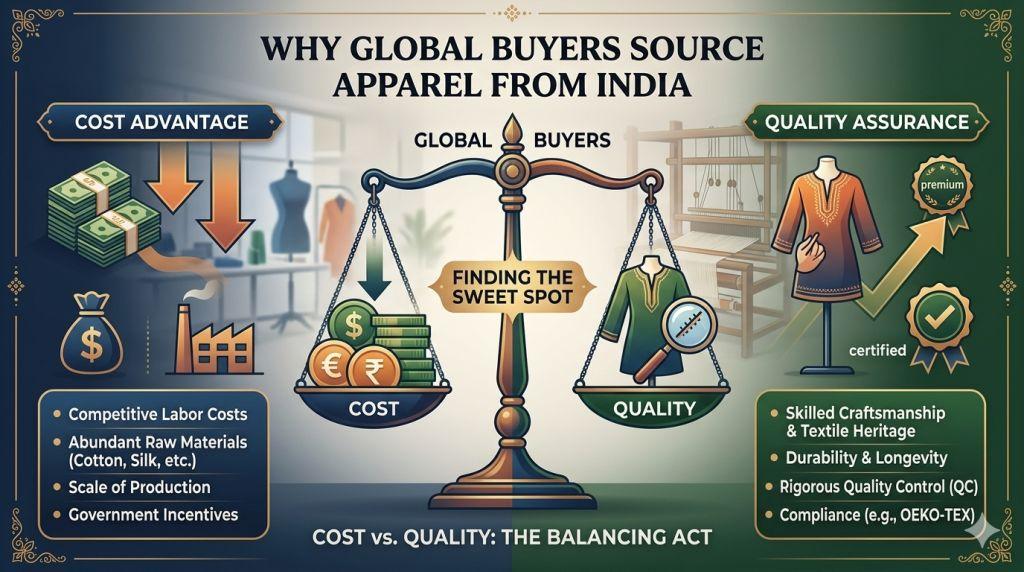
Why Global Buyers Source Apparel from India: Cost vs Quality


India shipped $15.99 billion in ready-made garments in FY2024-25 - a 10% jump from the year before. That number does not happen by accident.
Behind it is a sourcing shift that has been building for years: US fashion companies, European retailers, and Middle East distributors are moving orders to India faster than they are to almost any other country. In the 2024 USFIA (US Fashion Industry Association) benchmarking survey, India jumped past Bangladesh to become the third most-used apparel sourcing base for US fashion companies, after China and Vietnam. Nearly 60% of respondents said they planned to expand India sourcing in the next two years.
That is a significant vote of confidence. But what is actually driving it? This guide covers the real reasons - cost structure, quality positioning, supply chain depth, government backing, and where India beats (and sometimes loses to) competitors.
India's Apparel Export Industry at a Glance
Before getting into the comparison, some context on the scale:
- India's total textile and apparel exports hit $37.8 billion in FY2024–25, up 6% year-on-year
- Apparel (ready-made garments) accounts for 43.4% of that - the largest single category
- The Indian textile market was valued at $146.55 billion in 2024 and is projected to reach $213.51 billion by 2033
- India employs 45 million people directly in textiles and apparel, and around 100 million across the allied sector
- In FY25, T&A made up 8.63% of India's total merchandise exports
The government has set a target of $100 billion in textile exports by 2030 - with $40 billion coming from apparel alone. That ambition is backed by real policy: the PLI scheme's textile allocation jumped from $5.15 million in 2024–25 to $131.5 million in 2025-26.
Sources: Ministry of Textiles, PIB India | IBEF Apparel Industry Report
1. The Cost Picture - Not the Cheapest, But Often the Best Value
This is where most sourcing articles get it wrong. They compare India to Bangladesh on hourly wages and conclude India is expensive. That is a narrow read.
Bangladesh minimum wages are roughly $95-100/month. India's garment workers earn $150–$250/month depending on state and skill level. On raw labor cost alone, Bangladesh wins for bulk basics.
But consider what that labor cost actually buys you:
Productivity per worker - India produces more output per worker hour in value-added categories. Embroidery, smocking, detailed finishing, complex cuts: these are not Bangladesh's sweet spot.
Quality rejection rates - Low wages do not mean low defect rates. Bangladesh factories producing $2-3 T-shirts carry real quality management overhead. For premium and mid-tier apparel, Indian factories typically run tighter QC.
Product mix - In Jan–Oct 2024, over 45% of India's apparel newly introduced to the US retail market targeted the luxury and premium segment, nearly matching China's 50% and far ahead of Bangladesh (13%) and Vietnam (20%). Indian-made clothing sold in US mass-market retail was priced higher than Bangladesh and Vietnam equivalents - buyers were paying more and accepting it because the product justified it.
The US Fashion Industry Association's own framing: India is increasingly viewed as "a cost-effective alternative to China for high-quality, value-added clothing." Not Bangladesh's lane. China's lane, at better prices.
For buyers sourcing basics - plain T-shirts, underwear, commodity knitwear - Bangladesh is probably cheaper. For anything with design complexity, embellishment, or quality requirements that matter for brand positioning, India often delivers better value per dollar.
Related reading on Navi Exports: Browse Indian Apparel & Accessories Exporters | Textile Products & Fabric
2. Supply Chain Depth - India Controls Its Own Raw Materials
This one does not get enough attention in sourcing guides.
India grows its own cotton. It is one of the world's largest cotton producers, supporting around 6 million farmers. The domestic textile value chain runs from farm to finished garment without leaving the country - spinning, weaving, dyeing, printing, garmenting, all integrated.
Bangladesh cannot say the same. Bangladesh manufactures about 85% of its own knit fabric but only about 40% of the woven fabric it needs - the rest gets imported, mostly from India and China. That import dependency adds lead time. When global supply chains clog (as they did during the Red Sea disruptions in early 2024, and again during Bangladesh's 2024 political crisis), factories without domestic raw material access feel it harder.
India's vertical integration is a real operational advantage. When you place an order in India, you are not waiting for fabric from another country before production can start.
India also has 977 SA8000-certified units (social accountability standard) compared to 606 in China and just 4 in Bangladesh. It produces 40% of the world's Fair Trade cotton and has 217 GRS (Global Recycled Standard) certified facilities. If your brand has sustainability commitments - and in 2025, most mid-to-large retailers do — India's supply chain infrastructure supports them in ways Bangladesh simply cannot match today.
3. Product Range and MOQ Flexibility
One of the most underappreciated edges India has is range.
India's factories cover cotton kurtas and kaftans, silk saris, performance activewear, technical workwear, luxury women's occasion wear, children's clothing, and everything in between. The Herfindahl-Hirschman Index (used to measure product concentration in US import data) shows Indian apparel imports are more diversified across categories than virtually any other Asian supplier.
For smaller and mid-market brands, minimum order quantity (MOQ) matters. Bangladesh's large factory model is designed for massive uniform orders - 10,000 units of the same T-shirt. India has small boutique manufacturers handling 300-unit runs alongside large exporters doing 50,000+.
In the 2024 USFIA survey, respondents rated India's sourcing flexibility and agility second only to China - above Bangladesh, Cambodia, and Central America. India's ability to quickly adjust delivery volume and product mix is a genuine differentiator.
That flexibility is partly cultural. English is widely spoken in Indian manufacturing centers. Indian exporters generally understand Western brand requirements and communication styles. It is a softer factor, but it matters when things go sideways - as they sometimes do in any supply chain.
4. Key Apparel Manufacturing Clusters in India
Buyers often do not know where to start geographically. Here is a quick map:
Tirupur, Tamil Nadu - India's knitwear capital. T-shirts, sportswear, casual knits for volume buyers. Highly export-oriented with good port access.
Surat, Gujarat - Synthetic fabrics and embroidered garments. Strong in women's ethnic wear and polyester-based fashion.
Delhi NCR (Gurugram, Noida, Faridabad) - Fashion garments, western wear, denim. Home to many mid-sized exporters who handle international brands.
Mumbai/Dharavi - Large-scale garment production with direct port access. Strong in denim and casual wear.
Ludhiana, Punjab - Knitwear, hosiery, woolens. Particularly strong for winter wear categories.
Jaipur, Rajasthan - Handblock print, ethnic, artisanal. High demand in the artisan-to-retail segment for EU and US buyers.
Kolkata, West Bengal - Jute, handloom, and value-added wovens.
Each cluster has its specialty. Finding the right region for your product category makes a real difference on both price and quality.
5. Government Support That Actually Moves the Needle
India's government has been unusually consistent in backing apparel exports with real money and policy change. The initiatives worth knowing about if you are sourcing from India:
PM MITRA Parks - Seven Mega Integrated Textile Region and Apparel parks being set up across Tamil Nadu, Telangana, Gujarat, Karnataka, Madhya Pradesh, Uttar Pradesh, and Maharashtra. Each spans 1,000 acres, bringing the entire value chain - spinning to garmenting - under one integrated ecosystem with plug-and-play infrastructure. Total outlay: ₹4,445 crore over seven years. These parks are designed to cut logistics costs and reduce lead times substantially. → Ministry of Textiles: PM MITRA
PLI Scheme for Textiles - The Production Linked Incentive scheme covers MMF (man-made fibre) apparel and technical textiles, with a budget that rose sharply to $131.5 million in 2025–26. 74 applications selected, with projected investment of ₹28,711 crore expected to generate ₹2,16,760 crore in turnover and 2.59 lakh jobs. → PLI Scheme Details, DPIIT
RoSCTL Scheme - Rebate of State and Central Taxes and Levies on Export of Garments. Effectively a tax rebate that improves the cost position of Indian garment exporters in global markets.
AEPC (Apparel Export Promotion Council) - The official government body for apparel exporters. Runs Buyer-Seller Meets globally, provides market intelligence, trade show participation, compliance support and sustainability certification assistance. The body to contact if you want to find verified exporters. → AEPC Official Site
India–EU and India–US FTAs - Both free trade agreements have been signed recently. These give Indian exporters better tariff access to two of their largest markets and reduce the historical duty disadvantage compared to Bangladesh (which has LDC duty-free status in the EU).
SAMARTH Skilling Programme - Government-backed upskilling for garment workers. Directly addresses quality consistency by improving worker capability at the factory floor level.
These are not vague promises. The PLI scheme alone has committed investments of ₹1.76 lakh crore across all sectors as of early 2025, with 806 approved applications. The textile piece of this is being implemented.
6. India vs. Bangladesh vs. China: An Honest Comparison
Most comparison articles pick a winner and oversimplify. Here is a more honest take:
| Factor | India | Bangladesh | China |
|---|---|---|---|
| Labor cost | $150–250/month | $95–100/month | Higher |
| Product complexity | High | Low-medium | Very high |
| MOQ flexibility | High | Low | Medium-high |
| Raw material self-sufficiency | Very high | Low (woven) | Very high |
| Sustainability credentials | Strong | Improving | Mixed |
| Lead time | 60–90 days | 90–120 days | 45–70 days |
| Premium segment fit | Strong | Weak | Very strong |
| Language/communication | Easy (English) | Moderate | Variable |
| Political stability risk | Low | Higher (2024 disruption) | Geopolitical risk |
Bangladesh makes sense for: very high volume, price-sensitive basics, buyers who are comfortable with long lead times and can manage factory compliance themselves.
China makes sense for: complex tech-intensive garments, buyers who need China's full raw material ecosystem, or brands where speed and automation matter most.
India makes sense for: value-added and differentiated apparel, brands needing flexibility on MOQ and product range, buyers with sustainability compliance requirements, and any sourcing strategy that wants to reduce China dependence without going all the way down-market.
7. What Buyers Are Getting Wrong About India
A few real gaps in how many international buyers currently think about India:
They assume India is only for ethnic wear. Not true. Tirupur alone does hundreds of millions of dollars in sportswear and casual knits for global brands annually. The product range is far broader than many buyers realize.
They compare FOB unit prices without factoring rejection rates and compliance costs. A marginally cheaper FOB price from a Bangladesh supplier that requires two rounds of QC inspection and one factory audit every year may not actually be cheaper in total.
They do not account for lead time risk in long supply chains. When Bangladesh faced political disruption in mid-2024, some brands scrambled. Indian suppliers absorbed some of that overflow. Diversified sourcing between India and Bangladesh (rather than all of one) is a risk management move, not just a cost optimization.
They underestimate how fast India's sustainability infrastructure has built out. 977 SA8000 certified units, 217 GRS facilities, and 40% of global Fair Trade cotton production - this is not a country struggling to meet ESG compliance. EU buyers facing incoming mandatory due diligence requirements should take this seriously.
8. How to Start Sourcing Apparel from India
The practical steps for international buyers:
- Define your product category first. Knitwear? Woven bottoms? Embellished women's wear? Technical workwear? The right supplier region depends entirely on what you are making.
- Use verified platforms. Random Google searches for "Indian garment manufacturer" will get you hundreds of unvetted contacts. Use platforms like Navi Exports where exporters have submitted credentials and can be compared directly.
- Request samples before any bulk order. Standard practice, but worth saying: any legitimate Indian exporter will offer sampling. Use the sampling process to test both quality and communication responsiveness.
- Understand certifications relevant to your market. EU buyers need GOTS, OEKO-TEX, or GRS certifications depending on product. US buyers need CPSC compliance for children's clothing. Ask AEPC or your freight forwarder which apply to your specific product.
- Build in real lead times. Indian exporters typically need 60–90 days from order confirmation to shipment. Plan accordingly - especially for seasonal ranges.
- Consider visiting manufacturing clusters. Delhi NCR, Tirupur, and Surat all have buyer-facing infrastructure. Meeting suppliers in person, or sending a quality agent, changes the relationship significantly.
Related categories on Navi Exports:
- Apparel & Accessories Exporters
- Textile Products & Fabric
- Yarn, Threads & Fiber
- Leather & Leather Products
- Fashion Accessories
CONCLUSION
India is not the cheapest place to make a T-shirt. It is also not trying to be.
What India offers is a complete textile supply chain, genuine product range from basics to luxury, a workforce that can handle complex and embellished garments, a government investing real money in export infrastructure, and a sustainability track record that competing countries are still building toward.
The 60% of US fashion companies planning to expand India sourcing in the next two years are not doing it because they ran out of ideas. They are doing it because the math works for value-added garments, because the China-plus-one strategy needs somewhere to land, and because the 2024 Bangladesh political disruption was a reminder that single-country sourcing concentration is a risk.
India's apparel export sector posted 10% growth in FY25. The trajectory is up. If you are a buyer who has been meaning to add India to your sourcing strategy but has not done it yet, the window for getting ahead of the curve is still open — but it is narrowing as more buyers figure this out.
Frequently Asked Questions
Indian garment labor costs are higher ($150–250/month vs. $95-100/month in Bangladesh), but India offers better value for complex, embellished, or premium garments. For basic commodity items, Bangladesh may have a lower FOB price. For value-added products, India typically wins on total cost including QC, compliance, and rejection rates.
Tirupur for knitwear, Surat for synthetics and embroidered fashion, Delhi NCR for western wear and fashion garments, Ludhiana for woolens and knitwear, Jaipur for artisan and block-printed products, and Mumbai for denim and casual volume production.
Yes. India has 977 SA8000-certified units, 217 GRS (Global Recycled Standard) facilities, and produces 40% of the world's Fair Trade cotton. GOTS and OEKO-TEX certified mills are widely available.
Navi Exports connects international buyers with verified Indian apparel exporters across all categories — from knitwear to embroidered fashion to technical textiles. Browse the Apparel & Accessories category to start.
The Government of India has set a target of $100 billion in total textile exports by 2030, with $40 billion specifically from apparel. The sector currently exports around $16 billion annually in ready-made garments.