 Sat, 13 Jun 2026
Machinery Export from India: Key Sectors and Buyer Countries


India's engineering goods exports reached a record $116.67 billion in FY25 - up 6.74% year-on-year, outpacing total merchandise export growth by a factor of nearly 70. Engineering goods now account for 26.67% of India's total merchandise exports, the largest single category.
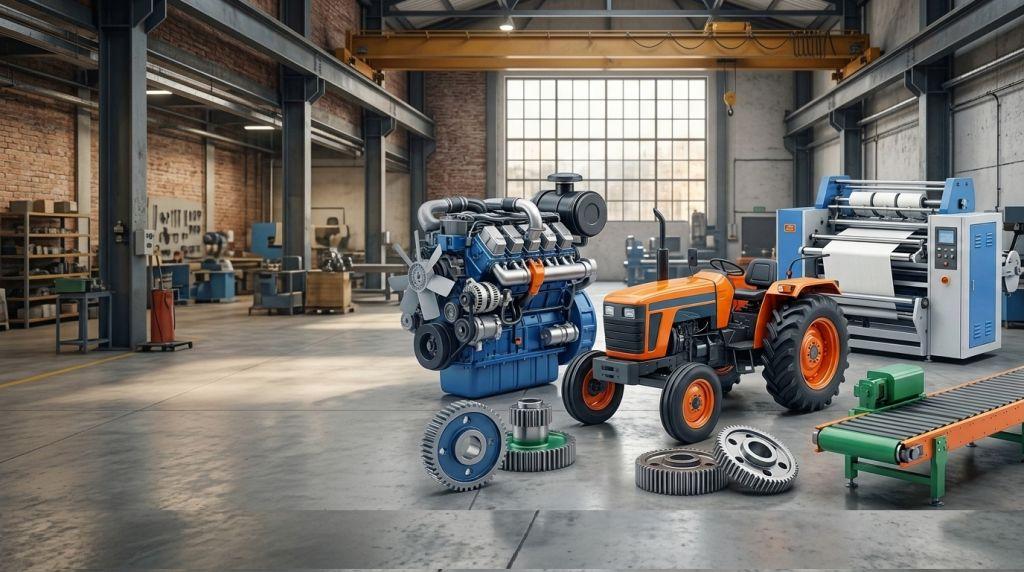
Machinery sits inside that number. The specific figure for HS Chapter 84 machinery (nuclear reactors, boilers, mechanical appliances) is approximately $14 billion in export value annually. But to understand India's true machinery export position, you have to look beyond that single chapter. Agricultural equipment, construction machines, textile machinery, pumps, power generation equipment, and auto components all have their own export footprints, their own buyer bases, and their own compliance requirements.
This guide covers six major machinery sectors, the companies that lead them, the countries that buy, and what new exporters need to understand before shipping the first unit.
One upfront note on framing: India's machinery export position is uneven. In some categories - mid-range agricultural equipment, submersible pumps, certain industrial machinery - India competes globally on quality and price simultaneously. In others - high-precision CNC machining centers, semiconductor fab equipment, advanced robotics - India is a buyer, not a seller. Knowing which side of that line your product sits on matters more than any general statement about India being a "machinery exporting nation."
The Sector Snapshot
| Machinery Segment | Approximate Export Value | Key Buyers |
|---|---|---|
| Engineering goods total (incl. machinery) | $116.67B FY25 (record) | USA, UAE, Saudi Arabia, Germany, Italy |
| Machinery (HS Ch. 84) | ~$14 billion | USA, UAE, Bangladesh, Indonesia, Saudi Arabia |
| Agricultural machinery | Significant sub-segment | Bangladesh, Nepal, Africa, Middle East |
| Construction equipment | ~$1-2B range | Africa, Southeast Asia, Middle East |
| Pumps and fluid handling | Strong segment | USA, Europe, Middle East, Africa |
| Textile machinery | ~$530M (Rs 44.51B FY24) | Bangladesh, Sri Lanka, Central Asia, Africa |
| Power equipment (BHEL-led) | Growing | Africa, Southeast Asia, South Asia |
Top 5 engineering goods export destinations FY25: USA (20.5% share), EU (17.1%), West Asia-North Africa (16.7%), followed by growing markets in Southeast Asia and Africa.
1. Agricultural Machinery - India's Volume Story
Agricultural machinery is where India punches above its weight globally. The country is one of the world's largest tractor manufacturers and exporters. Its farm equipment sector produces products designed for conditions that resemble much of Asia, Africa, and parts of Latin America - small-to-medium landholding farms, variable terrain, tropical and semi-arid climates.
What gets exported:
Tractors - India is the world's largest tractor market domestically and a significant exporter. Mahindra & Mahindra, TAFE, Escorts-Kubota, Sonalika, and Force Motors are the major manufacturers. Export destinations include the USA, Africa, Southeast Asia, and Central Asia. Mahindra Tractors has a US distribution network - an Indian brand in a Midwestern dealership is now a reasonably normal sight.
Combine harvesters - India's combine harvester sector has grown substantially. Claas, CNH Industrial (Case-New Holland), and domestic manufacturers produce combines in India for both domestic and export markets. Bangladesh and Nepal are consistent buyers of Indian combine harvesters.
Rice transplanters and cultivation equipment - Designed specifically for paddy cultivation. Bangladesh, Sri Lanka, Indonesia, and Vietnam buy these products because the cultivation conditions match India's paddy belt.
Irrigation equipment - Drip systems, sprinkler systems, micro-irrigation hardware. India is one of the world's largest producers of drip irrigation equipment (Jain Irrigation, Netafim India, Rivulis). Export markets span Africa, the Middle East, and South Asia where water-efficient agriculture is a priority and government programs are actively subsidizing equipment upgrades.
Threshers, tillers, and small farm equipment - High volume, lower-cost products for markets where small-holder farmers need affordable equipment. Bangladesh, Nepal, and sub-Saharan African markets buy these at scale.
The cluster picture: Rajkot in Gujarat produces a large share of India's small farm equipment. Bhopal and Madhya Pradesh are important for larger agricultural machinery. Chandigarh area for Punjab-origin equipment.
The honest competition picture: For tractors specifically, India's manufacturers compete against Japanese (Kubota, Yanmar) and Korean (LS Tractor) machines in Southeast Asia and US markets. India's competitive advantage is price - a comparable-spec Indian tractor costs 15-30% less than a Japanese equivalent - but the gap in operator cabin quality and precision electronic systems is real and matters for premium market segments.
2. Construction Equipment - Underplayed Export Strength
India's construction equipment sector is often discussed as an import market - JCB, Komatsu, Caterpillar all manufacture here - but the export side is growing.
The key players:
JCB India - JCB's India manufacturing operations in Ballabgarh and Vadodara produce backhoe loaders, compactors, and telescopic handlers for export to Africa, Southeast Asia, and Middle East markets. JCB India is explicitly one of JCB's global manufacturing hubs, not just a domestic plant.
Tata Hitachi - Excavators and construction machinery. Export to Africa and Southeast Asia has been building. The Dharwad, Karnataka plant was set up partly for export capacity.
L&T Construction Equipment - Cranes, material handlers, and specialized construction machines. L&T's engineering division exports across infrastructure sectors.
CASE India and Komatsu India - Both companies produce locally for export to specific regions.
What the market buys from India: Mid-range backhoe loaders, compactors, motor graders, and small-to-medium excavators. Africa is the primary market because Indian pricing is competitive against European alternatives and product durability in tropical/dusty conditions has been validated. Nigeria, Kenya, Tanzania, Ghana, and Ethiopia are consistent buyers. The Gulf construction market (Saudi Arabia, UAE) buys Indian construction equipment at the lower-to-mid price tier.
India's specific advantage in construction equipment: The Indian market itself is brutal on machinery - dusty roads, extreme heat, variable operators, minimal maintenance infrastructure. Equipment that survives Indian construction site conditions has already been stress-tested for much of Africa and Southeast Asia's equivalent environments. That earned reliability is a real selling point.
3. Pumps and Fluid Handling - A Quiet Export Leader
Coimbatore in Tamil Nadu is, without exaggeration, one of the most concentrated pump manufacturing clusters in the world. The city produces submersible pumps, centrifugal pumps, sewage pumps, fire pumps, and agricultural water pumps in volumes that supply both domestic demand and export markets in over 80 countries.
The numbers: India's pump export market was valued at $540 million in 2023 and is growing at an 8.3% CAGR. Coimbatore alone has more than 300 pump manufacturers; an estimated 40% of India's pump production comes from this single city.
Major exporters: Kirloskar Brothers (Pune), Grundfos India, Wilo India, CRI Pumps (Coimbatore), Texmo Pipes (Coimbatore), Shakti Pumps (Indore). CRI Pumps exports to over 90 countries.
What gets exported:
Submersible pumps - For borewell and groundwater extraction. Strong demand in Africa (rural electrification and groundwater programs), Middle East (desalination support), and South Asia.
Centrifugal pumps - Industrial and municipal water supply, irrigation. Buyers in the USA, EU, Southeast Asia, and the Middle East buy Indian centrifugal pumps for mid-range industrial applications.
Agricultural pumps - Diesel and electric-powered surface pumps for irrigation. Africa, Bangladesh, Nepal, and Sri Lanka are significant buyers.
Fire pumps and industrial pumps - Building services and industrial applications. Gulf construction projects specify Indian pumps routinely.
Why India wins in pumps: The combination of manufacturing scale, decades of product refinement for sub-Saharan African and South Asian conditions, and price competitiveness against European alternatives creates a durable export position. UK buyers specifying Indian pumps for building services, African utilities buying Indian submersible pumps for rural water programs, Middle East contractors sourcing Indian fire pumps for construction projects - this trade flows in volume and has done so for years.
Compliance note: For EU market pumps, the Ecodesign Directive sets energy efficiency standards for water pumps. IE ratings (International Efficiency) for electric motors - IE3 minimum for many applications in the EU - apply. American Petroleum Institute (API) standards apply for oil and gas pumps exported to the US or Gulf markets. ISO 9906 covers pump testing and performance standards.
4. Textile Machinery - India Exports What It Builds Domestically
India's textile industry is the second-largest in the world. To produce $36.55 billion in textiles annually, it runs a large domestic machinery base and some of that machinery now exports.
Textile machinery exports reached Rs 44.51 billion ($530 million approximately) in FY24. The six clusters that produce 87% of India's textile machinery are: Ahmedabad, Bengaluru, Coimbatore, Ludhiana, Mumbai, and Surat.
What gets exported:
Weaving machines and looms - India produces rapier looms, shuttle looms, and narrow fabric weaving machines. The Central Manufacturing Technology Institute (CMTI) in Bengaluru introduced a high-speed rapier loom (450 RPM) at ITMA 2023 in Milan - an indication of where India's textile machinery capability is pushing. Bangladesh, Sri Lanka, Uzbekistan, and Turkmenistan are buyers of Indian weaving machines.
Spinning machines and components - Lakshmi Machine Works (LMW) in Coimbatore is India's largest textile machinery manufacturer and one of a handful of companies globally that produces the full spinning line — blow room, carding, combing, draw frames, speed frames, ring spinning. LMW exports to Asia, Africa, and South America.
Warping, sizing, and finishing machines - For woven fabric production. Buyers in Central Asia (Uzbekistan, Kazakhstan, Turkmenistan) have been significant importers of Indian textile machinery as they develop their own production capacity.
Knitting machines and circular knitting - Coimbatore's knitwear industry (Tirupur is its knitwear capital) has created a co-located machinery manufacturing ecosystem. Some of this machinery exports.
Dyeing, finishing, and processing machinery - Chemical processing machines for textiles. Surat's synthetic textile industry has created a cluster of process machinery manufacturers.
The honest competitive picture: India's textile machinery competes against European manufacturers (Karl Mayer, Saurer, Rieter, Picanol) on price and against Chinese manufacturers on quality. For Bangladesh, Sri Lanka, and Central Asian buyers on a budget, Indian machinery offers a middle path. For buyers seeking state-of-the-art automation and precision, European and Japanese machinery still leads.
5. Power Generation Equipment - BHEL and Beyond
India's power generation equipment sector is led by BHEL (Bharat Heavy Electricals Limited) - a state-owned company that manufactures steam turbines, boilers, hydro turbines, gas turbines, and associated equipment. BHEL has executed power plant projects in more than 80 countries.
BHEL's export projects include:
- Power plants in Malaysia, Libya, Iraq, Russia, Kazakhstan, and Ethiopia
- Diesel power plants in Malta and Libya
- Hydro projects in Nepal, Bhutan, Russia, and New Zealand
- Transmission projects across Sub-Saharan Africa
Private sector power equipment manufacturers are also growing: Triveni Turbine (steam turbines for industrial and power applications), Thermax (heat exchangers, boilers, heating and cooling systems), and Doosan India (large boilers, under the Doosan Enerbility global network).
India's defence exports touched $2.70 billion in FY25 - up 12% - and defence machinery (naval vessels, artillery systems, helicopters, radar) is now a genuine export category. The government targets Rs 50,000 crore ($5.71 billion) by 2029. HAL (Hindustan Aeronautics), BEL (Bharat Electronics), Larsen & Toubro's defence division, and DRDO-commercialized products are driving this.
Export destinations for power equipment: Africa (where India is financing and building power plant projects under EXIM Bank financing), Southeast Asia (Myanmar, Vietnam, Indonesia), South Asia (Nepal, Bangladesh, Sri Lanka), and Central Asia.
6. Industrial Machinery - The Mid-Market Niche
India's broader industrial machinery export category covers food processing equipment, printing machinery, material handling equipment, HVAC machinery, refrigeration equipment, and general-purpose industrial machines.
Food processing machinery - India's food processing machinery sector has been growing as domestic food processing capacity expands. Export markets include Bangladesh, Sri Lanka, Southeast Asia, and Africa - markets where Indian food processing equipment offers cost-competitive alternatives to European brands. SPX Flow India, Alfa Laval India, and domestic manufacturers produce here.
Printing machinery - Niche but real. India exports printing machinery components and some complete systems.
Material handling equipment - Conveyors, lifting equipment, packaging machinery. Export markets in Southeast Asia and Africa.
HVAC and refrigeration - Voltas (TATA group), Blue Star, Carrier India. India exports room air conditioners and commercial refrigeration equipment to the Middle East, Africa, and Southeast Asia.
Sugar processing machinery - India is the world's second-largest sugar producer. Its sugar mill machinery sector (centrifuges, evaporators, crystallizers) exports to Brazil, South America, Africa, and Southeast Asia.
Top Buyer Countries - and What Each Wants
United States - 20.5% of India's engineering goods exports The US buys agricultural machinery (tractors under Indian brands), industrial pumps and process equipment, and auto components that are classified under machinery. It is India's largest engineering export market, though specific machinery categories vary. US buyers want ISO, ASME, UL, or API certification depending on product category. CE marking is irrelevant in the US; American national standards apply.
UAE and Saudi Arabia - 16.7% combined (WANA region) Construction and infrastructure drive this. Pumps, construction equipment, power equipment, and industrial machinery for Saudi Vision 2030 and UAE infrastructure projects. India-UAE CEPA provides preferential tariff access. Gulf buyers want ISO 9001 at minimum; API standards for oil and gas equipment; specific Saudi SASO approvals for some categories.
Germany - Part of EU's 17.1% share Germany imports Indian machinery primarily for industrial applications where Indian pricing offers an alternative to intra-European sourcing. ISO and CE certification are baseline requirements. German buyers are exacting on documentation — test reports, material certificates, dimensional inspection reports - and reliability of delivery.
Bangladesh - $5.43B total machinery imports from India in 2024 Bangladesh's dependence on Indian machinery is structural. The garment industry drives textile machinery demand. Agricultural equipment serves the delta's farming sector. Engines and pumps for rural applications are significant. India's proximity, shared understanding of farming and manufacturing conditions, and cost advantage make India Bangladesh's primary machinery supplier.
Nepal, Sri Lanka, Myanmar - Extension of Bangladesh's pattern. Proximity, similar conditions, competitive pricing. Agricultural and textile machinery primarily.
Africa (Nigeria, Kenya, Ethiopia, Tanzania, South Africa) Africa is where India's machinery export story is most strategically interesting. African infrastructure investment is accelerating - construction equipment, power equipment, agricultural machinery, and pumps are all in demand. Indian manufacturers have competed here for decades. The India-Africa Forum Summit framework includes specific trade and financing mechanisms for this market. EXIM Bank of India finances Indian-made machinery for African government procurement.
Southeast Asia (Indonesia, Vietnam, Philippines, Thailand) $550.77 million from India to Indonesia in HS Chapter 84 alone in 2024. The region buys engines, pumps, filtering machinery, and industrial appliances. Vietnam and Thailand are more industrially developed and therefore buy higher-specification equipment; Indonesia and Philippines are more price-sensitive.
Compliance: What International Machinery Buyers Require
ISO 9001:2015 - Universal baseline. Any serious international machinery buyer will ask for this. Covers the manufacturer's quality management system, not the product itself.
CE Marking (EU) - Required for machinery sold in the EU under the Machinery Directive 2006/42/EC. Covers design and construction safety. For complex machinery: a Technical File, Risk Assessment, Declaration of Conformity, and CE marking. For some categories, third-party Notified Body assessment is required. For agricultural and food processing machinery: separate EU regulations may apply. Post-2027, the Machinery Regulation (EU) 2023/1230 replaces the Machinery Directive - exporters targeting the EU should track this transition.
BIS Certification (India mandatory) - For machinery that is both sold domestically and exported, BIS ISI certification under mandatory product lists is required. For export-only production, BIS certification still provides a credibility baseline.
API Standards (Oil & Gas Machinery) - American Petroleum Institute standards (API 610 for centrifugal pumps in oil and gas service, API 614 for lubrication systems, API 674 for reciprocating pumps) are required for machinery going into oil and gas applications in the US, Gulf, and global oil sector. This is a specific and demanding compliance pathway.
ASME Standards (Pressure Equipment) - American Society of Mechanical Engineers standards for pressure vessels, boilers, and piping. ASME U-stamp for pressure vessels is required for US market. ASME stamps are recognized in many markets including Canada, Middle East, and India itself for critical applications.
IEC Standards (Electrical Components in Machinery) - Motors, control panels, and electrical systems within exported machinery need to comply with IEC standards for the destination market. This intersects with the CE marking requirement for EU and with UL for US.
Bureau of Energy Efficiency (BEE) Star Ratings - Relevant for export of pumps, air conditioners, and motors to markets that recognize Indian BEE ratings. The UNIDO-awarded BLDC submersible pump from CMTI Coimbatore (88% motor efficiency, 78% pump efficiency) achieving recognition at Sitarc is a specific example of India's energy efficiency credentials being recognized internationally.
What Competitor Guides Get Wrong
They aggregate too broadly. Most competitor articles on "Indian machinery exports" describe it as a monolithic $14 billion industry without explaining that agricultural equipment, pumps, textile machinery, and power equipment have completely different buyer profiles, certification requirements, and competitive dynamics. A new exporter in pumps needs different information than a new exporter in textile machinery. Lumping them together serves no one.
They skip the competitive honesty. India exports $14 billion in machinery, but China exports over $300 billion. Germany exports over $200 billion. Japan over $100 billion. India's machinery export position is real but specific - competitive in mid-range segments, agriculture-adapted products, and markets (Africa, South Asia, Central Asia) where cost matters more than cutting-edge specification. Guides that do not say this give new exporters false expectations.
They ignore Africa. The Africa angle appears in every expert conversation about Indian machinery exports and in almost no competitor article. Africa is where Indian construction equipment, agricultural machinery, and power equipment compete most favorably. EXIM Bank financing, bilateral agreements, and competitive pricing have made India a meaningful machinery supplier to African infrastructure programs. This market deserves prominent coverage.
Government Support for Machinery Exporters
EEPC India (Engineering Export Promotion Council) The primary body for engineering goods including machinery. Provides Market Development Assistance (MDA), Market Access Initiative (MAI) grants, and organizes international buyer-seller meets and trade fair participation. Hannover Messe (Germany, May) and Metalex (Thailand) are key shows where EEPC supports Indian machinery exhibitors. → EEPC India
PLI Scheme for Capital Goods Production Linked Incentive for capital goods - including machine tools, textile machinery, and agricultural equipment — provides 10-15% incentive on incremental sales for five years. This is directly relevant for machinery exporters building production capacity.
EPCG Scheme (Export Promotion Capital Goods) Allows duty-free import of capital goods for export production. For machinery manufacturers, importing precision components or specialized manufacturing equipment duty-free in exchange for export obligations reduces capex significantly.
EXIM Bank of India Finances buyer's credit for Indian machinery sold to government and corporate buyers in Africa, Southeast Asia, and South Asia. The buyer gets a credit line; the Indian exporter gets paid. This mechanism has been instrumental in India's power equipment and construction equipment exports to Africa. → EXIM Bank
National Capital Goods Policy (NCGP) 2016 — revised target 2025 Targets $80 billion in capital goods production and $40 billion in exports by 2025. The policy includes measures for quality certification support, technology development, and skill building. The export figure is being revised upward given actual performance.
IMTMA (Indian Machine Tool Manufacturers' Association) Specifically for machine tool exporters. Organizes IMTEX (Bengaluru, biennial) and TOOLTECH. IMTEX 2025 (January 2025, Bengaluru) attracted significant international buyer attendance. → IMTMA
How to Start Exporting Machinery from India
Step 1: IEC from DGFT - Rs 500, online, 5-7 days. Mandatory.
Step 2: EEPC RCMC - For engineering goods including machinery. Unlocks MDA grants and export promotion programs.
Step 3: ISO 9001:2015 - The minimum credential for international B2B machinery buyers. Get this before approaching any serious export market.
Step 4: Identify your HS code - Chapter 84 covers most machinery. Sub-headings matter: 8413 (pumps), 8414 (compressors), 8479 (general-purpose machines), 8502 (electric generators). Wrong code = wrong duty rate in destination country and wrong RoDTEP rebate.
Step 5: Map destination market standards - CE (EU), ASME/API/UL (USA and oil & gas globally), API (pumps in oil and gas), BIS (India). Confirm which your product needs and budget accordingly.
Step 6: EEPC trade shows - Hannover Messe is the primary global industrial machinery fair. EXCON (Bengaluru, biennial) is India's construction equipment show with international buyer attendance. IMTEX for machine tools. Agritechnica (Hannover) for agricultural machinery.
Step 7: EXIM Bank buyer's credit - For large equipment exports to African or South Asian government buyers, EXIM Bank financing often closes deals that would otherwise be impossible. Engage with EXIM Bank's business development team early in major tender pursuits.
Pre-Export Checklist
- IEC from DGFT - active
- EEPC RCMC - issued
- ISO 9001:2015 - current
- BIS certification - for any products with mandatory domestic certification
- HS code confirmed at 8-digit level (Chapter 84 sub-heading)
- CE marking completed if targeting EU (Machinery Directive / future Machinery Regulation)
- API or ASME certification if targeting oil and gas or US pressure equipment markets
- Technical documentation package prepared: manual, circuit diagrams, parts list, maintenance schedule
- Spare parts supply arrangement identified - international buyers of machinery routinely ask about after-sales parts availability before committing to purchase
- Warranty terms and service arrangement documented - especially important for capital equipment
Related Navi Exports Categories
- Machinery & Parts Exporters
- Industrial Equipments & Tools
- Electrical Equipment & Accessories
- Solar & Environmental Systems
- Processing Services & Equipments
- Agriculture & Food
The Bottom Line
India's machinery export position is more defensible than most analyses give it credit for - and more limited than the headline $116.67 billion engineering goods number suggests.
The defensible part: agricultural machinery for tropical and semi-arid conditions, Coimbatore pumps for 80 countries, textile machinery from LMW competing on price and proximity in South Asia and Central Asia, BHEL power projects in 80+ countries, JCB India building machines specifically for Africa and the Gulf. These are real, durable positions built over decades of manufacturing investment and buyer relationship development.
The limited part: India's machinery export is concentrated in the mid-market and in geographies where price competitiveness matters more than technical specification. High-end CNC equipment, precision manufacturing systems, semiconductor fab tools, and advanced robotics are not India's export - they are India's import. Being honest about this helps new exporters choose the right markets rather than walking into specification mismatches with buyers who expect German precision at Indian prices.
Africa, South Asia, and Central Asia are where India's machinery exports find the most receptive audience. The US and EU are accessible for specific product categories (pumps, agri equipment, select industrial machines) but require real certification investment to enter seriously.
The certification investment - ISO 9001, CE where relevant, API or ASME for specialized categories - is the table stake. Skipping it and trying to sell on price alone works in some markets temporarily. It does not build the sustained export business that the global manufacturing boom warrants pursuing.
→ Browse verified Indian machinery exporters on Navi Exports
Data sources: IBEF Engineering Goods Exports from India (FY25 record $116.67B, FY26 Apr-Jul data), IBEF Capital Goods and Engineering Sector (top 5 export destinations FY25), UN COMTRADE India machinery exports to Bangladesh/Indonesia/Indonesia 2024, Statista India Textile Machinery Export FY24 (Rs 44.51B), Ministry of Heavy Industries, Invest India "Back to Growth: Textile Machinery" analysis, PIB India Total Exports FY26 (April 15, 2026 release $860.09B), Metroplastic India Machinery Export Overview (October 2025), EEPC India FY25 engineering exports report, IBEF Manufacturing Sector India (defence exports $2.70B FY25, CMTI BLDC pump UNIDO award).
Frequently Asked Questions
India's total engineering goods exports reached a record $116.67 billion in FY25, with machinery (HS Chapter 84, covering nuclear reactors, boilers, and mechanical appliances) accounting for approximately $14 billion. FY26 (April-July 2025) engineering exports were $37.9 billion for the four-month period, up from $35.8 billion the prior year. Machinery spans multiple categories: agricultural equipment, pumps, textile machinery, construction equipment, and power generation equipment are the main export segments.
The top five engineering goods export destinations in FY25 were USA (20.5% share), EU (17.1%), West Asia-North Africa (16.7%), and growing markets in Southeast Asia and Africa. For specific machinery: Bangladesh is India's largest machinery import market by proximity and dependence ($5.43B in HS Chapter 84 imports from India in 2024). USA, UAE, Saudi Arabia, Indonesia, Kenya, and Nigeria are major buyers of specific machinery categories.
Agricultural machinery (tractors, irrigation equipment, farm implements), pumps and fluid handling equipment (Coimbatore cluster with 300+ manufacturers), textile machinery (LMW in Coimbatore, other clusters in Ahmedabad and Surat), and power generation equipment (BHEL) are India's established export positions. Construction equipment (JCB India, Tata Hitachi) is the fastest-growing. Mid-range industrial machinery (food processing, sugar, HVAC) also exports significantly.
ISO 9001:2015 is the universal baseline. CE marking under the Machinery Directive (2006/42/EC) is required for EU-bound machinery. ASME standards apply for US pressure equipment. API 610/674 applies for oil and gas pumps. BIS ISI certification applies to specific products with mandatory Indian certification requirements. The destination market determines which standards apply — map this before investing in certification.
EXIM Bank of India provides buyer's credit lines to foreign government and corporate buyers of Indian machinery. The mechanism: EXIM Bank extends credit to the foreign buyer; the Indian exporter gets paid at shipment. This is particularly used for power equipment, construction machinery, and industrial equipment exports to African and South Asian government procurement programs. Contact EXIM Bank's business development team during tender pursuit - not after winning.
Agricultural machinery: Mahindra & Mahindra, TAFE, Escorts-Kubota, Sonalika. Construction equipment: JCB India, Tata Hitachi, L&T. Pumps: Kirloskar Brothers, CRI Pumps, Shakti Pumps, Texmo Pipes. Textile machinery: Lakshmi Machine Works (LMW), Rieter India, Trutzschler India. Power equipment: BHEL, Triveni Turbine, Thermax. Machine tools: Ace Micromatic, LMW Machine Tools, BFW (Bharat Fritz Werner).