-
-
-
Toy Exports from India: Competing with China in the Global Market
 Fri, 26 Jun 2026
Toy Exports from India: Competing with China in the Global Market


In 2014-15, India imported $332 million in toys and exported $96 million. By 2022-23, it imported $159 million and exported $326 million. The country went from a net importer to a net exporter in eight years, while simultaneously cutting toy imports by 52% and growing exports by 239%.
That is not an incremental shift. Something structurally changed.
The most concrete signal came from Koppal, Karnataka, where Aequs - an Indian aerospace precision manufacturing company - built a 400-acre toy manufacturing cluster and landed contracts with Hasbro and Spin Master, two of the world's most recognizable toy brands. When Hasbro is sourcing from Karnataka, the global toy supply chain has genuinely reconfigured.
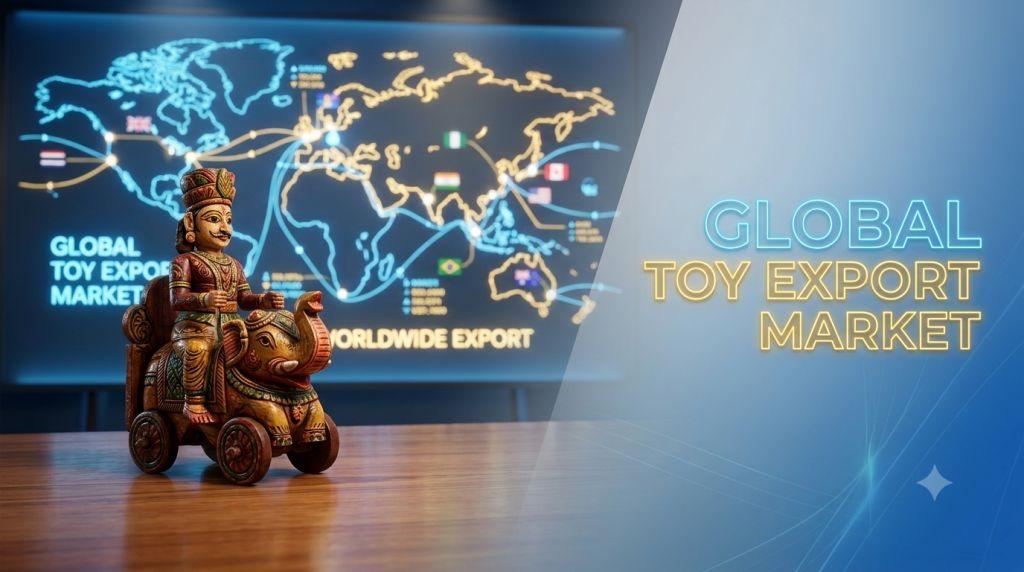
India is now the world's fourth-largest toy exporter and exporting to 153 countries. The domestic toy market itself is valued at $2.09 billion in 2025 and expected to reach $4.74 billion by 2034. Commerce Minister Piyush Goyal made the point directly at the 16th Toy Biz International B2B Expo in June 2025: "Our toy industry, which was once heavily dependent on imports, is now exporting to 153 countries."
This is the pivot point. Not the endpoint.
China still dominates global toy trade at a scale India cannot yet match - China controls roughly 70-75% of global toy exports while India holds under 1%. But the gap is closing, the policy tailwinds are real, and the specific market segments where India has genuine competitive advantage are clearer than most analysis acknowledges.
This guide covers the full picture - what India exports, where it comes from, who buys it, what the compliance requires, and where India is genuinely competitive versus where it is still catching up.
India's Toy Export Snapshot - 2025/2026
| Metric | Data |
|---|---|
| Total toy exports FY25 | $326 million (up 239% from $96M in FY14-15) |
| Global rank | 4th largest toy exporter in 2025 |
| Countries receiving Indian toys | 153 countries |
| Annual export shipments | ~43,000 shipments from ~2,000 exporters to ~5,000 buyers |
| Toy market size (domestic) | $2.09 billion in 2025 |
| Market forecast | $4.74 billion by 2034 at 9.53% CAGR |
| Chinese toy imports into India | Crashed 83% — from $235M in FY20 to ~$40M in FY25 |
| US tariff impact (2025) | 50% tariff triggered 8-10% dip in shipments |
| Largest export destination | USA (~50% of exports before tariff disruption) |
The 239% export growth from FY14-15 to FY22-23 looks dramatic. Here is what actually drove it: the government raised basic customs duty on toys from 20% to 60% in February 2020, then to 70% in March 2023. Chinese imports that had been $235 million in FY20 dropped to roughly $40 million by FY25 - an 83% collapse. International toy brands that had been sourcing entirely from China could no longer profitably import finished toys into India. They had to consider local manufacturing.
The Quality Control Order (QCO) - making BIS certification mandatory for toys from 2025 - completed the picture by establishing quality standards that foreign manufacturers had to meet or leave the market.
What India Actually Exports: The Two Distinct Markets
India's toy export sector is not one market. It is two, with different products, different buyers, different competitive dynamics, and different compliance requirements.
The Traditional and Artisan Segment
This is where India's historical competitive advantage is most genuine. No other country has what Channapatna, Kondapalli, and Jodhpur produce - and that specificity is commercially valuable.
Channapatna, Karnataka - "Toy Town of India." The lacquered wooden toys here, made using ivory wood (Hale Mara) and natural dyes, have a distinct visual identity recognized internationally. European buyers - particularly German, Dutch, and French importers of educational and heritage toys - specifically seek Channapatna product. Museum shops in Europe stock them. Educational toy buyers in the US buy them. The craft has a geographic indication (GI) tag that documents its authenticity.
Kondapalli, Andhra Pradesh - Brightly painted wooden toys and figurines with a distinctive folk art style. Hollow softwood painted in vivid colors. Demand in diaspora markets, gift retail, and international craft buyers.
Jodhpur and Rajasthan - Wooden toys, hand-painted figurines, and decorative toys with the distinctive blue and ochre Rajasthani palette. Jodhpur has developed from a purely artisan cluster into one with some organized export infrastructure.
Varanasi, Uttar Pradesh - Silk-based dolls, clay figurines, and crafted play items rooted in Benarasi artisan traditions. Small volumes but high value.
Agra, Uttar Pradesh - Soft toys and stuffed animals alongside the marble craft sector. Exports to the Middle East and Southeast Asia.
The artisan segment is not high volume. It is high story. A Channapatna toy sitting in a European toy shop has a narrative - handmade, natural materials, centuries-old technique, geographic indication - that a plastic toy from Guangdong cannot have. International specialty retailers, museum shops, educational toy importers, and fair-trade platforms are the buyers. This segment does not compete with China. It occupies a lane China cannot enter.
The Mass-Market Manufacturing Segment
This is where the real scale ambitions sit - and where India is most directly competing with China and Vietnam.
Plastic toys, action figures, and toy vehicles - Manufactured in Mumbai, Pune, Noida, and surrounding industrial areas. These compete directly with Chinese product on price and quality.
Battery-operated and electronic toys - Growing segment. India's PLI scheme specifically targeted this. Electronic toy exports "have sharply increased" per BW Businessworld, with India now producing technology-integrated toys and coding kits.
Soft toys and plush - A significant export category. Soft toy manufacturing requires relatively lower technical barrier to entry; Indian manufacturers have developed this segment for export to the Middle East, Africa, and South Asia.
Educational toys and puzzles - One of India's strongest growth segments. Global demand for STEM toys, coding kits, and educational puzzles has grown significantly. Indian manufacturers with BIS certification are entering this market.
The Koppal cluster - The largest organized mass-market toy manufacturing investment in India. Aequs built a 400-acre cluster specifically for toy manufacturing, applying aerospace precision manufacturing principles to toy production. The result: Hasbro and Spin Master are sourcing from Koppal. That is not a development to dismiss. Those are top-five global toy brands choosing India.
Key Manufacturers: Who Is Actually Exporting
Funskool India (Chennai) - Production approximately $36 million, exports $30 million. Funskool is a joint venture with Hasbro (Mattel brands license) and one of India's most export-oriented toy companies. Established supply chain with international compliance infrastructure.
Microplastics (Bengaluru) - Production approximately $85 million, exports $65 million. One of India's largest toy manufacturers. The production scale and export volume suggest a fully industrialized operation.
Triple Ess Toys (Noida, NCR) - NCR-based manufacturer with export operations.
Toy Zone (Delhi NCR) - Delhi-area manufacturer targeting export markets.
Aditi Toys (Rajkot, Gujarat) - Rajkot-based, part of Gujarat's broader toy manufacturing cluster.
Simba Toys India (Mumbai) - The Indian arm of Simba-Dickie Group (Germany's largest toy company). Manufactures in India for both domestic and export supply.
Per BW Businessworld data: nearly 2,000 exporters made approximately 43,000 shipments to 5,000 buyers in over 150 countries. That fragmentation is both a strength (geographic diversity) and a challenge (quality consistency across that many small players).
The Competitive Reality: India vs China vs Vietnam
Being honest about this matters more than being promotional. India's toy sector has made remarkable progress. It is still not close to China in overall capacity.
Where India is genuinely competitive:
Artisan and traditional toys - No competition. Channapatna, Kondapalli, and Jodhpur products are unique. European and US premium buyers who want these products have nowhere else to go.
Educational and STEM toys - India's engineering talent base creates a natural pipeline for educational toy design. Indian-designed coding kits and STEM learning products have authenticity that Chinese equivalent products cannot claim as easily in Western markets.
Mid-market mass toys for South Asia, Middle East, and Africa - India's proximity, shared cultural context, and competitive pricing make it the natural supplier for these markets rather than China.
Premium segment for US and European brands seeking non-China sourcing - The Koppal/Hasbro/Spin Master example. Brands trying to reduce China dependency are actively qualifying Indian manufacturers.
Where China still wins decisively:
Volume at the lowest price point - A $0.50 retail toy from Guangdong is not something Indian manufacturers can profitably replicate today.
Electronics complexity - Chinese toy manufacturers have deep electronics ecosystems (microcontrollers, small motors, LED systems, sound chips) at costs India cannot match. Battery-operated toys with complex electronics remain China's stronghold.
Existing brand and retail relationships - Decades of Walmart/Target/Toys R Us sourcing relationships from China are not switched overnight.
Supply chain depth - China's plastics, electronics, and component supply chain is infinitely deeper than India's current infrastructure.
Where Vietnam is entering the conversation:
Vietnam has emerged as the second-most significant China alternative for toy sourcing. US tariff policy that disadvantaged Chinese toys also affected Vietnamese toys in 2025. India's 50% US tariff (2025) and Vietnam's tariff both disrupted export flows. For buyers trying to diversify away from China+Vietnam, India is the logical next step - but that 50% US tariff is a real obstacle.
The US tariff reality: the 2025 imposition of 50% duties on Indian goods - including toys — triggered an 8-10% dip in India's toy export shipments. Nearly half of India's toy exports had been going to the US. Some buyers shifted orders toward Indonesia. This is the most significant near-term constraint on India's toy export ambitions.
Manufacturing Clusters: Where to Source and Why
Koppal, Karnataka - The most organized mass-market cluster. Aequs's 400-acre integrated facility. Targets international brands. Apply-and-qualify model rather than traditional supplier search.
Channapatna, Karnataka - Traditional wooden toys. GI-tagged. Artisan cooperative model alongside individual workshops. Best for premium, educational, and heritage toy buyers in EU and US.
Bengaluru, Karnataka - Mass-market manufacturers including Microplastics. Industrial scale.
Chennai, Tamil Nadu - Funskool's primary manufacturing base. Corporate-scale toy manufacturing with international compliance.
Noida and Delhi NCR - Mix of traditional and modern manufacturers. Good for plastic toys, educational products, and soft toys. Proximity to buyers sourcing agents in Delhi.
Mumbai and Pune, Maharashtra - Simba Toys India and other manufacturers. Access to port for sea freight; competitive for large shipments.
Jodhpur, Rajasthan - Traditional wooden and painted toys. Lower scale than Karnataka clusters but distinct product identity.
Rajkot, Gujarat - Growing toy manufacturing presence. Aditi Toys and others. Gujarat's industrial ecosystem provides good component supply access.
Nagpur, Maharashtra - Emerging toy cluster with government cluster support under SFURTI.
Firozabad, Uttar Pradesh - Glass toys and decorative items. Niche but genuine export category.
Under the SFURTI (Scheme of Fund for Regeneration of Traditional Industries) and NAPT (National Action Plan for Toys), 19 toy clusters across Karnataka, Uttar Pradesh, Maharashtra, and NCR now have shared testing labs, tooling facilities, and design support. This infrastructure reduces the barrier for smaller manufacturers to access international certifications.
Top Destination Markets
United States - Historically ~50% of exports The largest market and the most complicated right now. The 50% US tariff imposed in 2025 triggered that 8-10% shipment dip. The February 2026 US-India interim trade framework covers toys at 18% - still not zero, but substantially better than 50%. US buyers require ASTM F963 compliance (see compliance section). The US retail market's appetite for Indian wooden toys, STEM learning kits, and artisan products remains strong regardless of tariff changes - it is the mass-market plastic toy segment that faces the most competitive pressure.
United Kingdom - The second-largest market after the US. UK buyers require UKCA marking post-Brexit (transitional CE acceptance extended). EN 71 safety standards apply. UK specialty toy retail is receptive to Indian wooden, educational, and artisan toys. The India-UK FTA recently signed should improve market access terms.
Germany - Europe's most important toy market. German toy buyers are serious about EN 71 compliance, sustainability credentials, and material documentation. The German educational toy segment (Waldorf-inspired, natural material, developmental toys) is a natural fit for Channapatna and premium Indian wooden toy producers. German trade fair Spielwarenmesse (Nuremberg, February) is where EU toy sourcing decisions are made.
Australia - Growing market with India-Australia CEPA providing preferential access. Educational toy demand is strong.
Middle East (UAE, Saudi Arabia, Kuwait) - Significant and growing. The large South Asian diaspora in the Gulf creates demand for Indian cultural toys and games. Gulf retail chains are also buyers of mid-market plastic and soft toys at competitive price points.
Africa (Nigeria, Kenya, South Africa) - Growing toy import market across Sub-Saharan Africa. Indian mass-market toys at price points that work for African retail. Proximity (relatively) and competitive pricing versus Chinese alternatives.
South Asia (Bangladesh, Sri Lanka, Nepal) - India's natural geographic advantage. These markets buy educational toys, plastic toys, and traditional products from India.
Compliance: What Every Market Actually Requires
Toy certification is non-negotiable. And it gets more scrutiny than most export categories because toys are used by children. Getting this wrong has consequences - product recalls, market bans, and liability that can end an export business.
BIS Certification - Now Mandatory in India
Since 2025, every toy sold in India - local or imported - must carry BIS certification and ISI marks. This is one of the toughest toy quality standards globally. The Quality Control Order (QCO) made this mandatory and it is now a baseline for Indian toy manufacturers. The good news: manufacturers who have achieved BIS certification have essentially completed a rigorous quality process that prepares them for international standards. The bad news: smaller manufacturers who have not done this cannot currently export legally from India.
EN 71 - European Union and UK Markets
EN 71 is the European toy safety standard, covering:
- EN 71-1: Mechanical and physical properties (no sharp edges, no small parts for under-3 toys)
- EN 71-2: Flammability
- EN 71-3: Migration of certain chemical elements (heavy metals, restricted dyes)
- EN 71-4 through EN 71-14: Category-specific (activity toys, graphical artwork, chemical sets, etc.)
For CE marking in the EU and UKCA in the UK, EN 71 compliance is mandatory. Testing must be done by an accredited laboratory (TÜV, SGS, Bureau Veritas, Intertek, or equivalent). Self-declaration is not acceptable for third-party buyers. The EU's RAPEX system (Rapid Alert System for dangerous products) publicly names non-compliant toy importers - the reputational risk of getting this wrong is public and permanent.
ASTM F963 - US Market
The US Consumer Product Safety Improvement Act (CPSIA) governs toys sold in the US. ASTM F963 is the standard that covers toy safety for children under 14. It covers:
- Small parts testing for under-3 age categories
- Flammability requirements
- Chemical requirements (lead content limits, phthalate restrictions)
- Mechanical and physical safety
Children's products sold in the US also require a Children's Product Certificate (CPC) - a document certifying ASTM F963 compliance from a CPSC-accepted testing laboratory. Importers are legally responsible for this certification even when sourcing from Indian manufacturers. US buyers will ask for it, and failure to provide it can result in CPSC enforcement action.
REACH Compliance (EU Chemical Safety)
The REACH regulation restricts the use of certain hazardous substances in products including toys. Phthalates (in PVC plastic), certain heavy metals, azo dyes, and other restricted substances must be below threshold limits. Certificates of compliance for materials used in toy manufacturing are required. This matters particularly for plastic toys and painted wooden toys (where paints must be tested for heavy metal migration).
ISO 8124 - International Standard
ISO 8124 is the international equivalent of EN 71, used in many non-EU markets (including some Middle East and Southeast Asian markets that reference international standards). For markets without their own national toy safety standard, ISO 8124 compliance is often the buyer's requirement.
Indian Standard IS 9873
India's own toy safety standard, which BIS certification covers. Aligned with international standards. For Indian-market compliance, this is the reference — but international buyers generally want EN 71, ASTM F963, or ISO 8124 documentation alongside IS 9873.
Government Support for Toy Exporters
PLI Scheme for Toy Manufacturing - Rs 3,500 crore (~$425 million) Production Linked Incentive covering toy manufacturing with a capex-linked component. A new capex scheme was announced in Budget FY25, modeled after successful electronics PLI. Targets: scale up manufacturing, meet global quality benchmarks, and expand export capacity.
National Action Plan for Toys (NAPT) Government's comprehensive toy sector development plan including cluster development, SFURTI support, skill development, design support, and market linkage. The plan targets making India a global toy hub.
Toy Cluster Programme Under NAPT: targeted creation of 40,000 jobs by 2025 and investment attraction of $685 million into toy clusters. 19 clusters across Karnataka, UP, Maharashtra, and NCR now have shared infrastructure.
Quality Control Order (QCO) - 2025 Made BIS certification mandatory for all toys. Purpose: protect the domestic market from substandard imports and simultaneously establish quality benchmarks that enable export. The combination of protecting domestic market (preventing cheap imports) and requiring quality (enabling export) is the policy logic.
Increased customs duty on toy imports - 70% (FY24) 70% basic customs duty on imported toys effectively protects Indian manufacturers in the domestic market, forcing brands that sell in India to either manufacture locally or pay punitive import costs. This policy choice directly drove the Koppal cluster investment.
Toy Biz International B2B Expo Annual government-supported B2B matchmaking event for toy exporters and international buyers. The 16th edition in June 2025 drew significant buyer attendance. Commerce Minister Piyush Goyal personally addressed the event — unusual for a sector of this size, signaling the government's specific attention to toys.
DGFT Schemes (RoDTEP, EPCG) Toy exporters eligible for RoDTEP rebates on FOB value. EPCG allows duty-free import of manufacturing equipment in exchange for export obligations — relevant for toy manufacturers investing in modern injection molding, finishing, and testing equipment.
What Competitor Guides Get Wrong
Three gaps consistently appear:
They present the 239% export growth without the context of what caused it. The growth was substantially driven by import duty increases (20% to 70%) and the QCO mandating BIS certification, which choked off Chinese imports and forced brand investment in Indian manufacturing. That is different from India's manufacturers organically becoming more competitive. Understanding the policy driver matters because it tells you whether the growth is sustainable (policy support) or reversible (if duties change).
They ignore the US tariff problem. India's toy export base was heavily concentrated in the US - around half of all exports. The 2025 50% US tariff caused an 8-10% shipment dip and pushed some buyers toward Indonesia. Any guide written about Indian toy exports that does not address this is writing about a version of the sector that no longer exists in the same form. The India-US interim framework's 18% tariff is better but not resolved.
They lump artisan and mass-market toys together. A Channapatna wooden toy and a plastic action figure from Noida have nothing in common except the HS code. The buyers are different, the certification requirements are different, the competitive dynamics are different, and the growth strategies are different. Treating them as one "Indian toy sector" produces analysis that is useful for neither segment.
How to Start Exporting Toys from India
Step 1: IEC from DGFT - Mandatory. No exports without it.
Step 2: GST registration - Standard.
Step 3: BIS Certification - Since 2025, mandatory for all toy manufacturers selling in India. The IS 9873 certification process involves product testing at a BIS-recognized laboratory and factory inspection. This is the foundation; build from here.
Step 4: RCMC from EEPC - Toys fall under engineering exports broadly; EEPC RCMC is the relevant one for accessing export promotion programs. Some toy exporters also register with EPCH (handicraft artisan toys).
Step 5: Identify your HS code - Toys: HS Chapter 95. Key sub-headings: 9501 (wheeled toys for children, dolls' carriages), 9502 (dolls), 9503 (other toys), 9504 (games equipment). Getting the 8-digit code right matters for import duty rates in destination countries.
Step 6: Target market certification - EU and UK: EN 71 + CE or UKCA marking. US: ASTM F963 + Children's Product Certificate from CPSC-accepted lab. International markets referencing ISO standards: ISO 8124. Budget testing costs: an EN 71 test suite can cost Rs 50,000-100,000 per product; ASTM F963 similar. These are one-time-per-product-line costs that amortize across export volumes.
Step 7: Sample testing first - No international buyer will place an order without samples. Commission samples from your production line, have them tested at an accredited lab (SGS, Intertek, TÜV, Bureau Veritas all operate in India), and get test certificates. This documentation package is what you present to buyers.
Step 8: Trade show attendance - Spielwarenmesse Nuremberg (February, Germany) is the world's largest toy trade show and the primary EU buyer sourcing event. Hong Kong Toys & Games Fair (January) is the Asia gateway. Toy Biz International (New Delhi, annually) is the government-organized domestic event specifically for B2B buyer connections.
Pre-Export Checklist
- IEC from DGFT - active
- GST registration - in place
- BIS IS 9873 certification - current for all products being exported
- Target market certification confirmed - EN 71/UKCA (EU/UK), ASTM F963/CPC (US), ISO 8124 (others)
- Test reports from accredited laboratory - per product line
- HS code confirmed at 8-digit level (Chapter 95 sub-heading)
- REACH compliance documentation - for plastic and painted toys going to EU
- Age-grade labeling confirmed - small parts warnings for under-3, age range marking per destination market
- Packaging compliant with destination market - language requirements (EU: local language mandatory), barcode format
- Product samples tested and documented - never ship before buyer has approved a physical sample
Related Navi Exports Categories
- Toys & Accessories Exporters
- Gifts, Crafts & Home Decor
- Printing, Books & Media Products
- Plastic & Products
- Apparel & Accessories
The Bottom Line
India's toy export story from 2014 to 2025 is genuinely impressive - 239% growth, net exporter status, 4th largest globally, 153 countries. The policy combination of import duty increases, mandatory quality standards, cluster investment, and PLI incentives produced a real transformation.
The honest position for 2026: the US tariff disruption knocked 8-10% off shipments and exposed the concentration risk of having half of exports going to a single market. Diversifying toward the EU, UK, Middle East, Africa, and South Asia is the strategic response - and those markets are growing.
India is not going to be China in toys in the next decade. China's manufacturing depth, electronics ecosystem, and supply chain integration in toys are too substantial. But India does not need to be China. It needs to be what it already is - the world's premium destination for artisan, traditional, and educational toys, a credible mass-market alternative for brands wanting non-China sourcing, and the natural supplier for South Asia, the Middle East, and Africa.
The artisan segment is India's least competitive and most unique position. No other country makes what Channapatna, Kondapalli, and Jodhpur make. The mass-market segment requires patient investment in compliance, scale, and electronics supply chains. The Koppal/Hasbro example shows what that looks like when it comes together.
The compliance investment - EN 71, ASTM F963, REACH - is the entry fee for the markets that matter. It is not optional or negotiable. Get the certifications, find the buyers, and build on India's genuine strengths rather than trying to out-China China.
→ Browse verified Indian toy exporters on Navi Exports
Data sources: India Briefing "India's US$2.09 Billion Toyconomy Winning Global Shelves in 2026" (April 2026), BW Businessworld "India Can Build A Global Toy Hub, But Needs Focus" (October 2025), Upstox/Deccan Herald "Not Just Child's Play: India's 239 Export Surge Explained" (September 2025), Organiser.org "From Import-Dependent to Export Powerhouse" Piyush Goyal Toy Biz International speech (July 2025), Tribune India "Govt to Implement Scheme to Make India Toy Hub of World", India Investment Grid Toys Manufacturing Sector, Navi Exports Toys & Accessories category page, Department of Commerce (GoI) toy export data, IIM Lucknow toy trade report (cited in Deccan Herald), CPSC ASTM F963 guidance, EU RAPEX toy safety regulations.
Frequently Asked Questions
India's toy exports reached approximately $326 million in FY2024-25, up 239% from $96 million in FY2014-15. India is now the world's fourth-largest toy exporter, supplying to 153 countries through approximately 2,000 exporters making 43,000 annual shipments to 5,000 buyers globally. The Indian toy market is valued at $2.09 billion domestically in 2025 and is projected to reach $4.74 billion by 2034.
Three policy actions drove the transformation: the government raised basic customs duty on imported toys from 20% to 60% in 2020, then to 70% in 2023. The Quality Control Order (QCO) made BIS IS 9873 certification mandatory for all toys from 2025. PLI scheme support of Rs 3,500 crore was allocated for toy manufacturing scale-up. Together, these throttled cheap Chinese imports (down 83% from FY20 to FY25) and forced international brands to consider Indian manufacturing.
Channapatna in Karnataka is India's "Toy Town" - a centuries-old cluster producing lacquered wooden toys using traditional ivory wood and natural dyes. The products carry a Geographic Indication (GI) tag confirming authenticity. European educational toy buyers, museum shops, and premium toy retailers specifically source Channapatna toys because the craft, material, and heritage cannot be replicated elsewhere. It is India's clearest competitive moat in toys.
BIS IS 9873 certification is mandatory for all toys sold in India (including for export) as of 2025. For EU and UK markets: EN 71 safety certification (covering mechanical, flammability, and chemical safety) plus CE or UKCA marking. For the US: ASTM F963 compliance tested by a CPSC-accepted laboratory plus a Children's Product Certificate. For markets referencing international standards: ISO 8124. REACH compliance is required for chemical substances in toys going to the EU.
The 50% US tariff imposed in 2025 triggered approximately an 8-10% dip in India's overall toy export shipments, with some US buyers shifting orders to Indonesia. Since nearly half of India's toy exports had been going to the US, the concentration made this impact significant. The February 2026 US-India interim trade framework set toys at 18% tariff - substantially better than 50% but not zero. Market diversification toward the EU, UK, Middle East, and Africa is the strategic response.
The Koppal cluster in Karnataka is a 400-acre integrated toy manufacturing facility built by Aequs - an Indian aerospace precision manufacturing company. Aequs applied precision manufacturing principles to toy production and succeeded in qualifying Hasbro and Spin Master (two of the world's largest toy companies) as customers. This is significant because it demonstrates that India can meet the quality and scale requirements of top-tier global toy brands, not just regional buyers. The Koppal model represents what Indian organized toy manufacturing at its best currently looks like.