 Thu, 06 Aug 2026
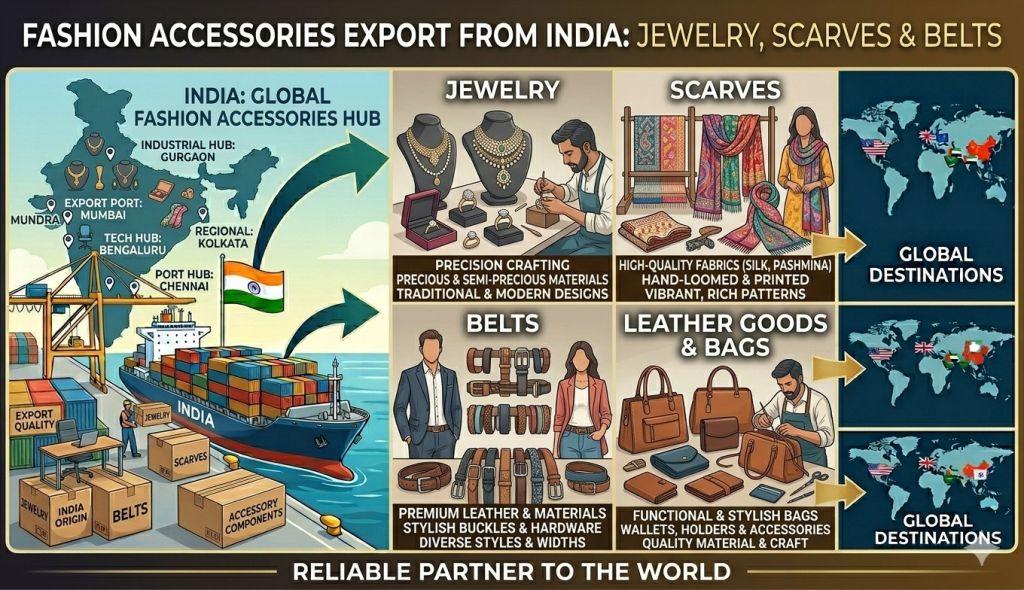
Fashion Accessories Export from India: Jewelry, Scarves & Belts


Here is a number worth sitting with: India's gems and jewelry sector alone exported $28.5 billion in FY2024-25. That single category outpaces the entire apparel export revenue of most countries.
Now add fashion jewelry and imitation pieces ($136 million in FY25, up 12%), handprinted textiles and scarves ($56.81 million in just April–June 2025), leather belts (321,773 shipments annually - more than China and Italy combined), and handicraft accessories worth $3.9 billion annually. The picture that emerges is not a niche. It is a serious global supply chain.
And yet most international buyers still think of India primarily as a textiles and pharma exporter. Fashion accessories barely registers in the conversation. That gap between what India actually ships and what buyers know about - is exactly why this guide exists.
The Big Picture: India's Fashion Accessories Export at a Glance
| Category | FY25 Export Value | Key Fact |
|---|---|---|
| Gems & Fine Jewelry | $28.5 billion | 8th largest jewelry exporter globally |
| Imitation / Fashion Jewelry | $136 million (growing 12% YoY) | US, UAE, UK are top 3 buyers |
| Handicraft Accessories (incl. scarves) | $3.9 billion | USA takes 38.69% share |
| Handprinted Textiles & Scarves | $56.81M (Apr–Jun 2025 alone) | Germany, UAE, France top buyers |
| Leather Products incl. Belts | $2.77 billion (Aug 2024–Jul 2025) | India is the world's #1 leather belt exporter by shipment volume |
| Fashion Jewelry & Accessories (EPCH) | $517 million (FY23–24) | IFJAS show draws buyers from 25+ countries |
The India fashion accessories market domestically was valued at $14.7 billion in 2024 and is growing at 9% CAGR toward $24.3 billion by 2030. On the export side, the numbers are harder to isolate because fashion accessories span multiple HS code categories — handicrafts, leather goods, textiles, gems. But taken together, India's fashion accessories export ecosystem is well past the billion-dollar mark and growing.
Sources: IBEF, GJEPC, EPCH, Ministry of Commerce & Industry (PIB India)
1. Jewelry - Fine, Fashion & Everything In Between
Fine and Precious Jewelry
India processes over 90% of the world's cut and polished diamonds by volume. That one fact explains a lot about why Mumbai and Surat are where they are in global jewelry trade. The country is not just manufacturing, it is the processing hub that the entire global diamond trade routes through.
Total gems and jewelry exports in FY25: $28.5 billion. In FY26 (just April-August 2025), exports were already at $11.1 billion.
The product breakdown for FY25:
- Cut and polished diamonds: the largest constituent at ~44% of total exports
- Gold jewelry (plain and studded): $11.36 billion - essentially flat year-on-year
- Silver jewelry: $961 million in FY25 (though it surged 52% to $1.47 billion in FY26, driven by silver price rises and demand in emerging markets)
- Platinum jewelry: growing fast, up 39% to $254 million in FY26
- Lab-grown diamonds: $1.27 billion in FY25, though prices have been correcting
The top five destination countries for FY25: USA ($9.93B), UAE ($7.75B), Hong Kong ($4.56B), Belgium ($1.60B), UK ($967M).
One thing that happened in FY26 worth noting: US jewelry exports fell sharply (down 44.92% to $5.09B) due to tariff-related disruptions. The UAE overtook the US as India's top market, with exports reaching $8.70 billion. Australia grew 38.33%. The GJEPC's chairman specifically called out the India-UAE and India-Australia FTAs as what made that diversification possible.
The takeaway for buyers sourcing fine jewelry from India: the infrastructure is world-class, particularly in Surat (diamonds), Mumbai (gold and studded pieces), Jaipur (colored gemstones and silver), and Delhi NCR (gold and fashion pieces). Mandatory hallmarking of gold jewelry is in place, and India is actively moving toward broader certification standards.
Key certification body: GJEPC (Gem & Jewellery Export Promotion Council) → GJEPC Official Site
Fashion and Imitation Jewelry
This is the faster-growing, less capital-intensive side of Indian jewelry export - and it is where smaller brands and independent buyers tend to source.
India exported $136 million worth of imitation and fashion jewelry in FY25, and the growth trajectory is significant: 5,048 consignments to 625 customers worldwide in the 12-month period ending May 2025, up 12% year-on-year. The artificial jewelry market in India is projected to grow at 11.4% CAGR through 2029.
What actually moves:
Kundan and Meenakari jewelry - Traditional Rajasthani techniques using colored glass and enamel, set in gold-foil base metals. Strong demand in the US, UK, and diaspora markets globally. These are not cheap trinkets - quality Kundan pieces retail for $50-$500 abroad.
Silver-tone fashion jewelry - Contemporary designs that sit between costume and fine jewelry. Strong in the US and Europe for everyday wear. Jaipur, Delhi, and Mumbai are the main manufacturing centers.
Statement accessories - Oversized earrings, layered necklaces, bold cuffs. These travel well in the fast-fashion retail channel and through e-commerce. Moradabad (Uttar Pradesh) and Sambhal are major export clusters for brass and metal fashion jewelry.
Tribal and artisan-inspired pieces - Pieces rooted in regional craft traditions - Bastar dhokra casting, Odisha filigree (Tarakasi), Manipuri traditional designs. Strong demand in the EU and US artisan-retail segment, particularly through Etsy and specialist importers.
The US, Spain, UAE, UK, Netherlands, Canada, Australia, France, Italy, and Nigeria are the main buyers of Indian imitation jewelry.
Key promotion body: EPCH (Export Promotion Council for Handicrafts) runs IFJAS - the Indian Fashion Jewellery & Accessories Show - annually at India Expo Mart, Greater Noida. This is the primary B2B trade show for this segment. → EPCH | IFJAS
2. Scarves, Shawls & Handprinted Textiles
This category is where India's craft heritage most directly becomes an export product - and where buyers are often paying for something genuinely irreplaceable.
Handprinted textiles and scarves exported $56.81 million in just the April–June 2025 quarter per EPCH provisional data. Indian silk scarves alone contributed $13.2 million in FY25 handloom exports. For context: the handloom sector overall exported $139.38 million in FY25.
The products that actually drive demand:
Block-print scarves (Jaipur, Rajasthan) - Hand-carved wooden block printing on cotton, silk, and modal. Jaipur's block-print cluster is one of the most recognized in global fashion. Buyers from Europe - particularly Germany, Netherlands, France - are consistent importers. The US (38.69% of total handicraft exports) buys significant volumes through boutique importers and platforms like World Market, Ten Thousand Villages, and specialty fair-trade retailers.
Pashmina shawls and stoles (Kashmir) - The most premium segment of Indian scarf exports. Authentic Pashmina (from Changthangi goat undercoat, woven in Kashmir) commands significant price premiums in European luxury retail. The geographic indication (GI) protection for Kashmiri Pashmina matters here - buyers want to confirm authenticity before sourcing.
Banarasi silk stoles and dupattas (Varanasi) - Silk-interwoven pieces with traditional brocade motifs. These sell into the diaspora market but increasingly into mainstream global fashion as ethnic-inspired design gains traction.
Phulkari embroidered pieces (Punjab) - Bright floral embroidery on cotton or silk grounds. Strong in the UK market and through online platforms.
Ajrakh and resist-dyed textiles (Gujarat) - Natural dye, geometric block print. Strong in the EU's sustainable/organic fashion segment.
Digital print and contemporary scarves - Export from Surat and Delhi NCR targeting fast-fashion buyers globally. These compete on price with Chinese product - lower margins, but high volume.
Top destination countries for scarves and handprinted textiles: USA, UAE, UK, Germany, Netherlands, France, Australia.
The compliance angle buyers miss: Scarves exported from India as handicrafts or handloom products carry specific HS codes (6214 for scarves and shawls, 5209 or 5804 for handprinted textiles depending on construction). Getting the code right matters for duty classification. Handloom products that qualify under the Handicrafts export certification benefit from simplified export procedures via EPCH.
3. Belts - India Is the World's Largest Exporter
This is the fact that surprises most people in global fashion sourcing: India is the world's #1 exporter of leather belts by shipment volume - ahead of China and Italy, which rank second and third.
Volza's export data shows India made 321,773 leather belt export shipments (versus China's 89,825 and Italy's 72,663). In the 12-month period March 2023 to February 2024, India made 42,295 leather belt shipments from 1,984 exporters to 7,003 buyers globally.
The top buyers: USA, Germany, United Kingdom.
India's total leather exports (finished goods) reached $2.77 billion for August 2024–July 2025. The US imported $803.83 million in Indian leather in FY25 - making it the largest single buyer.
Where the belts come from:
Kanpur, Uttar Pradesh - India's "Leather City." Largest concentration of tanneries and leather goods manufacturers in the country. Buffalo-based leather dominates; strong in belts, harness goods, and industrial leather products. The Uttar Pradesh government's 2025 Footwear & Leather Development Policy offers capex subsidies and cluster expansion support.
Agra, Uttar Pradesh - Strong in fashion leather goods. Belts with embellishment, decorative stitching, and fashion-forward designs. Agra manufacturers tend toward the mid-market segment with strong styling capability.
Chennai and Tamil Nadu - More technically sophisticated leather; tanneries here serve premium European brands. Leather Working Group (LWG) certified facilities are concentrated in Tamil Nadu - relevant for buyers with sustainability compliance requirements.
Kolkata, West Bengal - The Bantala Leather Complex houses approximately 500 tannery units. Strong in leather garments and accessories. Good Eastern corridor shipping access.
Delhi NCR (Noida) - Fashion leather accessories. Belts, wallets, small leather goods targeting international fashion buyers.
What global buyers need to know about Indian leather belts:
- Leather Working Group (LWG) certification - 100+ facilities in India are LWG certified. For EU and US premium buyers, this is increasingly required. Confirm certification status before contracting with any supplier.
- REACH compliance - EU requires compliance with REACH regulations on restricted chemical substances in leather goods. Major Indian exporters have REACH-compliant processing, but verify this with smaller suppliers.
- MOQ flexibility - India's leather belt sector ranges from artisan-scale operations (300-unit runs possible) to large industrial manufacturers handling 50,000+ units per style. The right supplier depends entirely on your volume.
- Pricing - Indian leather belts are competitively priced against Italian and Chinese alternatives, particularly in the $8–$35 FOB range. Italian leather commands a premium for heritage branding; Chinese product is cheaper for basic styles. India's sweet spot is quality mid-market and fashion-forward belt production.
Key body: Council for Leather Exports (CLE) → Council for Leather Exports
4. Other Fashion Accessories That Travel Well From India
The jewelry-scarves-belts framing captures the main categories, but serious buyers look across a broader range:
Hair accessories - Scrunchies, embroidered headbands, beaded hair clips. Strong e-commerce export category. Jaipur, Mumbai, and Surat are main manufacturing hubs.
Bags and clutches - Embroidered potli bags, jute totes, leather handbags. The EPCH reports embroidered and crocheted goods at $114.70 million in just April-June 2025. Clutches and ethnic bags are strong in the Middle East, UK, and US diaspora markets.
Beaded and fabric accessories - Belts with beading and embroidery, statement collars, decorative chains. Lucknow (chikankari embroidery) and Varanasi (zari work) produce accessories with distinct regional craft signatures.
Footwear accessories - Embellished shoe clips, ankle jewelry, toe rings. These fall partly under fashion jewelry and partly under footwear accessories. Strong in the Middle East (anklets and toe rings particularly) and in festival/occasion-wear retail globally.
Zari and zari goods - Gold and silver metallic thread goods. Zari is exported both as raw material for textile manufacturing and as finished embellished accessories. Major export from Surat.
Manufacturing Clusters - Where to Source What
| Product | Primary Clusters | Secondary Clusters |
|---|---|---|
| Fine jewelry (gold, diamond) | Surat, Mumbai, Jaipur | Delhi NCR, Kolkata |
| Fashion / imitation jewelry | Jaipur, Delhi NCR, Moradabad | Sambhal, Mumbai |
| Block-print scarves | Jaipur | Sanganer, Bagru (both near Jaipur) |
| Silk scarves / stoles | Varanasi, Mysore | Dharmavaram (AP) |
| Pashmina / Kashmiri shawls | Srinagar, Kashmir | — |
| Leather belts | Kanpur, Agra | Noida, Chennai, Kolkata |
| Embroidered accessories | Lucknow, Varanasi | Amritsar, Delhi NCR |
| Brass / metal fashion jewelry | Moradabad | Sambhal, Delhi |
| Tribal / dhokra jewelry | Bastar (Chhattisgarh) | Odisha clusters |
Knowing the cluster matters more than most buyers realize. A buyer in Germany sourcing block-print scarves should be talking to Jaipur exporters. A US retailer sourcing leather belts for a private label line should be in Kanpur or Agra. Approaching the wrong cluster adds cost, extends lead times, and produces product that is technically acceptable but lacks the craft knowledge that makes Indian accessories worth sourcing.
What Competitors Guides Get Wrong
Most competitor articles on Indian fashion accessories export either list product categories without specifics, or focus entirely on gems and jewelry to the exclusion of everything else. Three gaps worth calling out:
They skip the policy and certification detail. Buyers sourcing leather from India for the EU need REACH compliance. Buyers sourcing precious jewelry need hallmarking documentation and GJEPC certification. Buyers sourcing Pashmina need GI-tagged authentic product. Most export guides say "ensure quality compliance" - which is not useful. The specific certifications per category are what matter.
They ignore the FTA impact on jewelry. The India-UAE CEPA and India-Australia FTA have materially changed which markets Indian jewelry exporters can access at preferential tariff rates. FY26 data shows this playing out - Australia grew 38.33%, UAE held strong at 10.52% growth. Buyers in these markets get a pricing advantage over US-sourced product right now, and the anticipated India-UK and India-EU FTAs will extend that further.
They treat imitation jewelry as a footnote. Fashion / imitation jewelry at $136 million exports (growing 12%) and expanding rapidly through e-commerce is not a footnote. It is one of the most accessible entry points for small and mid-size international buyers who cannot place $50,000+ orders for fine jewelry. The EPCH's IFJAS show draws buyers from 25+ countries specifically for this segment.
Government Support Bodies for Fashion Accessories Exporters
GJEPC (Gem & Jewellery Export Promotion Council) Set up by the Ministry of Commerce in 1966. Represents 10,900+ members. Runs Virtual Buyer-Seller Meets, India International Jewellery Show (IIJS), and markets Indian jewelry in over 50 countries. If you are exporting fine jewelry, GJEPC membership and its associated market access infrastructure is the industry standard. → gjepc.org
EPCH (Export Promotion Council for Handicrafts) The primary body for fashion jewelry, accessories, scarves, embroidered goods, and artisan fashion products. Organizes IFJAS annually - the dedicated fashion jewelry and accessories trade show - as well as IHGF (India International Handicrafts Fair). Essential for exporters in the fashion accessories, imitation jewelry, and textile accessories segments. → epch.in
CLE (Council for Leather Exports) The official body for Indian leather exporters. Facilitates LWG certifications, maintains export data, and runs the India International Leather Fair (IILF). Mandatory registration for leather product exporters. → leatherindia.org
Handloom Export Promotion Council For silk scarves, handloom stoles, and woven textile accessories.
Weavers Service Centres (under Ministry of Textiles) Technical support for handloom and artisan textile exporters.
Export Certifications - What You Actually Need
Getting the paperwork right is where most new exporters lose time. Here is the practical breakdown by product:
Fine and precious jewelry:
- IEC (Import Export Code) from DGFT - mandatory for all exports
- GJEPC membership (RCMC certificate) - required for fine jewelry exports
- Hallmarking certificate (BIS) - mandatory for gold jewelry exports
- Certificate of Origin from GJEPC for GPA/FTA benefits
- For diamond exports: KP Certificate (Kimberley Process) for rough diamonds
- US buyers: FTC labeling compliance (accurate metal content, gemstone disclosure)
- EU buyers: CE marking not required for jewelry, but REACH restricted substances compliance is essential
Fashion / imitation jewelry:
- IEC from DGFT
- EPCH RCMC certificate
- FSSAI certification (not required for jewelry, but relevant if products have contact with food/skin formulations)
- For US export: CPSC compliance for products marketed to children
- California Proposition 65 compliance if selling to California-based buyers
Scarves and handprinted textiles:
- IEC
- EPCH RCMC certificate (for handicraft classification)
- Handloom mark (from Handloom Export Promotion Council) if claiming handloom status - this affects duty classification
- OEKO-TEX Standard 100 if required by EU buyers (tests for harmful substances in textiles)
- For organic/natural dye products: GOTS certification if marketing as organic
Leather belts:
- IEC
- CLE (Council for Leather Exports) RCMC certificate
- LWG certification if supplying EU/US premium brands
- REACH compliance documentation
- For export to EU: DFS (Designated Full Substance) test reports for restricted chemicals
All categories:
- HS code must be accurately declared. Key codes: Jewelry/imitation jewelry - 7117 (imitation), 7113–7116 (precious); Scarves/shawls - 6214; Leather belts - 4203.
Destination Markets: Who Buys and What They Want
United States - The largest single buyer across almost every category. Takes 38.69% of Indian handicraft exports, the dominant share of imitation jewelry, and was (until recent tariff disruption) the largest buyer of Indian gems and jewelry at $9.93 billion. US buyers want CPSC compliance for children's products, FTC-accurate labeling for jewelry, and increasingly, sustainability credentials. The diaspora market is enormous - South Asian communities in New Jersey, California, and Texas create baseline demand for ethnic jewelry, scarves, and accessories that mainstream retailers are now feeding into.
UAE - Overtook the US as the top gems and jewelry market in FY26 with $8.70 billion. The UAE functions both as a consumer market (local demand for gold and Indian jewelry) and as a re-export hub for the broader Middle East and Africa. India-UAE CEPA gives Indian exporters preferential tariff access. Fashion accessories and handprinted textiles also sell well through the UAE's large South Asian expat community and luxury retail sector.
United Kingdom - Second-largest buyer of EPCH handicraft products. Strong diaspora market plus mainstream interest in Indian-inspired fashion. The India-UK FTA (recently signed) is expected to more than double India's gems and jewelry exports to the UK, reaching $2.5 billion within two years. UK buyers tend to want cruelty-free certifications on leather products and OEKO-TEX on textiles.
Germany - Key market for block-print textiles and scarves, imitation jewelry, and artisan accessories. German buyers are serious about materials traceability and sustainability certification - GOTS, OEKO-TEX, and Fair Trade are meaningful to this market. Vivaness and Ambiente trade shows in Frankfurt are where German buyers often find Indian accessories suppliers.
France, Italy, Netherlands - Premium fashion markets. French buyers want distinctive design and craftsmanship storytelling. Italian buyers, particularly for leather goods, want LWG certification and REACH compliance. The Netherlands functions as a distribution hub with wholesale buyers active across multiple categories.
Australia - Fastest-growing jewelry market for India in FY26 at +38.33%. India-Australia CEPA opened significant duty-free access. Australian buyers are active across jewelry, textile accessories, and leather goods - particularly through sustainable/artisan retail channels.
Canada - Growing imitation jewelry market. Canadian customs generally follow US compliance frameworks (Health Canada for product safety). Active through online retail and specialty boutique channels.
How to Start Sourcing Fashion Accessories from India
Whether you are buying for a boutique retail chain, a wholesale operation, or a DTC brand, the practical path is similar:
1. Define the product category and target price point first. Jewelry sourced from Jaipur for $8-$20 wholesale is a different supply chain than gold jewelry from Mumbai at $200–$1000. Leather belts from Kanpur at $12 FOB are a different conversation than artisan-embellished belts from Agra at $35. Know your spec before approaching any supplier.
2. Use the right trade shows. IFJAS (Indian Fashion Jewellery & Accessories Show, Delhi NCR, June annually) for fashion jewelry and accessories. IIJS (India International Jewellery Show, Mumbai, August) for fine and precious jewelry. IHGF Delhi Fair for handicrafts and artisan accessories. India International Leather Fair (Chennai) for leather goods.
3. Use verified B2B platforms. Navi Exports lists verified Indian fashion accessories exporters across jewelry, fashion accessories, leather goods, and textile categories. Browse the Fashion Accessories category to find credentialed exporters with direct contact.
4. Request samples and compliance documents together. Any professional Indian exporter will offer sampling. When requesting samples, simultaneously ask for: IEC copy, RCMC certificate from the relevant body (GJEPC, EPCH, or CLE), and any product-specific certifications (LWG, OEKO-TEX, BIS hallmarking). This tells you immediately whether the supplier operates at export-grade or not.
5. Confirm HS codes and duty classifications before finalizing orders. Wrong HS code = overpaying import duty or customs delays. For jewelry, the fine vs imitation distinction (7113-7116 vs 7117) makes a meaningful duty difference in most import markets.
Related Navi Exports Categories
- Fashion Accessories Exporters
- Gems & Jewelry Exporters
- Leather & Leather Products
- Apparel & Accessories
- Textile Products & Fabric
- Gifts, Crafts & Home Decor
The Bottom Line
India is the world's largest leather belt exporter. It processes 90% of the world's cut diamonds. It is one of the most significant global sources for artisan scarves, imitation jewelry, and handcraft accessories. Most international buyers have not fully mapped what that means for their sourcing options.
The categories that often get overlooked - imitation jewelry, block-print scarves, embroidered accessories, artisan leather goods — are where Indian exporters are frequently undervalued and under-sourced. These are not consolation products. A well-sourced Jaipur block-print scarf retails at $60-$120 in European boutiques. A quality Kanpur leather belt at $14 FOB sits at $55–$80 on US retail shelves. The margins are there. The supply is there. What is missing, for a lot of buyers, is the verified connection to the right exporter in the right cluster.
That is the gap Navi Exports is built to close.
→ Browse verified Indian fashion accessories exporters on Navi Exports
→ For demand trends across other categories and markets, see this
Data sources: IBEF (India Brand Equity Foundation), GJEPC (Gem & Jewellery Export Promotion Council), EPCH (Export Promotion Council for Handicrafts), Ministry of Commerce & Industry (PIB India), Volza Global Export Data, Council for Leather Exports (CLE), Handloom Export Promotion Council, Outlook Business, IFJAS 2024/2025 press releases.
Frequently Asked Questions
India's largest fashion accessories export by value is gems and fine jewelry at $28.5 billion in FY25. Leather goods (including belts) account for $2.77 billion in finished goods exports. Handicraft accessories including fashion jewelry, scarves, and embroidered goods add another $3.9 billion. India is the world's #1 leather belt exporter by shipment count, ahead of China and Italy.
For jewelry: USA ($9.93B), UAE ($7.75B), Hong Kong ($4.56B), Belgium ($1.60B), UK ($967M) in FY25. For handicraft accessories including scarves and fashion jewelry: USA (38.69% share), UAE, UK, Germany, Netherlands, France. For leather belts: USA, Germany, UK.
Quality varies significantly by supplier and cluster, as it does anywhere. India's top fashion jewelry exporters - particularly in Jaipur, Moradabad, and Delhi NCR - produce product that retails at $30–$300 internationally and passes US/EU compliance standards. The key is working with EPCH-registered exporters who have documented compliance history. Requesting samples with compliance documentation (rather than samples alone) filters for serious suppliers.
All jewelry exporters need an IEC from DGFT. Fine/precious jewelry exporters need GJEPC membership and RCMC. Gold jewelry requires BIS hallmarking certification. Diamond exports require Kimberley Process documentation. For leather accessories, CLE registration and LWG certification (for EU/US premium buyers) are standard. Fashion/imitation jewelry exports need EPCH RCMC.
Kanpur (Uttar Pradesh) is the dominant belt manufacturing cluster - largest concentration of tanneries and manufacturers. Agra is strong for fashion-forward and embellished belts. Chennai and Tamil Nadu have more LWG-certified facilities for buyers requiring premium sustainability compliance. Delhi NCR (Noida) handles smaller-run fashion leather goods.
The most direct route is through verified B2B platforms like Navi Exports, which lists exporters with credentials. For in-person sourcing, IFJAS (fashion jewelry and accessories, Delhi NCR, June annually) and IIJS (fine jewelry, Mumbai, August) are the two main trade shows. The EPCH and GJEPC websites both maintain exporter directories.