 Sat, 31 Oct 2026
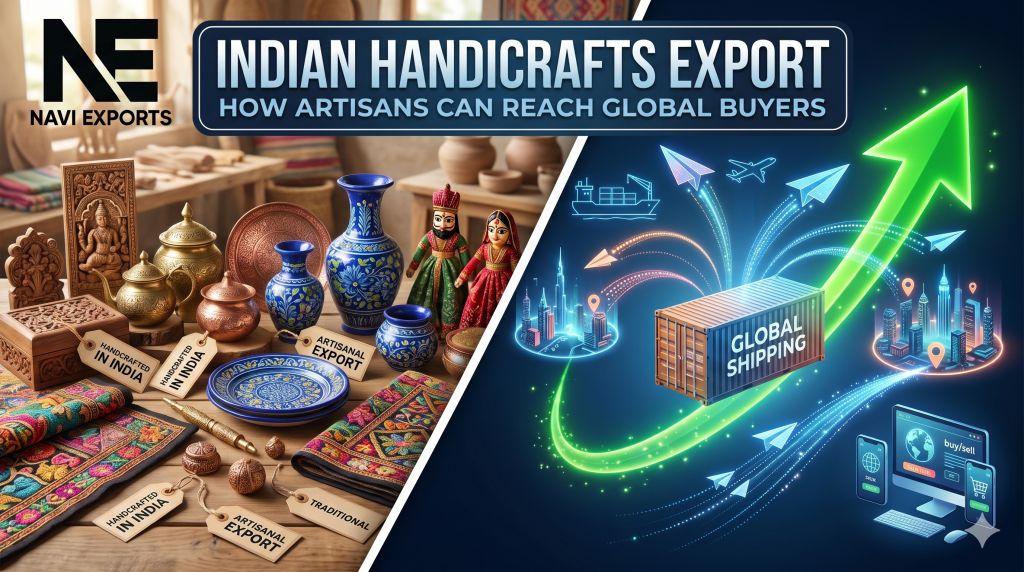
Indian Handicrafts Export: How Artisans Can Reach Global Buyers


India exported handicrafts worth Rs 33,425 crore (about US$3.78 billion) in FY2025-26, and the export figure was nearly flat. Behind that number sit roughly 64.66 lakh handloom and handicraft artisans, 64% of them women, working in clusters like Moradabad, Saharanpur, Jaipur and Jodhpur. The hard part for most of them is not making something a buyer in Chicago or Hamburg will want. It is getting that buyer to find them, trust them and pay them.
This guide covers what Indian crafts sell abroad, what buyers in the USA, Germany and Japan look for, which rules apply to brass, wood, pottery and textile products, and the practical route from a workshop to a first export order. It is written for artisans, small manufacturers and first-time exporters. If you want the wider basics of exporting, our import and export beginner's guide covers the definitions. This post stays on handicrafts.
The Numbers Behind Indian Handicraft Exports
| Indicator | Figure |
|---|---|
| Handicraft exports, FY2025-26 | Rs 33,425.26 crore (US$3,783.16 million) |
| Change versus FY2024-25 | +0.91% in rupees, -3.40% in US dollars |
| Handicraft exports, FY2024-25 (excluding hand-knotted carpets) | Rs 33,122.79 crore |
| Handicraft exports, FY2023-24 | About Rs 32,759 crore (about US$3.9 billion) |
| USA share | About 37% in FY2024-25; Rs 13,381 crore (about 41%) in FY2023-24 |
| Next largest markets, FY2023-24 | UK Rs 2,369 crore, UAE Rs 2,049 crore, Germany Rs 1,530 crore, Netherlands Rs 1,493 crore |
| Woodwares, FY2024-25 | Rs 8,524 crore |
| Art metalwares, FY2024-25 | Rs 4,386 crore |
| Embroidered and crocheted goods, FY2024-25 | Rs 4,350 crore |
| Hand-printed textiles, FY2024-25 | Rs 3,217 crore |
| GI-tagged handicraft products | 318 |
Three readings of this table matter for a seller. First, the market is large but not growing fast, and the dollar decline means price pressure is real. Second, wood and metal together make up the biggest block of exports, so brass and wood artisans are working in the center of the category. Third, the USA alone takes well over a third of everything, which is both an opportunity and a concentration risk. April to July 2026 shipments grew 12.79% in rupees but only 1.76% in dollars, so rupee weakness is doing part of the work.
Japan needs a plain note. It does not appear among India's top five handicraft destinations. The last country-wise EPCH split I could find put Japan at 2.23% of exports, and that figure is old. Treat Japan as a small, high-standard market that rewards finish and consistency, not as a volume play.
Data sources: PIB, EPCH, fibre2fashion (see the end of this post).
The Crafts That Sell: Brass, Wood, Pottery, Textiles and More
Brass and Metal Crafts
Moradabad, in Uttar Pradesh, is the center of Indian brassware, and its metal craft carries a GI tag. Exporters ship candle holders, trays, bowls, planters, lanterns and decor pieces to the USA and Europe. Brass decor is one of the product types US buyers search for most. Buyers who source table items can browse Table Decor Items, and lighting-led pieces sit under Decorative Lamps & Lanterns. Statues and animal forms in brass, bronze and marble fall under Showpieces & Figurines.
The compliance catch with brass is food contact. A brass bowl sold as decor and a brass bowl sold for serving food are treated differently in the USA and EU. Decide how you will label each item before you ship.
Wooden Crafts
Saharanpur is known for carved wood, and Jodhpur and Jaipur ship large volumes of hand-finished wooden decor. Sheesham (Dalbergia sissoo), mango wood, sandalwood and rosewood are common. Panels, boxes, trays, mirrors and wall pieces are the usual export lines. Carved panels and hangings are listed under Wall Art & Hangings, and mixed craft items sit in the broader Handicrafts page. Wooden furniture is a separate trade with its own buyers and rules, so it is not covered here.
Wood is also the category where regulation bites hardest. CITES, the EU Deforestation Regulation and the US Lacey Act all touch it. The compliance section below covers each.
Pottery and Ceramics
Jaipur blue pottery has a GI tag, and clusters like Khurja ship glazed ceramics in volume. Vases, planters, bowls and decorative plates move well in home decor. Vases & Flower Pots is the matching listing page for decorative ceramic and metal vases.
EPCH export data does not list ceramics as its own line, so pottery numbers are harder to find than wood or metal. That also means less visible competition from Indian sellers in some search terms. The risk is the lead and cadmium rules discussed below. A glazed piece that is safe for display can fail a food-contact test.
Textile Crafts and Handmade Soft Goods
Hand-block printing, zari, embroidery, crochet and shawls make up a large share of the category. Embroidered and crocheted goods alone earned Rs 4,350 crore in FY2024-25. Soft furnishings such as Cushion Covers & Throws are an easy first export because they are light, ship cheaply and can be made to a buyer's color card. Hand-crocheted items, toys and home pieces are grouped under Crochet Handmade Items.
If your craft is jute or canvas bags, see our separate guide on exporting jute and canvas bags from India, which covers that trade in full.
Religious Items and Handmade Gifts
Brass idols, incense, prayer items and puja accessories form a steady line, both for the Indian diaspora in the USA and UK and for general spiritual-decor buyers. They are listed under Religious & Spiritual Items. Buyers who want smaller, giftable pieces, including corporate and festival orders, can look at Handmade Gifts.
What Buyers in the USA, Germany and Japan Look For
USA. The USA takes the largest share by far. Typical lines are brass decor, wood carvings, embroidered and block-printed textiles and handmade home pieces. US buyers range from small boutiques and Etsy-style resellers to large retail chains. Small buyers want low minimum order quantities and fast samples. Chains want compliance paperwork, consistent quality across thousands of pieces, and firm lead times. Tariff rates on Indian goods have changed several times since 2025 and were still moving through legal and trade-deal changes as this post was written. Do not quote a landed price to a US buyer without checking the current duty on the exact tariff line.
Germany. Germany is India's fourth largest handicraft market in the FY2023-24 data and a gateway to wider European retail. German buyers tend to ask about materials, origin, sustainability and safety documentation before they ask about price. Natural materials, FSC-certified or traceable wood, and clear product-safety information are what move a conversation along. Ambiente in Frankfurt, held every February, is the main European consumer-goods fair for home and gift products, and EPCH regularly organizes Indian participation.
Japan. Japanese buyers are small in volume and exacting on finish. Expect close inspection of joins, glazes, edges and packaging, and expect a rejected batch to cost more goodwill than money. Japan is best approached through a distributor or a trade fair introduction, with a small first order of the most consistent product line you have. Check the Food Sanitation Act requirements with JETRO or Japan's health ministry before sending any item that could touch food.
Where Indian Crafts Are Made
| Cluster | Craft | Typical export lines |
|---|---|---|
| Moradabad, UP | Brass and metal craft (GI) | Decor, trays, lanterns, serveware |
| Saharanpur, UP | Carved wood (GI) | Boxes, panels, trays, small furniture |
| Jodhpur and Jaipur, Rajasthan | Wood, iron, block print, blue pottery (GI) | Decor, furniture accents, textiles, ceramics |
| Khurja, UP | Ceramics | Tableware, vases, decor |
| Agra, Firozabad, Delhi-NCR | Marble inlay, glass, fashion jewellery | Decor, gifts, accessories |
Buying from a recognized cluster helps your marketing. A GI tag is a legal proof of origin, and 318 handicraft products now hold one. If your craft has a GI, say so on the product page, the packaging and the commercial invoice.
Rules Every Handicraft Exporter Should Know
Indian registrations. You need an Import Export Code (IEC) from the DGFT, a GST registration, and a Registration-cum-Membership Certificate (RCMC) from the Export Promotion Council for Handicrafts (EPCH). Exports are zero-rated under GST, which means you either export under a Letter of Undertaking (LUT) or pay IGST and claim a refund. RoDTEP refunds apply to many handicraft tariff lines, but rates differ by line, so check the notified rate for your HS code.
CITES and shisham (sissoo). Dalbergia sissoo is listed in CITES Appendix II. After CoP19 in November 2022, finished timber-based items weighing less than 10 kg each can be exported in a consignment without CITES permits, with only the timber counted toward that weight. Heavier items still need permits. Confirm the current procedure with DGFT or the relevant Indian authority before each shipment, because a mistake at the port holds up the whole container.
EU Deforestation Regulation (EUDR). For large and medium EU operators the EUDR applies from 30 December 2026. For micro and small operators it applies from 30 June 2027. India is classed as low risk, which simplifies the EU buyer's checks but does not remove the paperwork. Exporters of wood products should expect their EU buyers to ask for plot geolocation, proof the wood was not harvested from land deforested after 31 December 2020, and batch-level traceability. Check whether the HS code for your wooden item is within the regulation's scope before assuming you are exempt.
EU General Product Safety Regulation (GPSR). Since 13 December 2024, consumer products sold in the EU need an economic operator based in the EU. That can be an importer, an authorized representative or a fulfillment provider. Products or packaging must carry the manufacturer's name, postal address and an electronic contact, a batch or type identifier, and any warnings in the local language. Online listings must show the same information. If you sell directly to German consumers through a marketplace, this applies to you.
Lead, cadmium and food contact. The US FDA sets limits on lead and cadmium leaching from ceramic foodware and checks imports. California adds its own tableware rules and Proposition 65 warnings. Brass and glazed ceramics sold for food use need lab testing. Pieces sold as decor only should be marked as not for food use. The EU and Japan have their own food-contact regimes, so test to the strictest market you plan to enter.
Plant material and wood. In the USA, wood and plant-based products can fall under the Lacey Act declaration and APHIS requirements. Untreated wood and natural-fiber items may also need fumigation or heat-treatment certificates for some countries.
Labeling and packaging. Country of origin ("Made in India"), materials, care instructions and the buyer's required barcode or SKU label are the basics. Fragile brass, glass and ceramic need export-grade cartons, edge protection and tested drop performance. Breakage is a large hidden cost.
Government Support for Handicraft Exporters
- EPCH. The council provides RCMC, market intelligence, buyer-seller meets and fair participation support. Its 2026-27 export promotion plan includes overseas warehousing in the EU and USA, a design centre with trend access in Moradabad, upgrades to the Saharanpur common facility centre and a skilling centre at Jodhpur.
- IHGF Delhi Fair. Held twice a year, it is the largest sourcing fair for Indian handicrafts and brings thousands of overseas buyers to Greater Noida. EPCH is reducing participation rates for the 2026-27 editions.
- RoDTEP. Refunds embedded duties and taxes on exported products.
- GI registration. Protects the name and origin of regional crafts.
- Pehchan artisan identification. Over 32 lakh artisans were registered by 2024, which helps them access welfare and scheme benefits.
Policy details change often, so confirm current rates and dates on the EPCH and DGFT websites.
How an Artisan Gets from Workshop to First Export Order
Step 1: Get your IEC from the DGFT. It takes a few days and costs a small fee. Without it you cannot clear a shipment.
Step 2: Register for GST and decide your LUT or refund route. Handicraft exports are zero-rated, so decide early how you will manage input tax.
Step 3: Join EPCH and get your RCMC. Membership fees vary by category. The RCMC is needed for many export incentives and shows buyers you are registered.
Step 4: Build a buyer-ready catalogue. Use clean photos on a plain background, product dimensions in both cm and inches, weight, material, finish, packed carton size, minimum order quantity, lead time and price in US dollars or euros. A buyer who has to ask five questions often asks someone else instead.
Step 5: Make and test samples. Fix your sample lead time and price. If the item touches food, send it for lab testing before you promote it. Keep the test report on file.
Step 6: Find buyers. Four routes work for most Indian craft sellers. Trade fairs such as the IHGF Delhi Fair and overseas shows like Ambiente in Frankfurt put you in front of buyers directly. EPCH buyer-seller meets give structured introductions. B2B marketplaces like Navi Exports let overseas buyers browse by category and send inquiries. Direct outreach to importers and boutique retailers works if you have a good catalogue and patience.
Step 7: Agree terms in writing. Use a proforma invoice with price, Incoterm (FOB or CIF are common), payment terms, lead time and a quality tolerance. For a first order, ask for an advance or a confirmed letter of credit. Under FEMA, export proceeds should be realized and repatriated within the prescribed period, so keep your e-BRC and shipping bill records in order.
Step 8: Pack, ship and file. Use export-grade packing, book a freight forwarder, file the shipping bill on ICEGATE and keep the commercial invoice, packing list and bill of lading together. Small consignments can move by courier or e-commerce export routes.
Step 9: Follow up. A repeat order is worth more than a first order. Send photos of production progress, ship on the date you promised and ask for feedback on quality.
Pre-Export Checklist
- IEC, GST and EPCH RCMC
- HS code confirmed and RoDTEP rate
- Product material declared correctly (brass, wood species, ceramic glaze)
- CITES check done for sheesham and other listed wood
- Food-contact items tested; decor-only items marked
- EU buyers: GPSR details, EUDR data request answered
- Samples approved, MOQ and price list sent
- Packing tested for breakage
- Proforma invoice signed, payment terms agreed
- Shipping documents ready
Related Navi Exports Categories
- Gifts, Crafts & Home Decor: the main category for every craft covered in this post
- Textile Home Furnishings: woven and printed furnishings beyond cushions and throws
- Wooden Furniture: hand-finished furniture, which has separate buyers and rules
The Bottom Line
Indian handicraft exports are steady, not booming, and the buyers who matter are asking harder questions about origin, safety and traceability than they did five years ago. That favors artisans who document their materials, test their products and communicate clearly. A GI tag, a clean catalogue and a lab report are small costs next to a lost container or a rejected order.
If you make or source Indian handicrafts and want overseas buyers to find your range, list your products on Navi Exports under Gifts, Crafts & Home Decor and start receiving inquiries from global importers.
Data sources: Press Information Bureau (PIB), Government of India, "Handicrafts at the Heart of India's Rural Economy" (December 2025); Export Promotion Council for Handicrafts (EPCH) strategic roadmap study (2024) and EPCH 2026-27 export promotion plan reported by Tennews (August 2026); CITES CoP19 decision on Dalbergia sissoo as summarized by Vajiram & Ravi; EU Regulation (EU) 2025/2650 on deforestation-free products as summarized by GreenSutra (June 2026); EU Regulation 2023/988 (GPSR) guidance from E-Commerce Germany; US FDA Compliance Policy Guides on ceramicware lead and cadmium; JETRO guidance on tableware imports to the USA; fibre2fashion for historic EPCH country-wise shares.
Frequently Asked Questions
Get an IEC from the DGFT, register for GST, join the Export Promotion Council for Handicrafts (EPCH) for an RCMC, and build a catalogue with prices, minimum order quantities and lead times. Then approach buyers through trade fairs, EPCH buyer-seller meets and B2B marketplaces. Start with a small number of products you can make consistently.
By value, woodwares lead (Rs 8,524 crore in FY2024-25), followed by art metalwares (Rs 4,386 crore), embroidered and crocheted goods (Rs 4,350 crore), hand-printed textiles (Rs 3,217 crore) and imitation jewellery (Rs 1,511 crore).
The USA is the largest market by a wide margin, taking about 37% of exports in FY2024-25. The UK, UAE, Germany and the Netherlands are the next largest destinations in FY2023-24 data. Japan is a smaller market that values finish and consistency.
You can ship with an IEC alone, but an RCMC from EPCH is needed to claim many export benefits and is expected by serious buyers. Membership fees depend on your category. It also gives access to buyer-seller meets and fairs such as the IHGF Delhi Fair.
Only if they use a CITES-listed species. Dalbergia sissoo (sheesham) is in Appendix II. Since CoP19, finished timber items under 10 kg each can ship in a consignment without CITES permits. Heavier items need permits. Check the current procedure with the DGFT before shipping.
Wood products in scope will need traceability data from 30 December 2026 for large and medium EU operators and from 30 June 2027 for micro and small operators. India is classed as low risk, but EU buyers still need geolocation and legality evidence. Check whether your item's code is in scope.
Yes, but food-contact brass and glazed ceramics must pass the lead and cadmium rules of the destination market. Test the product, keep the report and label decor-only pieces as not for food use. The rules differ for the USA, EU and Japan.
The main routes are trade fairs (IHGF Delhi Fair, Ambiente Frankfurt), EPCH buyer-seller meets, B2B marketplaces like Navi Exports and direct outreach to importers. Buyers respond best to clear photos, dimensions, MOQ and lead time on the first message.