-
-
-
-
-
-
-
Hot Air Oven for Laboratory and Medical Use - Dry Heat Sterilizer, Export Grade
Chandigarh, Punjab, India
Medical Hot Air Oven Exporter India - Lab Sterilizer - Source CE marked, ISO 13485 certified medical hot air ovens from Indian manufacturers.
Shipping Information
Exporter details revealed after verified importer registration
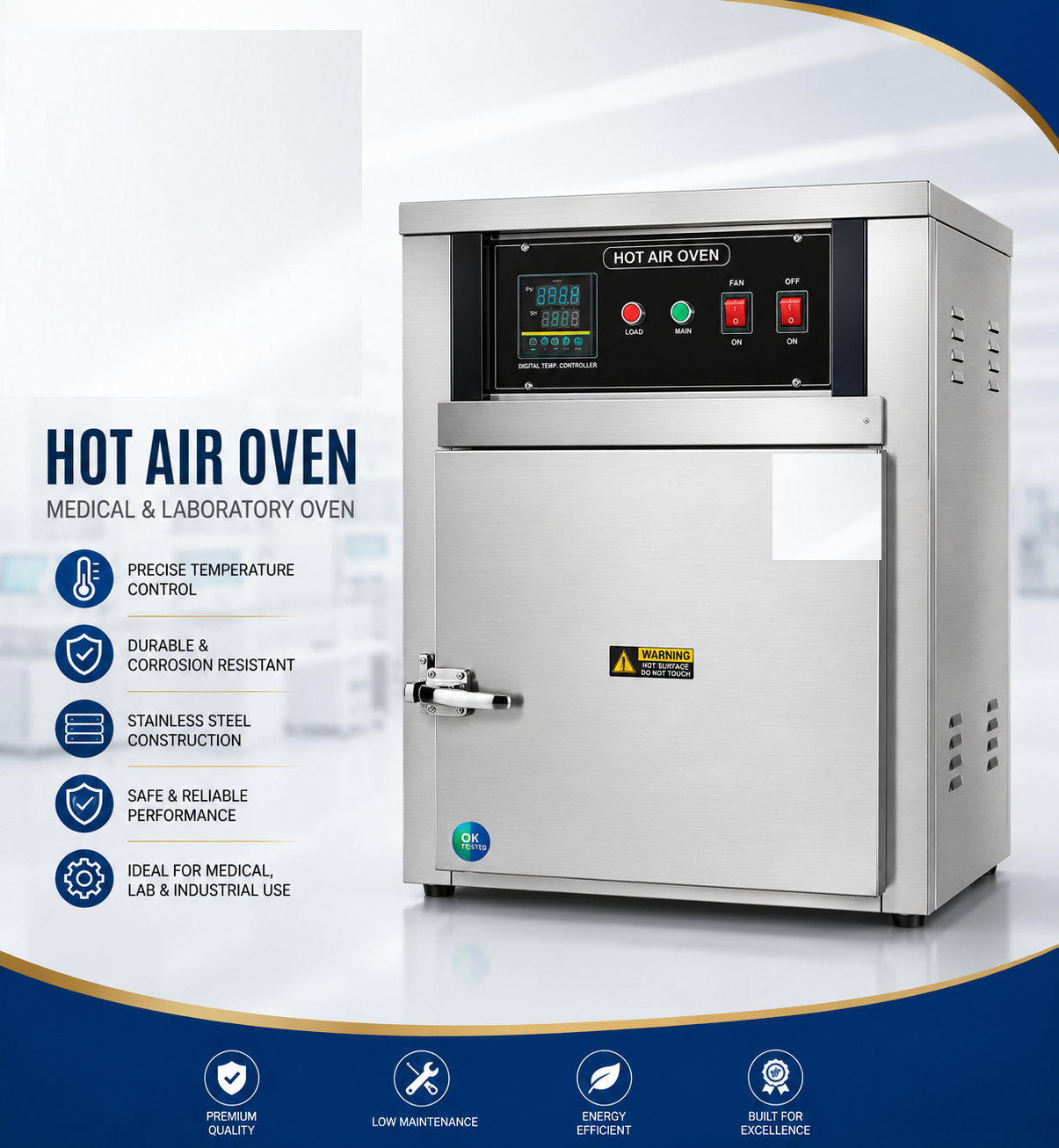
A medical hot air oven is a dry heat sterilization unit that uses electrically heated, fan-circulated air at 160-180°C to sterilize glassware, metal instruments, swabs, powders, oils, and heat-stable materials in hospitals, diagnostic laboratories, pharmaceutical manufacturing facilities, dental clinics, veterinary practices, and medical device production environments. The global medical hot air ovens market was valued at USD 0.5 billion in 2024, projected at USD 1.2 billion by 2034 at 8.5% CAGR. India's laboratory ovens market is at USD 187.3 million in 2025, growing at 5.8% annually through 2036. Indian manufacturers supply certified hot air ovens to hospitals, research institutions, and pharmaceutical companies across Southeast Asia, the Middle East, Africa, and Europe - markets where Indian-made laboratory equipment competes on price, CE marking, and ISO 13485 certification against European and US equivalents.
| Attribute | Details / Value |
|---|---|
| Product Type | Dry Heat Sterilizer / Hot Air Oven - Medical and Laboratory Grade |
| Heating Method | Electric resistance with forced air circulation (fan-assisted) |
| Temperature Range | 50°C to 250°C standard; up to 300°C for depyrogenation models |
| Temperature Uniformity | ±1°C (digital PID-controlled models) |
| Sterilization Protocol | 160°C / 2 hours; 170°C / 1 hour; 180°C / 30 minutes |
| Chamber Capacity | Benchtop: 30L, 54L, 80L; Floor-standing: 150L, 300L, 500L+; custom on request |
| Chamber Material | SS 304 interior (standard); SS 316 for pharma-grade; MS powder-coated exterior |
| Control System | Digital microprocessor PID; LED/LCD display; programmable timer; over-temperature cutoff |
| Door Configuration | Single door standard; double-door pass-through for pharmaceutical clean room |
| Power Supply | 220-240V / 50-60 Hz single phase; 415V three-phase for large capacity |
| Applications | Sterilization of glassware, metal instruments, powders, oils, swabs; drying; annealing; heat testing |
| HS Code | 8419.20 (medical, surgical or laboratory sterilizers) - confirm with CHA; 8514.10 also used |
| Certifications | CE marking, ISO 13485, IEC 61010-1, BIS, WHO-GMP on request |
Hospital procurement teams sometimes use "sterilizer" to mean either a hot air oven or an autoclave without distinguishing between them. They are not the same instrument and they do not handle the same materials. A hot air oven uses dry heat - no moisture - at 160-180°C. It works for glassware, metal surgical instruments, swabs, anhydrous oils, and powders. An autoclave uses pressurized steam at 121-134°C and is faster but will damage materials that react to moisture - certain powders, oils, and instruments with moisture-sensitive components. Petroleum jelly, glass syringes, and oil-based preparations go into a hot air oven. Wrapped surgical packs and liquids go into an autoclave. Many facilities need both. Ordering the wrong one creates a sterilization validation failure at the point of use.
Depyrogenation ovens run at 250-300°C and are built for pharmaceutical manufacturing - destroying bacterial endotoxins from vials and ampoules before sterile filling. They need validated temperature uniformity at ±5°C across the chamber at 250°C, HEPA-filtered airflow, and 21 CFR Part 11 compliant data logging for FDA-regulated lines. A standard medical hot air oven does not meet these requirements. If you are procuring for a pharmaceutical production line where depyrogenation is a validated step, say that at enquiry stage. The product category looks similar on paper but the engineering and compliance requirements are entirely different.
Ambala in Haryana has been India's scientific instruments manufacturing cluster for decades - hot air ovens, autoclaves, centrifuges, incubators - all produced in an established cluster with export experience across Southeast Asia, the Middle East, and Africa. Delhi NCR, Mumbai, and Pune also have manufacturers producing certified medical laboratory ovens. India's domestic pharmaceutical industry, valued at USD 49.78 billion in FY2023, buys this equipment in large volumes and to real quality requirements - the manufacturing standards are not being built for export alone. CE-marked and ISO 13485-certified hot air ovens from Indian manufacturers ship to hospitals and laboratories across Gulf Cooperation Council countries, East Africa, and ASEAN markets regularly. For buyers in these regions, Indian-made medical ovens offer a significant price advantage over European equivalents with the same certification stack.
Wooden crates with foam padding for benchtop models. Heavy-duty wooden crating with shock-absorbing mounts for floor-standing models. Each unit includes calibration certificate, operation manual, spare parts kit (heating elements, fuses), and test reports. Custom crating for FCL container loading. Installation documentation included as standard.
CE marking (EU Low Voltage Directive 2014/35/EU; Machinery Directive 2006/42/EC), ISO 13485 (medical device QMS), IEC 61010-1 (laboratory electrical safety), BIS, WHO-GMP compliance documentation on request. Calibration certificate and factory acceptance test (FAT) reports available per unit for pharmaceutical buyers.
A hot air oven uses dry heat at 160-180°C with no moisture - for glassware, metal instruments, anhydrous powders, oils, and swabs. An autoclave uses pressurized steam at 121-134°C - faster but unsuitable for moisture-sensitive materials. Petroleum jelly, glass syringes, talcum powder, and oil-based preparations require a hot air oven. Surgical packs, wrapped instruments, and liquids go into an autoclave. Many facilities need both. Ordering the wrong unit for your specific materials creates a sterilization validation failure at the point of use, not a simple exchange.
For EU import: CE marking under the Low Voltage Directive (2014/35/EU) and IEC 61010-1 compliance for laboratory electrical equipment. For US import: FDA facility registration if classified as a medical device; IEC 61010-1 or UL equivalent for lab equipment. ISO 13485 on the manufacturer's quality management system is specified by most hospital group purchasing organizations and pharmaceutical buyers in both markets. Get all certification documentation before the order is placed - missing paperwork at customs is the most common delay point for medical equipment imports.
Benchtop models (30-80 litres) work for diagnostic labs, dental clinics, small hospitals, and research labs with moderate sterilization loads. Floor-standing models (150-500+ litres) suit central sterile supply departments, pharmaceutical production, and high-throughput research facilities. Do not load more than 60-70% of the chamber capacity - overcrowding reduces temperature uniformity and compromises sterilization efficacy. Specify your typical load type and volume at enquiry stage so the manufacturer can recommend the right size and shelf configuration.
A depyrogenation oven runs at 250-300°C and destroys bacterial endotoxins from pharmaceutical vials, ampoules, and containers before sterile filling. It requires validated temperature uniformity of ±5°C at 250°C, HEPA-filtered airflow, and 21 CFR Part 11 compliant data logging for FDA-regulated manufacturing. A standard medical hot air oven at 160-180°C does not meet these requirements. If you are procuring for a pharmaceutical production line where depyrogenation is a validated step in your process, specify that clearly at enquiry stage - the two products look similar but are engineered and certified to different standards.
15-25 days production for standard catalog models. 30-45 days for custom chamber sizes, pass-through configurations, or depyrogenation units requiring factory acceptance testing. Sea freight from Nhava Sheva to UAE and Gulf: 7-12 days. Southeast Asia: 10-18 days. UK and Europe: 20-25 days. Air freight from Delhi or Mumbai for urgent single-unit orders. Include calibration certificates and compliance documentation in the shipment checklist - these are the most common missing items that cause customs holds for medical equipment imports.
Connect with EXP01040 and thousands of verified Indian exporters on Navi Exports